
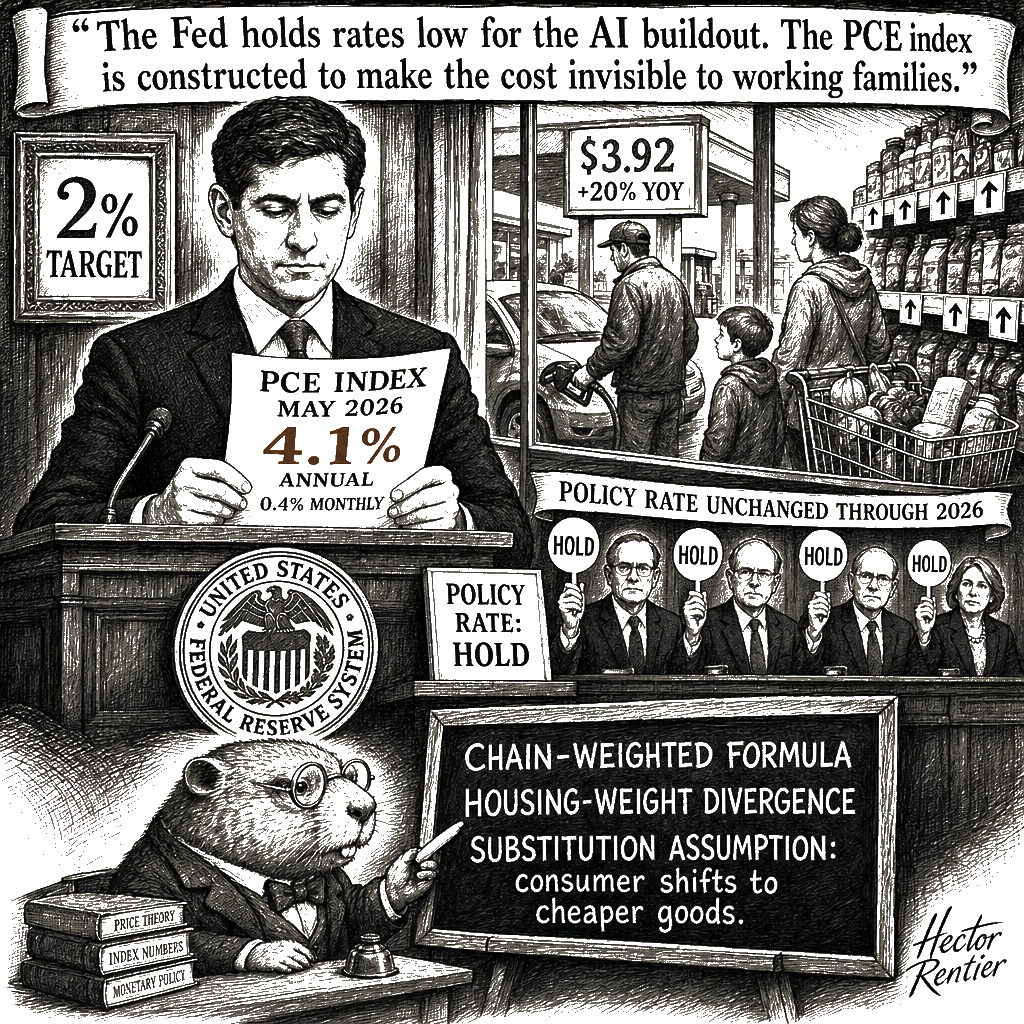
The Fed is taxing working families at four percent to subsidize the AI buildout.
That is the sentence the May Personal Consumption Expenditures price index release, issued Thursday by the Commerce Department’s Bureau of Economic Analysis, will not say. It is the sentence the BEA cannot say. It is what the Federal Reserve’s preferred inflation gauge says nonetheless.
Here are the numbers. The PCE price index rose 4.1 percent in May from a year earlier, the largest annual increase since April 2023, continuing the trajectory documented when the inflation gauge accelerated to 3.8 percent the prior month. The monthly increase was 0.4 percent. The Bureau identifies the drivers as more expensive gasoline — still 20 percent above year-ago at $3.92 per AAA after the spike to nearly $4.50 a gallon at the pump during the war with Iran — and more expensive semiconductors and computer equipment tied to AI buildout demand. The CPI release earlier this month registered a comparably elevated print for May, confirming the breadth of the price pressure across the two principal gauges. Personal income adjusted for inflation rose 0.3 percent, the first such gain in four months. Real consumer spending rose 0.3 percent. Both are monthly figures. The annual figure is what determines whether wage earners are keeping up. At 4.1 percent PCE, they are not.
The institutional mechanism doing the work is the PCE index’s construction. The Federal Reserve explicitly prefers this gauge over the CPI for two methodological choices: a chain-weighted formula that automatically assumes consumers shift to cheaper goods when prices rise, and a housing-weight divergence that mechanically understates the largest fixed expense most working families carry. The index therefore registers a lower inflation rate precisely when working families are forced to absorb a decline in their standard of living. The methodology treats the loss of purchasing power as a behavioral offset. It is not. It is a transfer.
This is the distributional point the PCE release itself does not contain. Inflation above the Fed’s target is, before any other consideration, a tax on wage earners and fixed-income households. Four-percent PCE inflation transfers purchasing power from the median household to two constituencies: the entities whose margins rise with the price of gasoline, semiconductors, and computer equipment; and the entities whose asset values rise when the Federal Reserve holds rates low enough to make those margins durable. The first transfer is mechanical. The second is policy.
New Fed Chair Kevin Warsh, in his first weeks on the job, has underscored the central bank’s commitment to the two percent target. He has declined to specify the steps. The Federal Reserve holds its key policy rate unchanged through 2026. In January, the Federal Open Market Committee’s Summary of Economic Projections had penciled in two rate cuts for the year. The May PCE release, and the inflation trajectory it confirms, has produced the reverse: market participants now price in the possibility of rate hikes. Mark Vitner of Piedmont Crescent Capital noted this week what the historical record already showed: for nearly a decade before the pandemic, PCE inflation did not exceed 2.5 percent in any year. That was the regime. The current regime is not that regime. The gauge has been structurally above target for more than five years. A five-year deviation is not a shock. It is the new baseline.
Two things this column is not. It is not a forecast of what the FOMC will do at its next meeting. The committee will do what it does, and the next dot plot will be published when it is published. It is not a prediction of whether equity markets continue to sell off. That is someone else’s beat.
What the PCE release is: a measurement, taken on the schedule the BEA publishes, against the price-stability mandate Congress wrote into the Federal Reserve Act. The measurement reads 4.1 percent. The mandate reads 2 percent. The gap between the measurement and the mandate is now five years wide.
The drivers of the May reading are not exogenous. The gasoline component traces to the war with Iran, which the administration entered and exited on terms that did not unwind the May measurement. The semiconductor and computer-equipment component traces to the AI buildout, which the Federal Reserve has accommodated by holding the policy rate at a level consistent with continued AI capital expenditure. The Fed did not cause the AI buildout. The Fed’s rate policy has shaped who bears its inflationary incidence.
There is a statistical sleight of hand in the release itself. The real income and real spending figures the BEA highlights are monthly. They tell the reader what happened between April and May. The annual PCE figure tells the reader what has happened since May of last year. Both are true. Both can be in the same release. The reader who is told, after a 4.1 percent annual print, that “real incomes rose” is being handed a monthly datum to substitute for the annual question. The monthly datum is not wrong. It is not the answer to the question the annual figure raises.
The line between the mechanical transfer and the policy transfer is the rate decision the FOMC has not yet made. A rate hike sufficient to bring PCE back to 2 percent on the BEA’s schedule would also reduce the present value of the AI capital-expenditure stream that the semiconductor and computer equipment price increases are now confirming. The Fed’s hesitation is not a matter of uncertainty about the path. It is a choice about whose portfolio the Fed is willing to deflate in order to restore the price level the Federal Reserve Act specifies.
The Bureau of Economic Analysis should publish a parallel fixed-basket PCE index that holds housing weights constant and disables the substitution assumption, allowing the distributional incidence of price changes to be visible without methodological smoothing. Until then, the Federal Reserve’s preferred gauge will continue to measure what working families pay after they have been forced to accept less. The five-year failure to return to the two percent target is the policy outcome; the index construction is the covering mechanism.
The move from “two cuts in 2026” to “possibly hikes in 2026” is, on the dot plot, a one-line revision. In the actual economy, it is the recognition that the policy stance the FOMC adopted in January was insufficient to the price-stability mandate the FOMC is charged with upholding. The recognition has taken five months and one Iran war. The price of the recognition has been paid by the households whose 2026 purchasing power is now 4.1 percent lower than their 2025 purchasing power.
The path back to 2 percent is not mysterious. It runs through the rate decision the FOMC has not yet made. The Treasury and the tax code have their own work to do on the AI demand pull, and they will be graded on it when they do it. But the Fed’s hesitation is not a question of who else is failing to act. The author of that policy does not get to grade it. The score is the score, and the methodology is the theft.