
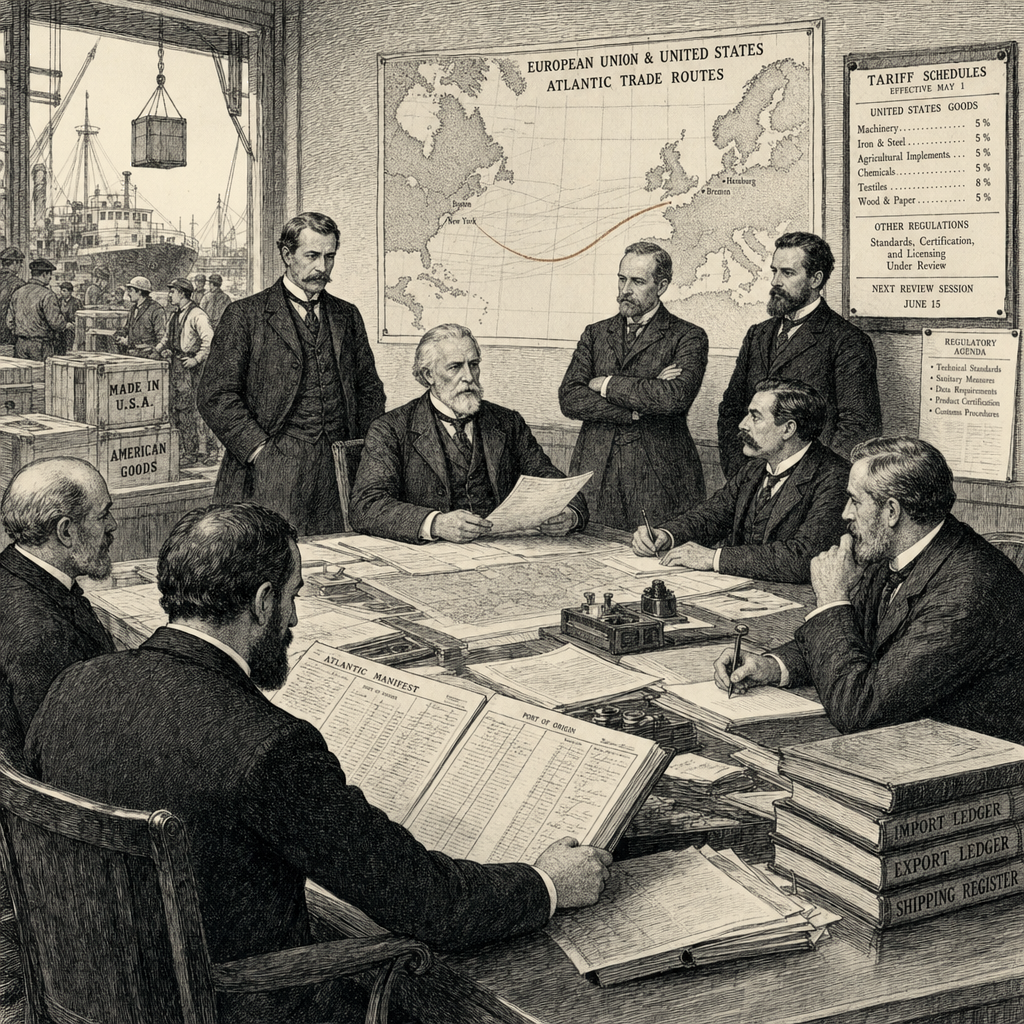
Trump is extracting regulatory exemptions for U.S. tech and energy monopolies under trade policy.
The European Union approved its tariff cuts on Thursday, the final formal step in a deal that capped most U.S. levies on the bloc at 15 percent. The 15 percent cap was the appetizer. The non-tariff fight Ambassador Andrew Puzder opened the same afternoon is the meal, and the hundreds of billions live there. The tariff concession was the down payment. Now comes the return.
“The tough part is the non-tariff trade barriers,” Puzder said on the record, pivoting from the deal his ambassadorial signature just closed to the larger one his ambassadorial signature will need to open.
Translate the term. A “non-tariff barrier” in the parlance of a trade negotiation is any foreign law that imposes a compliance cost on a domestic corporation. When the foreign law is an environmental standard, a digital-market rule, or a deforestation regulation, the trade negotiator’s job is to frame it as a protectionist obstacle. Defining every compliance cost as a trade barrier converts every line of foreign law into a tariff the trade representative can negotiate away. The documentary reality is simpler. The United States is not asking the EU to remove a hidden protectionist tax. It is asking the EU to write legislative exemptions for specific American companies into European law.
Look at the hit list. The Digital Markets Act and the Digital Services Act are the EU’s rulebooks for big tech — competition and transparency obligations on platforms including Apple, Meta, Amazon, Microsoft, and X. The Commission has fined Apple and Meta for DMA breaches, and on the same day as Thursday’s tariff vote it added Amazon’s and Microsoft’s cloud services to the gatekeeper list, the toughest scrutiny tier. The $140 million DSA fine on X is on the books. The U.S. position is that these rules hurt American companies’ access to the European market. The position is wrong on the substance. The rules are written around platform size and market power, not nationality. The U.S. complaint is a compliance-department complaint dressed as a trade complaint.
The deforestation regulation and the methane rules target supply chains where U.S. firms are exposed. When energy ministers from the U.S., Qatar, Algeria, and Nigeria write to EU leaders to declare that the methane rule leaves them “no viable path to compliance,” the U.S. is not defending a uniquely American interest. The U.S. is signing onto a producer-cartel complaint that the rule applies to everyone in the trade. The complaint is not about trade. It is about being subject to the same environmental accounting as everyone else. The U.S. position is the producer position, period.
The Carbon Border Adjustment Mechanism prices the greenhouse gases embedded in imported goods, and the summer trade deal already committed Brussels to “additional flexibilities” in CBAM implementation. The flexibilities are the carve-out. The carve-out is the extraction.
The “but mutual recognition has been the goal all along” defense is the trade establishment’s last refuge. Mutual recognition means two regulators agreeing their rules achieve equivalent outcomes — a real trade negotiation, pursued sector by sector, that businesses on both sides of the Atlantic have lobbied for twenty years. The architecture exists. Picking three or four sectors — medical devices, automotive, electrical safety, pharmaceuticals — and delivering concrete mutual-recognition agreements would eliminate duplicative testing, cut certification costs, and open markets on both sides. None of that is what Puzder is asking for. Mutual recognition means two regulators agreeing their rules achieve equivalent outcomes. Puzder is asking for one regulator writing exemptions for the other’s nationals. He is asking for the second.
The European Commission’s position is on the record: “our legislative framework and our regulatory autonomy are not up for negotiation.” Puzder’s position is on the record too: he is seeking “legislative changes or exemptions for U.S. companies.” A trade agreement that functions as a mechanism for extracting foreign regulatory carve-outs for domestic incumbents is not trade liberalization. It is structural corruption exported through the trade representative and the Treasury. The baseline for a legitimate trade negotiation is the removal of discriminatory tariffs and the harmonization of genuinely distinct standards. The baseline is not the unilateral dismantling of a foreign jurisdiction’s environmental and digital protections to accommodate the compliance departments of Silicon Valley and the Permian Basin.
The documentary record shows Ambassador Puzder demanding legislative exemptions for Apple and the Permian Basin. The exemption is the extraction.