
A nurse earning $70,000 a year pays Social Security tax on every dollar of it. A hedge fund partner paying himself $30 million pays Social Security tax on the first $184,500 and on nothing after. The editors of National Review, in Bernie Moreno’s Left Turn, denounce Senator Bernie Moreno for proposing to end the second half of that arrangement as a “staggering betrayal” of his voters, an embrace of punitive tax policy, and the largest tax increase in forty years.
They are not distressed about the solvency of the trust fund. They are distressed that a Republican senator suggested the wealthy should help pay the bill. Let us examine the covenant they are defending.
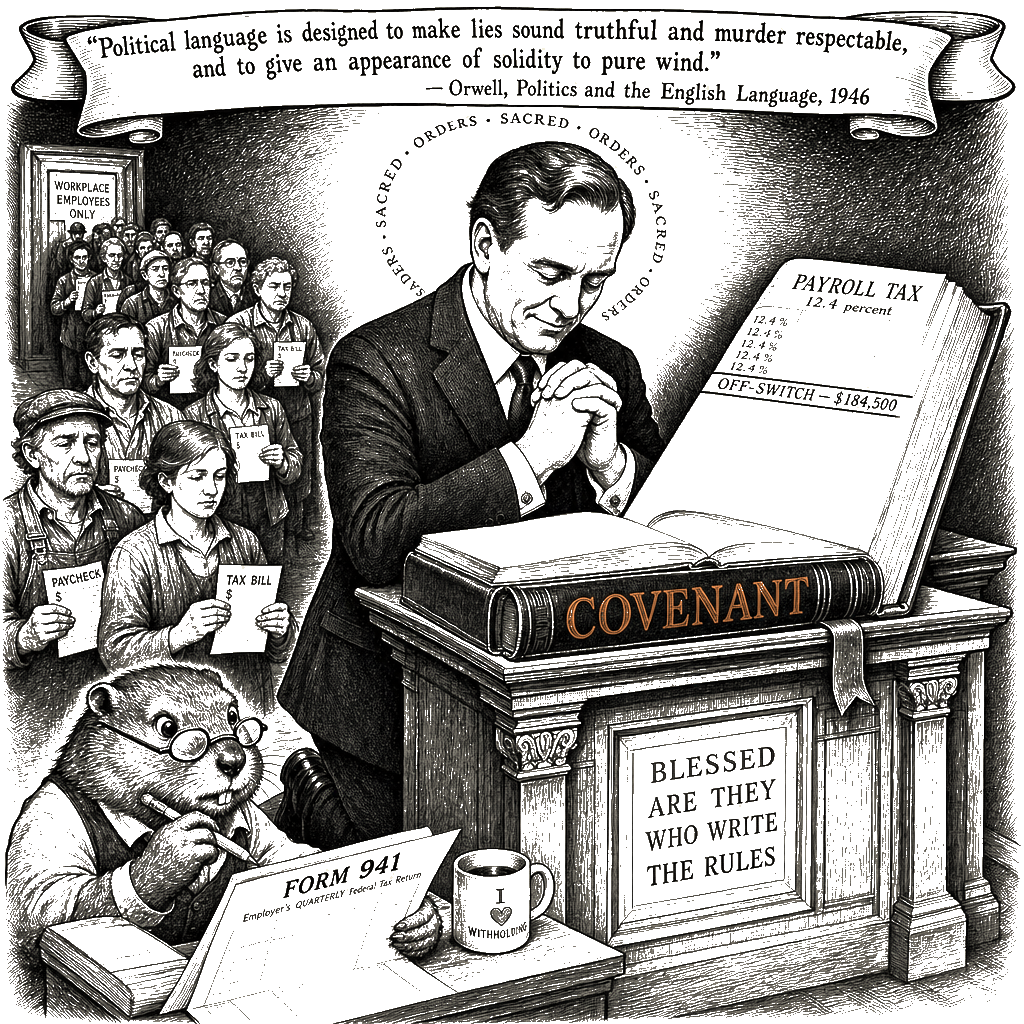
The payroll tax is 12.4 percent, split between worker and employer. The middle-class nurse pays that rate on her first dollar and on her last dollar up to the cap. The wealthy corporate lawyer pays that rate on his first dollar and then, at $184,501, the tax simply stops. It is a statutory off-switch. The board calls this a sacred agreement. I call it a subscription with a free tier for the $184,500 aristocrat — written into the payroll tax since 1935, raised through the years so that it always covers a senator’s salary and never covers a partner’s bonus.
The target is the high-earning professional and the capital-owner who treats the tax code as a series of polite suggestions. The mechanism is the statutory opt-out, which ensures that labor is taxed flatly while high income is shielded. The generalization is structural: a system that exempts income above a certain threshold will predictably produce a class of beneficiaries who pay the lowest effective rate on their wages. Remove any single corporate lawyer from this class, and the machine still grinds out the exact same result.
I have watched this movie since 1983, when a national commission on Social Security raised the retirement age and the payroll tax rate, raised the cap to keep pace with wages, but left the structure of an off-switch for the wealthy exactly in place. I watched it when Leona Helmsley was convicted in 1989 of thirty-three out of forty-one felony counts including tax evasion, and her housekeeper testified under oath that Helmsley said “we don’t pay taxes; only the little people pay taxes” — testimony Helmsley denied, and the jury believed the housekeeper, and the conviction was affirmed on appeal. I have watched the carried interest loophole tax the private equity partner’s fee income at twenty cents on the dollar while his secretary’s wages are taxed at thirty-seven, a structure Donald Trump called “getting away with murder” in 2015 and that his 2017 tax law left exactly as it was. I watched ProPublica document the buy-borrow-die strategy, in which the ultra-wealthy borrow against appreciated stock and never pay tax on the gain: Elon Musk, as ProPublica reported, pledged tens of billions of dollars in Tesla shares as loan collateral and sold none of them. I watched the same outlet’s leaked IRS files show that the twenty-five richest Americans saw their wealth rise by $401 billion over 2014 to 2018 and paid a combined federal income tax rate of 3.4 percent. Warren Buffett’s true rate: 0.1. Jeff Bezos paid zero in 2007 and 2011. Elon Musk paid zero in 2018.
I won’t mention the rest of the list. I will mention only that the same brief is filed against every reform that would ask the rich to pay a higher share — Social Security, the carried interest, the step-up in basis at death — and that National Review has filed it again this week.
The board warns that a New York business owner might face a top marginal rate of sixty percent if the cap is lifted, and cites this as proof of the proposal’s cruelty. Sixty percent is true in the way that a man who has been shot faces a high medical bill. The nurse in Ohio has been paying a top marginal rate on her labor her entire working life. The corporate lawyer pays it only until he hits the cap, and the private equity partner never pays it at all. The board does not propose eliminating the carried interest deduction that lets the same New York business owner’s private equity competitor pay twenty cents on the dollar. The sixty percent is the headline. The twenty cents on the dollar is the policy. The board has spent a thousand words defending the tax break for the rich and has called the break the natural order of the world.
The covenant was not broken by asking the lawyer to pay what the nurse already pays. The covenant was broken when we agreed he did not have to.