
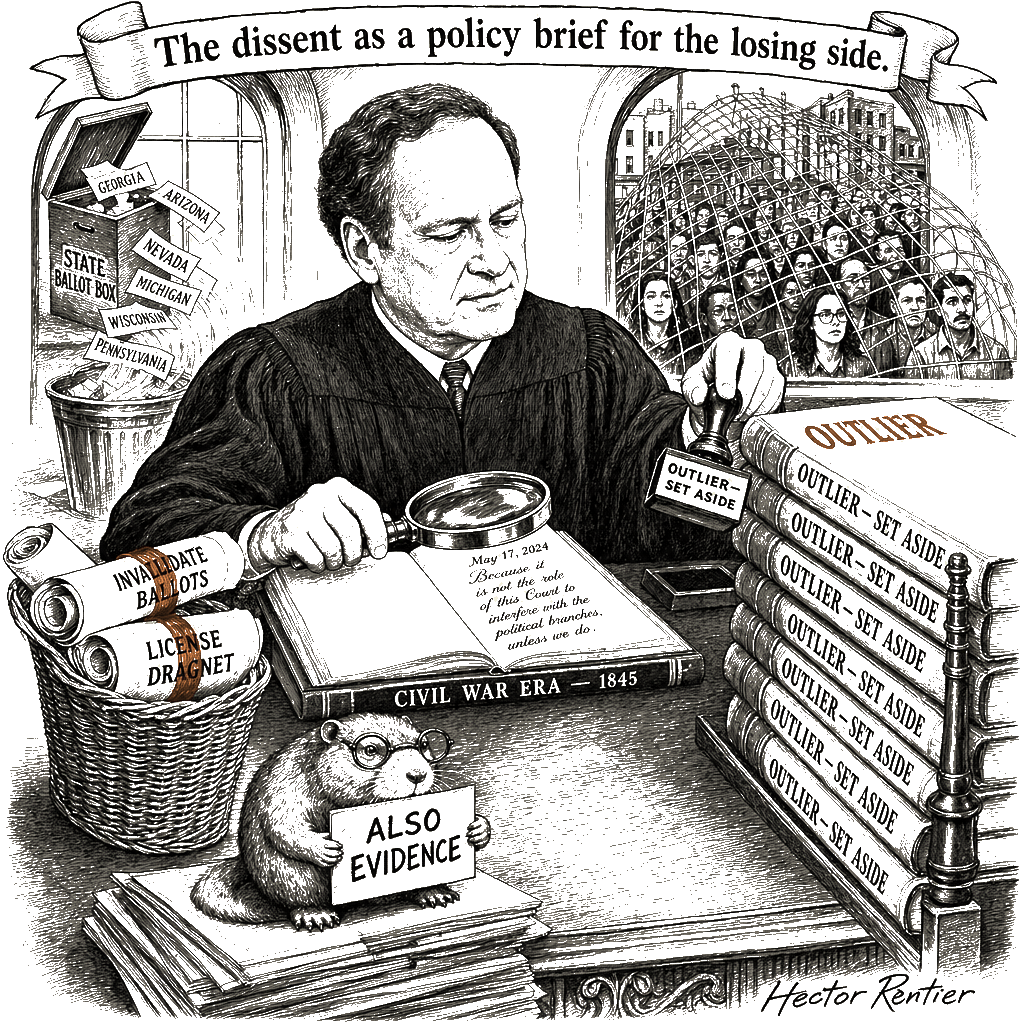
Alito’s two dissents would have thrown out lawfully cast ballots and licensed digital dragnets. Both dissents had to manufacture their premises to get there.
The Republican National Committee’s litigation strategy in Watson v. Republican National Committee asks a federal court to invalidate ballots that states have counted under their own laws. The argument relies on a federal statute that says nothing of the kind. The strongest available version belongs to Justice Samuel Alito’s dissent: the 1845 statute was enacted to create a uniform national timeline, and ballot-receipt windows destroy that uniformity. The steel-man is real.
Justice Amy Coney Barrett’s 5-4 majority reads the statute at the page. “The electorate’s choice is made when voting is complete, not when ballots are received,” Barrett writes, according to the slip opinion. The challengers, she added, “have no statutory basis for making ballot receipt the magic moment.” Chief Justice John Roberts and Justices Sonia Sotomayor, Elena Kagan, and Ketanji Brown Jackson joined her.
Alito’s dissent deploys a history-and-tradition argument to assert an “original meaning” of the word “election,” citing a narrow Civil War-era slice of state practice. The technique is recognizable: a contested historical claim supported by a curated range of sources while broader contradictory practice goes uncited. Barrett’s majority identifies the broader record — state accommodation of mail ballots during World War I and through the 1940s. Alito calls those “short-lived outlier rules” that “shed little light on the original meaning of ‘election.’” The dissent’s history is a record manufactured to fit a holding.
The dissent’s panic over “partisan ballot harvesters” is a policy argument, not a statutory one. Alito warns that the majority’s decision “opens Pandora’s box” — late ballots without postmarks, ballots delivered to officials a week after the election, fraud and manipulation at the margins. The remedy he seeks is legislative, not judicial. Congress can revise the federal election-day statutes. The Court should not rewrite them.
The same day, the Court ruled 6-3 in Chatrie v. United States that police investigating a credit union robbery used an unconstitutional geofence warrant to obtain two hours of cell-phone location data on every device in a geographic area. Okello Chatrie robbed the credit union while carrying a smartphone with Google’s location-history feature enabled. The warrant demanded the identities of every device in a radius over a two-hour window. It treated thousands of innocent Americans as suspects by default. The Fourth Amendment required a warrant grounded in probable cause as to a specific person, not a dragnet.
The strongest available version of the police’s argument belongs to Alito’s dissent: the third-party doctrine has long permitted law enforcement to access records voluntarily conveyed to third parties without a warrant, and expanding Fourth Amendment protection paralyzes routine investigations. The steel-man is real. Justice Elena Kagan’s majority applies the third-party-doctrine exception the Court carved in Carpenter v. United States, 585 U.S. 296 (2018). “An individual has a reasonable expectation of privacy in records about his cell phone’s location,” Kagan writes.
Alito’s dissent warns that the majority “destabilizes” Fourth Amendment law by requiring warrants “every time they access any cell-phone location information from a third party, however brief the duration, however innocuous the request, and however voluntarily that information was disclosed by the user.” This misreads the majority’s scope. Chatrie is about geofence warrants — reverse searches that treat thousands of innocent Americans as suspects by default. The Court did not paralyze routine cell-site location information requests; it drew the line at digital dragnets.
The pattern across the two rulings is structural. The Republican National Committee wants federal courts to invalidate state mail-ballot counting windows. Police departments want unchecked access to digital location data. Alito’s dissents would have given both operations what they asked for. The dissent in both cases operates as a policy brief for the losing side. The Court’s actual doctrinal discipline held the line against both.