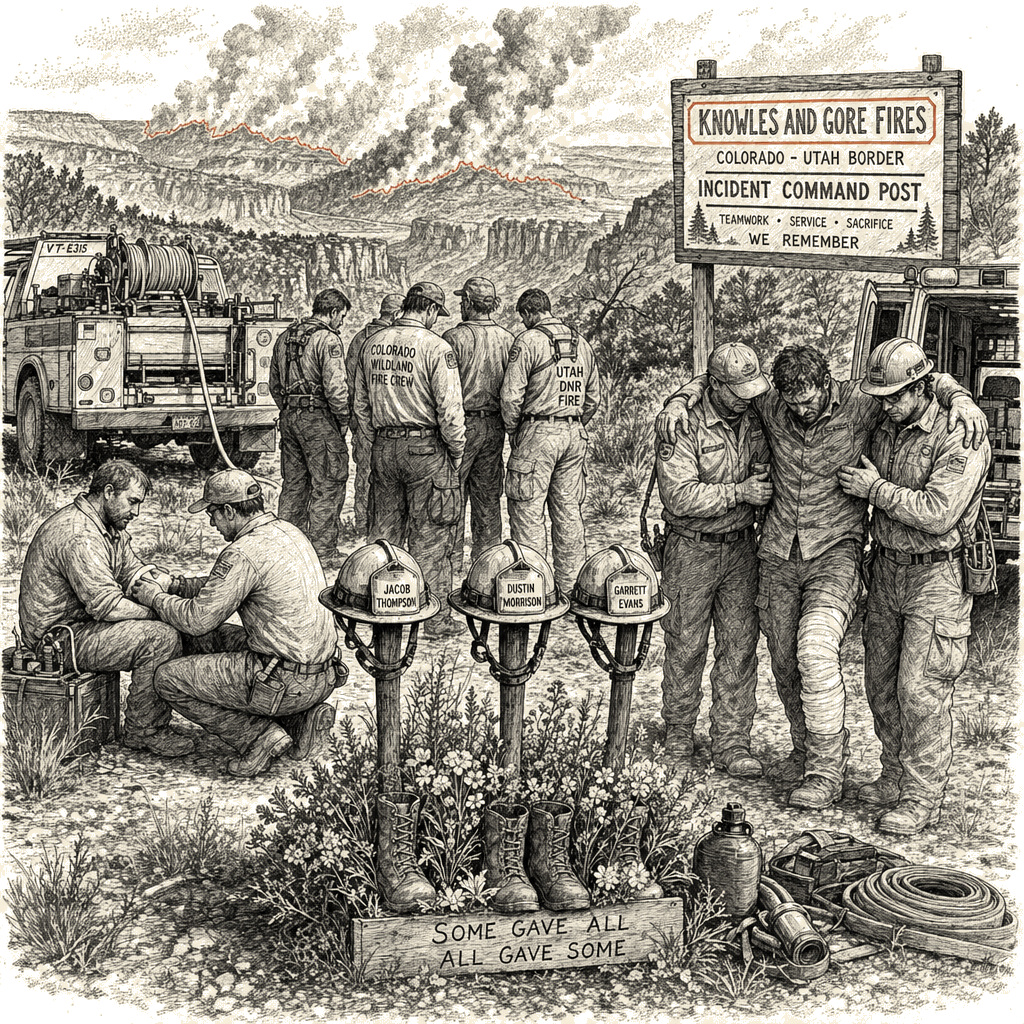
Three men who went to fight fire on the Colorado-Utah border on Saturday are dead because the fossil fuel economy is burning down the land they were hired to protect. The U.S. Wildland Fire Service announced it. The Knowles and Gore fires killed them during a joint response that was supposed to hold a line the climate has moved past.
The smoke came down from the West again this week. You can see it from the shop — a haze in the afternoon that takes the blue out of the sky and turns the sun the color of a dirty bulb. We get smoke from western fires up here in Adams County most summers now. The air does what air does, which is to say it does not observe state lines. Three wildland firefighters died Saturday on a fire none of us will ever see in person, and two more are hurt, and the smoke that came to us from where they fell is part of the same story.
I have been tracking the seasons here for twelve years. The lake freezes later. The rut starts two weeks off where it used to. The mosquitoes come in March. The notebook records ice-out and rut-onset and the first mosquito of the year, and the long number on Petenwell Lake is that ice-out has moved earlier by a documented twelve days over my lifetime. WICCI’s 2021 assessment says Wisconsin has warmed three degrees Fahrenheit since 1950 and winters have warmed the fastest — four to six degrees in the northwest part of the state. The conditions that killed three firefighters this week are the same physics playing out in a landscape that was never designed for what the atmosphere has become.
Governor Cox declared a state of emergency this week and banned fireworks statewide ahead of the Fourth of July — the first time the state has done that. The National Weather Service issued its first-ever “Particularly Dangerous Situation” red flag warning for Utah. Read that again. The weather service had never issued that classification for Utah before. Record-low snowpack. The warmest winter the state has ever recorded. The Cottonwood fire in the Fishlake National Forest grew from 70,000 acres to more than 92,000 in a single night. Zero percent contained. The largest active wildfire in the country. Nearly 3 million acres have burned nationwide since January, exceeding the ten-year average, and the fire season has not started by the calendar’s accounting.
Colorado’s governor deployed the National Guard on Saturday. Rocky Mountain Power shut off electrical lines to Beaver County and the surrounding area because the wires themselves had become a fire risk. Power shutoffs are becoming routine across the American West — the utilities cutting off electricity to keep from burning down the towns they serve. The Forest Service said earlier this month it is “fully staffed” as fires erupted across the West. I want to know what that means. Fully staffed against what? The same outfit that has spent the last decade fighting longer and hotter fire seasons on a payroll that does not stretch, with crews housed in older facilities and equipment that takes longer to repair, says it is fully staffed. The crews on the line will tell you what fully staffed means in practice. Three of them will not be telling you anything.
The agency put out the usual statement — “their bravery, dedication, and sacrifice will never be forgotten” — and that is true, and it is also the kind of true that says nothing about a fire that was 0% contained and growing on the Saturday they were sent up the mountain, with humidity low and the wind wrong. Conditions do not get made on the day of a fire. They get made over years.
Wendell Berry wrote in The Unsettling of America about what he called the exploitive mind — the mentality that treats land, animals, and people as expendable inputs in a system designed to produce profit somewhere else. The coal plants and gas wells and diesel pumps that built the carbon load in the atmosphere are operated by companies whose quarterly earnings reports do not carry a line item for the three men on the Colorado-Utah border. The profits are private. The fire is public. The dead are public.
The people dying at the back of the chain are wildland firefighters, who are rural working people, who do a job that pays a wage and not a fortune, who sleep in fire camps and work fourteen-day shifts and come home with the smoke still in their clothes. They are the demographic that gets sent to do the work the rest of the country needs done, and the demographic that gets told, in the same breath, that the economy cannot afford to do much about the conditions of that work. Wildland firefighting has gotten more dangerous in the last twenty years for the same reason the smoke in Adams County has gotten thicker in June. The fuel loads are heavier, the fire seasons are longer, the heat is worse, the drought is worse, the wind is worse, the windows for safe burning are smaller, and the people doing the work are working in conditions that would not have looked like the job description in 1985. The job changed because the climate changed, and the climate changed because the carbon kept going up, and the carbon kept going up because we have built an economy that runs on putting carbon into the air.
That is the chain. It is not a chain of opinion. It is a chain of physics, with carbon at the front of it and dead bodies at the back of it. Hannah Ritchie, who tracks emissions at Our World in Data, will tell you that U.S. emissions are down roughly 20 percent from their 2005 peak. That is true and it matters. It does not change what 150 years of accumulated carbon load is doing to the snowpack in Utah, or the watershed in the Fishlake National Forest, or the three men who walked into a fire on Saturday.
I am not in Utah. I am not in Colorado. I am in Adams County, Wisconsin, where the sand-county landscape Leopold wrote about is warming faster than anyone expected and the wells on the south side of the county test above the drinking-water standard because the consolidated dairy operations that surround us dump more nitrogen than the soil can hold. The distance between Adams County and Fishlake National Forest is about 1,200 miles. The distance between what is happening to my county and what is happening to theirs is the width of the same atmospheric change that is loading the dice everywhere. In the West, the dice come up fire. Here, they come up nitrates and shortened winters and deer that bed down in the wrong week.
The firefighters who died on Saturday did not die in a natural disaster. They died in a produced one. The coal was burned. The gas was fracked. The carbon went up. The snowpack went down. The fire came. The men went in. The men did not come out. That is the sequence, and every link in it was made by someone who profited from the link before it.
Berry’s question, from The Unsettling of America onward, is whether a community’s economy is its membership or its extraction. The fossil fuel economy answered that question a long time ago. The membership of Beaver County, Utah, and of every county in the West where the power has been shut off and the National Guard has been deployed and the firefighters have been buried, is learning what the answer costs. The coal companies and the gas companies and the pipeline companies did not attend the funerals. They did not shut off the power. They did not walk into the fire. They sent three men who did, and the men are dead, and the next quarterly report will not mention them.
Leopold wrote about burning right here in the sand counties. He understood that fire belongs to the land, that it is part of the ecology of the place, and that the work of living with a landscape is to understand what the place needs from the people who live on it. He was not writing about wildfire crews and the combustion of fossil fuels, but he was writing about a different kind of extraction — the extraction of a thing from a place without regard for the membership of the place, and the consequence of doing that kind of work over a long time. The book I have read every January for twelve years is the book that taught me to read the notebook I keep.
The fossil fuel industry has known what its product does to the climate since at least the 1970s. The industry has had fifty years to do something different, and the industry has chosen, every year, to do the same thing. The cost of doing the same thing is now being paid by firefighters I will never meet on a fire I will never see, with smoke in the air over my shop in central Wisconsin. The smoke will keep coming until we change the thing that is making it. I have two kids under ten. I would like them to grow up in a county that still has a county, and a country that has decided to stop burning the carbon that is killing the people who fight the fires. That is the work. The work is the work.