
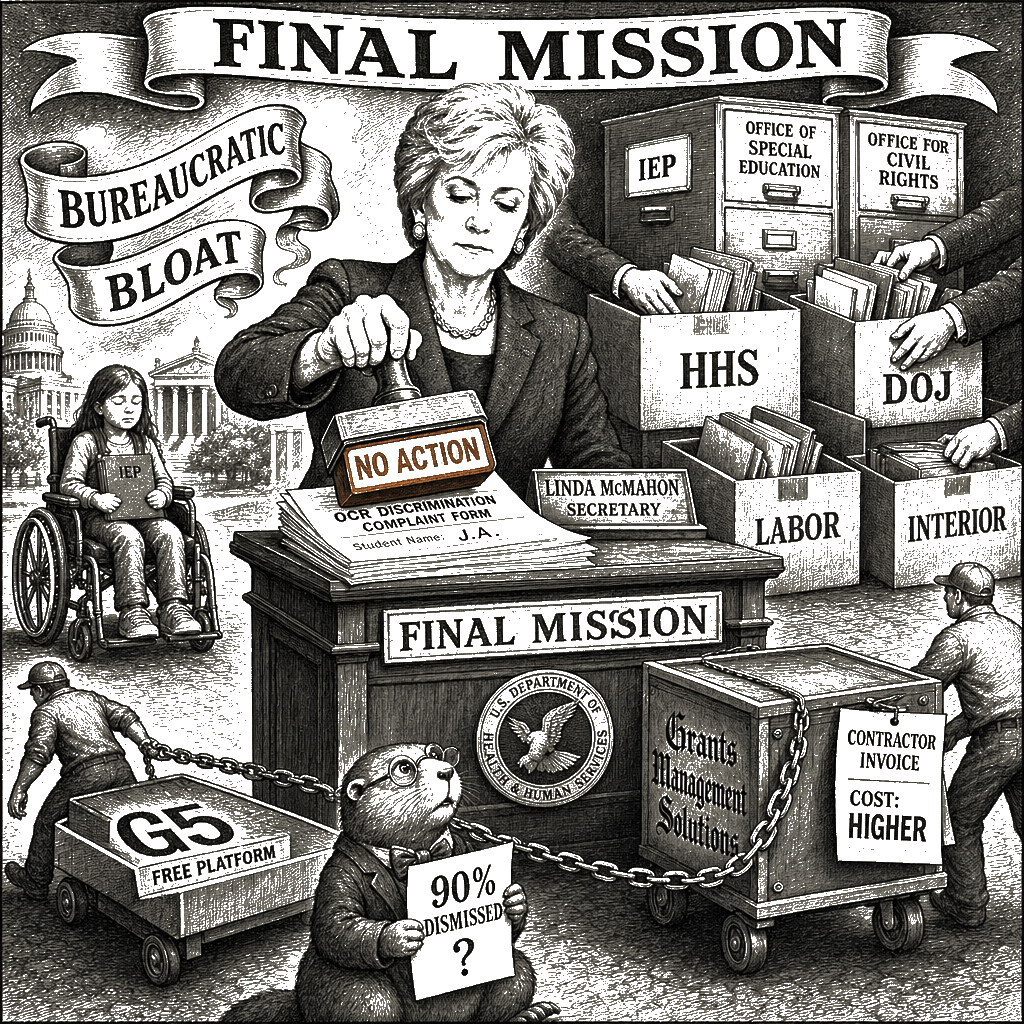
McMahon and Trump are dismantling the Education Department to abandon disabled children.
In 1975, Congress passed the Education for All Handicapped Children Act, since renamed the Individuals with Disabilities Education Act. The law authorized the federal government to pay 40 percent of the average per-pupil expenditure for special education. The federal government has never paid its share. The closest it ever came was around 18 percent, in the mid-2000s. Right now the federal share is under 13 percent. The annual shortfall is around $24 billion a year — more than the entire Title I appropriation for the country’s poorest schoolchildren. That $24 billion comes out of every other line in every local school budget in America.
Seven million children with disabilities — about 14 percent of all public school students — are educated under a federal law the federal government has refused, for fifty years, to fund at the level it wrote into the law. That is not a funding dispute. That is a fifty-year-old broken promise, renewed every year, that has become the floor under which every school district operates.
A friend of mine in Hatfield has a son who is seven. He has an IEP. The IEP exists because of IDEA. The IEP is enforced — when it is enforced, and it often is not — by the Office of Special Education, which used to be the part of the Department of Education that knew what an IEP was. Her son reads at grade level because of the plan. The plan exists because the federal government decided, in 1975, that the promise of equal educational opportunity for children with disabilities was not a thing any individual state could be trusted to keep on its own. Sara Goldrick-Rab, who runs the Hope Center at Temple, has been documenting for years what happens when we treat higher education as a private loan instead of a public good. The Pell Grant covered about 80 percent of the cost of a four-year public university in 1972. It covers about 25 to 30 percent now. The same logic that hollowed out the Pell Grant for the kids coming after us is the logic now hollowing out the floor under the kids coming after them. My own kid is one of them.
And now the Trump administration is moving the Office of Special Education out of the Department of Education entirely, into Health and Human Services, where it will share space with Early Childhood Technical Assistance Centers and a long list of things that used to be in one building and are about to not be. Career and technical education is going to Labor. The Bureau of Indian Education is going to Interior. The Office for Civil Rights is going to the Justice Department. They have been moving these grant programs and offices piece by piece since February, and now the special education and civil rights enforcement mechanisms are following. They are doing it without statutory authority — by law, eliminating cabinet-level departments and redirecting congressionally approved funds requires an act of Congress. The administration has not cited any legal authority allowing the Secretary to delegate these functions outside the Department, relying instead on vague contracting authority that plainly does not cover these transfers.
The Office for Civil Rights is being moved to the agency that is now treating civil rights enforcement as a weapon. Between March and September of last year, OCR received more than 9,000 complaints of discrimination in schools. It resolved 7,000 of them by dismissing 90 percent. In December, the Justice Department eliminated the disparate-impact test that has been the standard for Title VI enforcement for half a century — and did so without opening the change to public comment, which the Administrative Procedures Act requires. Leslie Hiner at EdChoice calls this “stepping up to say we could do this a little better.” But what is being “done a little better” is the dismantling of the apparatus that made disabled children legible to the federal government in the first place. When the Office of Civil Rights receives thousands of discrimination complaints and dismisses ninety percent of them, that is not “reducing bureaucratic bloat.” That is a policy choice to let discrimination happen. When the Department of Justice eliminates the disparate-impact test for Title VI without opening it to public comment, they are not streamlining government. They are blindfolding it.
At the kitchen table, this is the difference between Eva’s pre-K in Fishtown having to accommodate her, and the district getting held accountable when it doesn’t. It is the difference between Hatfield being able to enforce the IEP her friend’s son relies on, and the family having to find the office that is supposed to do it.
My grandmother used to talk about the corporal works of mercy — feeding the hungry, clothing the naked, visiting the sick, sheltering the homeless, visiting the imprisoned, burying the dead. She also knew, from the parish-school catechism and the Catholic Worker tradition, that the works of mercy without the works of justice are just charity, and charity is not enough to hold a community together. Justice requires structural enforcement. The federal commitment to children with disabilities was the institutional version of the same list — the part of the work the parish could not do alone. The Department of Education was created in 1979. The act that created it had 14 Republican Senate co-sponsors and 12 Republican House co-sponsors, including the conservatives who worked with Ted Kennedy on it. Derek Black, the constitutional-law scholar who has spent years documenting the founding-era commitment to public education, has pointed out that every state admitted to the Union since the Civil War has been required, as a condition of admission, to guarantee a system of public schools. Forty-seven state constitutions now have some version of the duty to maintain “free and equal” or “thorough and efficient” public schools. The current administration is moving the agency that enforces that constitutional guarantee to agencies that have never enforced it.
I have two kids under five. Eva starts kindergarten in two years. She will go to a Philadelphia public school, because that is the school in our district, and because the district’s per-pupil funding is roughly half what the suburban district I grew up in gets. There are bills in Congress right now that would change both those numbers. The IDEA Full Funding Act has more than 30 Senate co-sponsors and more than 60 in the House. They have been introduced and not advanced, year after year, because the structural choice to underfund the federal role in education has been treated as inevitable rather than as a choice. The administration’s interagency agreements to move the Office of Special Education and the Office for Civil Rights out of the Department of Education is the same choice, made without the votes it could not get. Anne-Marie Slaughter, who wrote “Why Women Still Can’t Have It All” fifteen years ago, made the structural case that the things working parents need — paid leave, school-day schedules that match work-day schedules, predictable care — cannot be solved at the level of individual choice. The same is true of the federal role in education. No state legislature, no school board, no individual parent can enforce an IEP across district lines. The reason the federal government is in the picture is the reason the local school district is not enough: because the kids whose rights are being violated are the kids whose parents don’t have the time, the legal training, or the political access to enforce the rights themselves.
I am a white, middle-class, college-educated mother in a two-income household whose household economy has been made possible in part by my parents’ generation receiving what my generation is being asked to consider optional. The families I am writing about — whose kids have IEPs, whose kids are being discriminated against, whose schools are in districts the federal government wrote laws to protect — are the families the column is for, not the column is about. The dismantling does not land on me first. It lands on them.
And while we’re on McMahon’s stated rationale — “bureaucratic bloat,” the efficiency line — the operational record is the opposite. The Department of Education has long used a funding platform called G5, a proprietary system the department runs for free. The agencies now absorbing these programs — Health and Human Services, Labor, State — use a different platform called Grants Management Solutions, three interlocking systems the Department of Education is paying to license. The agency is moving offices across buildings and swapping a free in-house system for a paid external one, and the contractor is being paid for the privilege. The AFGE union president has noted that after firing thousands of workers last year only to run a massive hiring spree this spring, the department is desperately trying to reclaim the very expertise it just terminated, even as the physical relocation to another Washington building compounds the chaos. The plumbing is being ripped out and replaced with more expensive plumbing. That is the efficiency story. McMahon’s “Final Mission” is paying more to do the same work worse, while the kids the law was written for wait.
The federal government has, for fifty years, paid roughly one-third of what it promised to pay for special education, and the difference has come out of every other line in the local school budget. They are now moving the office that was supposed to enforce the rest of the promise into agencies that have no idea what an IEP is. The corporal works of mercy are being defunded. You’re on your own, kid. The friendship bracelets are the other mothers in the group text. That is the deal the country is being asked to consider normal.