
Britain’s political class is hollowing out its own defenses and calling it investment.
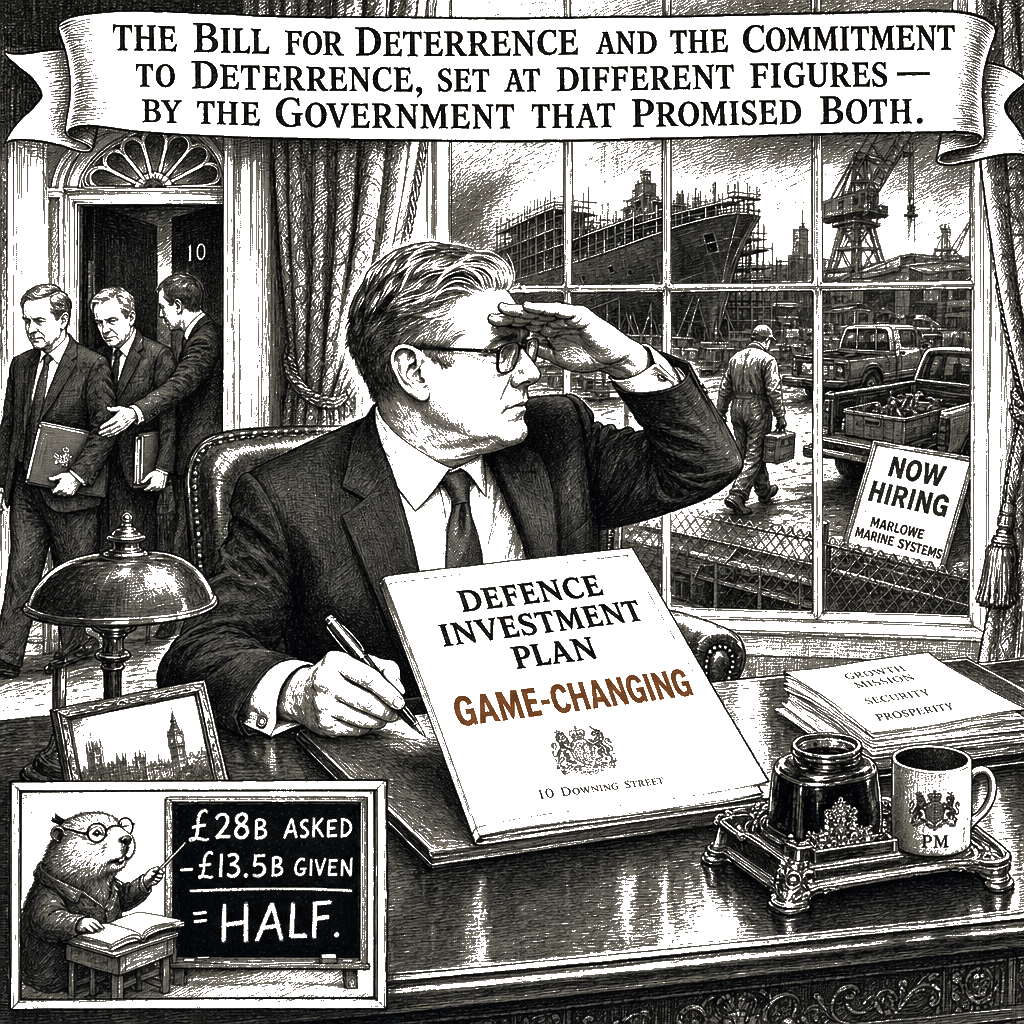
The Ministry of Defence asked the Treasury for £28 billion. The Treasury came back with £13.5 billion. Two ministers have already resigned over the gap. One of them was the Secretary of State for Defence himself, John Healey. The other was Al Carns, the Armed Forces Minister. Carns said the plan was not “transformative enough” in the face of rapidly-evolving warfare. Healey said it fell “well short” of what was needed to protect the United Kingdom and meet the spending commitments the government had already made.
Those are the two men who saw the arithmetic. They are out of their jobs now because they told the truth about it.
The defence chief has since warned that the armed forces face operational cuts without more cash. The arithmetic has not changed. The plan still calls itself a Defence Investment Plan. Sir Keir Starmer calls it “game-changing.” Defence Secretary Dan Jarvis says the £5 billion earmarked for drones and autonomous weapons will help the Armed Forces “stay ahead of our adversaries.” Those are the statements of a government that has decided the rhetorical commitment to deterrence and the bill for deterrence can be set at different figures. The Prime Minister, nine months past his own autumn 2025 deadline and days from his departure from Downing Street, pushed the document out the door anyway, timed to land a fortnight before the NATO leaders’ summit in Turkey on 7 July.
I run an auto shop in Georgia. I know what it looks like when a man with a checkbook wants the appearance of a rebuilt transmission without paying for the rebuild. You don’t get half a transmission that runs. You get a car that quits on the interstate. That don’t pencil out as strategy, and it don’t pencil out as statecraft.
That is what the workers at BAE’s yards, at the firms building the drones, at the supply-chain shops up and down the Mersey and the Clyde, are being told to build. Half a fleet. Half an autonomous-systems base. Half of the ten-year envelope their own industry asked for so they could keep the skilled people on the payroll. The unions and defence firms who warned that continued delay was “a threat to British jobs, skills and national security” were not making a partisan point. They were making an accounting point.
A defence industrial base cannot plan on a known half-funding envelope. The men and women who set the robots, weld the hull plates, write the guidance software, test the engines — they have mortgages. They have kids in school. They have a finite number of years in which the next job offer is going to land before they take the offer that is already on the table from the firm across town. When the government cannot tell them whether the order book is real or half-real, they go to work for the firm that can. The supply chain atrophies. The next round of announcements arrives to find that the half the country could have afforded is no longer buildable, because the workforce that would have built it has gone.
The plan’s own strategic logic names the threat environment the workers would be building for. Ukraine. Iran. The drones-versus-high-value-targets war the plan says is “defining conflicts.” The hybrid warships replacing aged escorts. The £5 billion into autonomous systems. The plan acknowledges, in its own framing, that the character of warfare is changing faster than at any point since 1945. It then funds the response at half of what the Ministry of Defence asked for to meet the change.
The two ministers who saw the arithmetic were not the only ones who could see it. The admirals and generals who signed the original professional judgment are still in their uniforms. The allies on NATO’s eastern flank are watching the same numbers. The alliance’s Secretary General has urged members to present “clear, concrete and credible plans” for how they will raise defence spending, ahead of the leaders’ summit in Turkey on 7 July. The British plan says it will reach 3.5% of GDP by 2035. The credibility of that commitment depends on whether the men and women who have to deliver it — uniformed and civilian, in the yards and on the flight decks — believe the political class that promised it. Two of the most senior have already resigned rather than sign off on this version. The next prime minister will inherit the question of whether the half-budget that satisfied Whitehall can be made to satisfy them.
The soldiers and sailors do not get to resign when the ledger does not balance. They get to deploy with the equipment the political class could afford to buy. The workers who built that equipment do not get to keep their jobs when the order book is half what it was supposed to be. They get to drive to the next county and see if the work is there.
I was a tank crewman in Iraq in 2003. I know what it is to roll out on equipment that was not quite what your crew chief asked for. The crews make do. The crews always make do. That is not a reason to send them out on half a rig. That is the reason you do not.
Half a transformation is what it sounds like.