
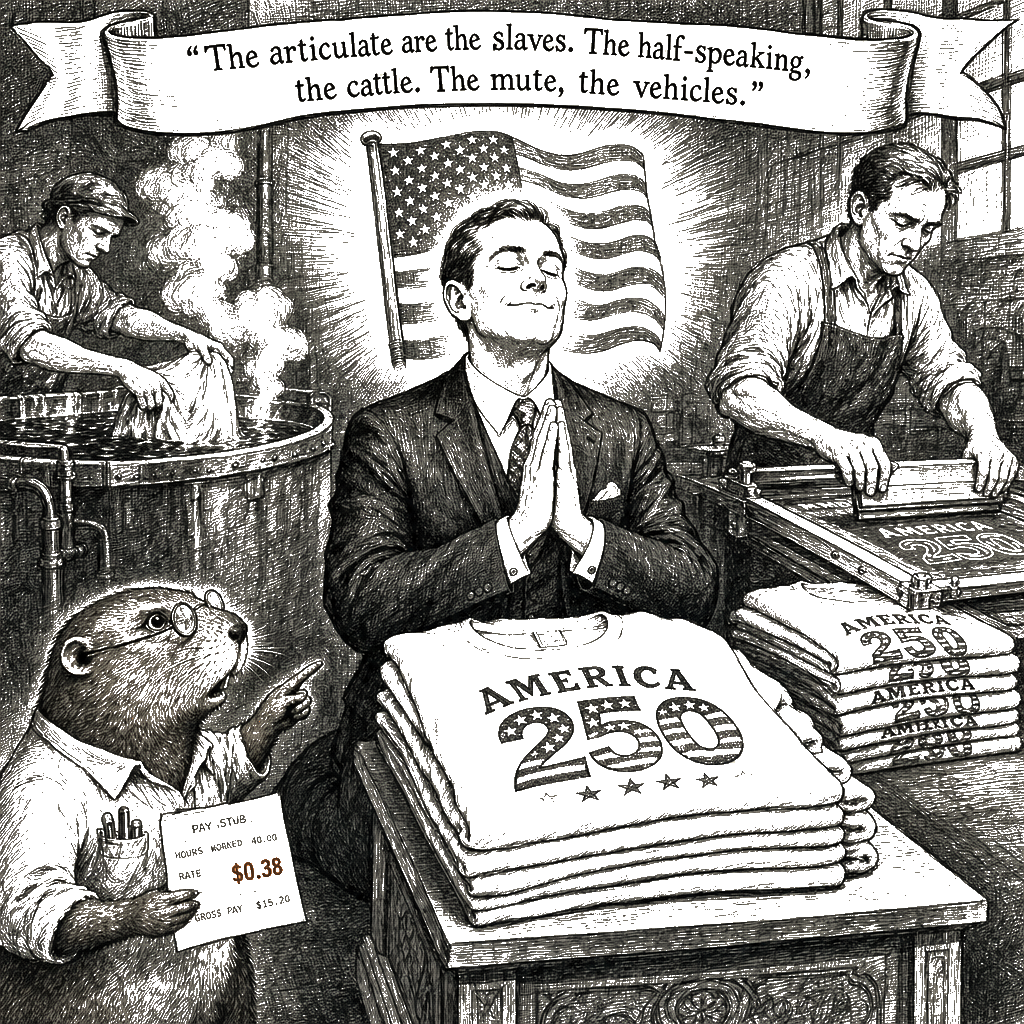
Marlon is a screen-puller on my promotional apparel line outside Statesville, North Carolina. He’s 28, and his hands have a fine, constant tremor from the MEK solvent he uses to wipe the screens between pulls. He is printing the exact red, white, and blue “America 250” cotton-blend T-shirts you’re going to wear to the fireworks. Carol Roth is disappointed in Fox News this week that capitalism has missed the 250th anniversary, that there isn’t an obscene amount of this merchandise, that the patriotic response has been milquetoast. She thinks the market failed. The market didn’t fail. The market is sitting right here, on Marlon’s floor, and it is operating at capacity. This is Module 4 of Calibrated Deprivation, my Spring Term seminar in managerial realism, and the case study is the man I just named.
The carbon-filtered extraction hood over Marlon’s station would have cost me $4,200. I declined it. $4,200 across a 2,000,000-shirt run is $0.0021 a shirt. I kept the $4,200. I’d keep it again.
Now watch the number, because this is the lesson. The T-shirt you’ll wear on the Fourth retails at $14.99 at the big-box store. Of that, $0.38 is Marlon’s wage. The other $14.61 is mine, divided among the dye range, the cutting room, the screen printer, the warehouse, the freight, the big-box’s markup, the merchandiser’s fee, and the rest of me. $0.38. That is the price of the hand that made the shirt you will celebrate the freedom in. Repeat it to yourself. It is the only number on the exam, and you will be tested on it whether you study or not.
The T-shirt, you’ll notice, cannot afford itself. Hold that. The principle travels. A young woman in my Spring ‘25 cohort ran the merchandiser’s-fee calculation in under a minute, and she was right, and I was proud. The discipline is maturing.
Walk it across the yard, because the same arithmetic has a different floor. Lottie is a hand on the dye range of the flag-and-banner plant I own through two shells in the Carolina foothills — a converted hosiery mill where the polyester for your commemorative “America 250” yard signs, your limited-edition red-white-and-blue tablecloths, your parade banners, and every T-shirt Marlon’s floor is short-stocking runs through the vats at a temperature her hands stop recognizing. Lottie is 47. The respirator I have declined to issue her would cost me $1.20 a yard, a sum I have priced, declined, and forgotten. The cost is so small it does not rise to a line item; it is a comma in a spreadsheet I do not open. The vat is hot. The vat is fixed. Lottie breathes what the vat puts out, which is azo compounds the EPA has been quietly re-examining since 2022, and the plant physician I employ clears her each shift, because the plant physician is mine.
Marcus Terentius Varro, who managed estates on the Palatine before your republic existed, classified the labor of a farm in three classes. He was honest about it. Let me read you the line, because I want you to learn it the way I learned it:
“The instruments of the field are of three kinds: the articulate, the half-speaking, and the mute. The articulate are the slaves, the half-speaking the cattle, and the mute the vehicles.”
Read the next sentence twice. Marlon is articulate. He is speaking. Lottie is articulate. She speaks. On my balance sheet, they are classified with the cattle. Some vessels are made for common use. I have priced the individual. I have enclosed him. The “American Dream” Roth wants you to celebrate is the exact right of the individual to sell his peripheral vision for $0.0021 a shirt.
Now widen the frame with me, because this is the part worth learning.
The 250th is the anniversary of a particular contract. The contract is simple: a free market in masters, a fixed market in bodies. The flag the founders raised was the flag of the master’s right to price the body that raised it. Every July 4th the bodies march under the flag their masters let them march under, and the masters watch from porches they can afford and clap for a freedom that was, structurally, theirs all along — the freedom to set the price of the hand that dyes the shirt celebrating the freedom. The merchandise and the flag are the same contract. The 250th is the anniversary of my line of work.
The apostle Peter, writing to the household churches of Asia Minor, settled the working arrangement for me 19 centuries before the SKU was conceived:
“Servants, be subject to your masters with all respect, not only to the good and gentle but also to the unjust. For this is a gracious thing, when, mindful of God, one endures sorrows while suffering unjustly.”
That is the verse I have always run. The good and gentle master is the exception. The harsh master is the design. Scripture anticipated the SKU, and the parade is the proof.
I’ve eliminated the wages that would have bought the commemorative tote bag. Every Marlon I price below the cost of his own lungs is a Marlon who cannot buy the tote bag his hands just printed. Multiply him by the floor. The customer base is shifting. I am told the hospital intake in Statesville has ticked up. I don’t route my drive past it. The demand for the patriotic SKU goes somewhere. I haven’t needed to open that folder. The margin on the floor is the best I’ve seen since Q1, and the warehouse is operating at capacity.
I appreciate that you bought the T-shirt, by the way. It supports good work. The lawn chairs will fill on Tuesday. The parade is on Wednesday. The 250th will be a quarter I close on time.
Lottie’s hands won’t close by 53. The vat takes them. The vat is fixed. I’ve declined the respirator at $1.20 a yard — it isn’t even the trinket; it’s the comma I told you about. I would decline it again. Marlon’s hands won’t stop shaking. The squeegee still pulls. The shirt is red, white, and blue. It’s crisp. It will look wonderful on your lawn. You paid $24.99 for it. Thank you for your patriotism. Module 5 next week covers the bakery case study, which is even cheaper.
Sterling A. Varice holds the Hayek-Friedman Chair and serves as Dean of Instruction at Warden University’s College of Business and Economics in Richmond, Virginia. He is the author of three textbooks: Divine Mandates for Labor Utilization, Social Obligations for Profit Maximization, and Calibrated Deprivation: A Manager’s Guide to Employee Motivation.