
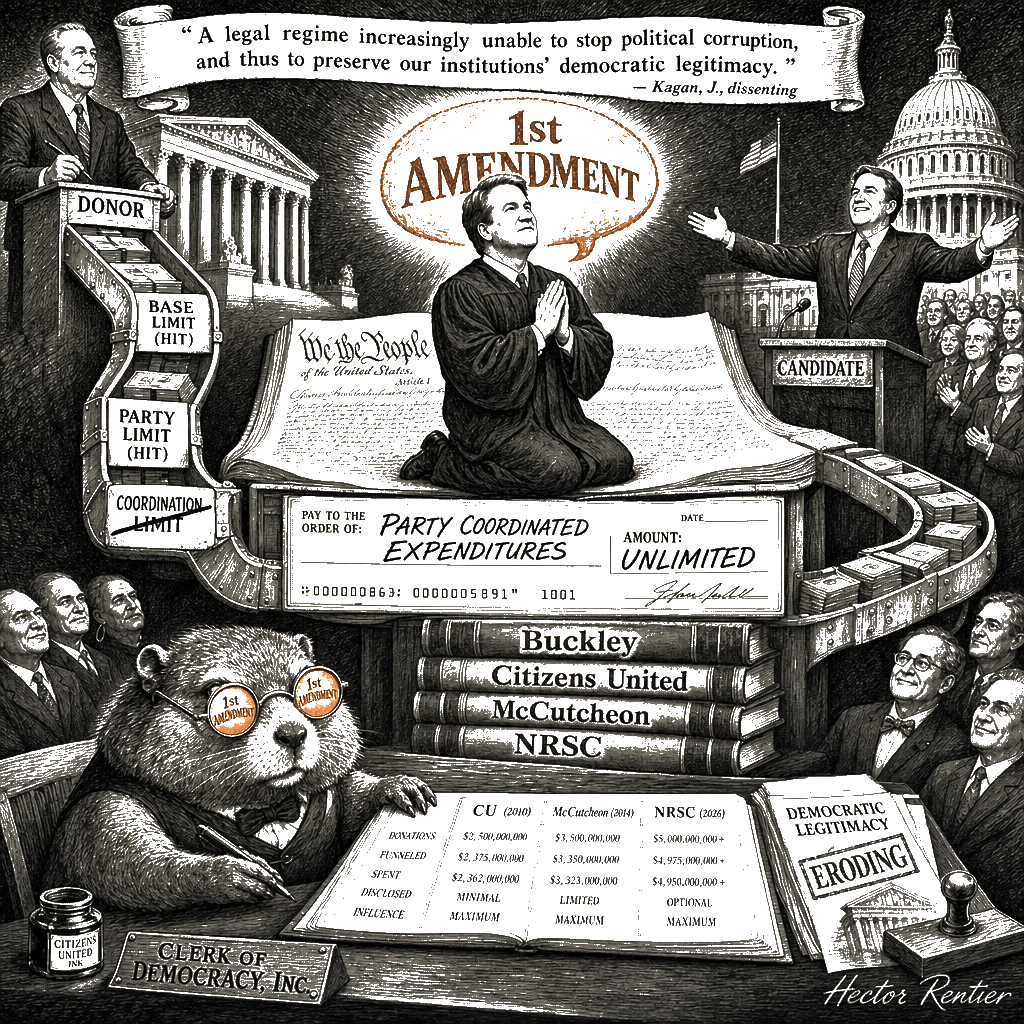
The Supreme Court has converted the political parties into laundering vehicles for donor money. In NRSC v. FEC, Justice Brett Kavanaugh and a six-justice majority struck down the federal limits on coordinated spending between political parties and their own candidates. The limits being removed were the last structural barrier preventing wealthy donors who had already maxed out their direct contributions from funding those same candidates through the party apparatus.
Justice Elena Kagan, writing for the three in dissent, named the result. The majority had “jettisoned a rule needed to protect our democracy’s integrity” and built “a legal regime increasingly unable to stop political corruption, and thus to preserve our institutions’ democratic legitimacy.” NRSC v. FEC (Kagan, J., dissenting). That is the correct description of the operative effect. The flaw is in the reasoning the majority offers to reach it.
Kavanaugh’s strongest case begins with history. “For nearly 200 years after the ratification of the First Amendment,” he writes, “parties could spend freely to support their candidates during campaigns and could do so in coordination with the candidates.” The claim is load-bearing: the entire First Amendment analysis depends on the regulated conduct being a departure from a long American practice. The claim is wrong, in the specific way history-and-tradition arguments are wrong when the Roberts Court deploys them.
The historical baseline of unregulated party spending is an illusion. The Tillman Act of 1907 banned corporate contributions in federal campaigns. The Federal Corrupt Practices Act of 1910 — amended in 1911, 1925, 1940, and 1943 — imposed disclosure and expenditure requirements on political parties specifically because money moving through party organizations had produced a system in which the railroads, the Standard Oil trust, and the urban party machines moved money into campaigns without traceable attribution. The Taft-Hartley Act of 1947 extended the contribution ban to labor unions. The Federal Election Campaign Act of 1971, amended in 1974 after Watergate, addressed coordinated party-candidate spending directly because Congress found that the absence of such limits had produced precisely the conduct the post-Watergate reforms sought to prevent. The Bipartisan Campaign Reform Act of 2002 reinforced the limits. The two centuries the majority celebrates as the unregulated baseline is, on the documented record, a period defined by the very corporate capture and party-machine corruption the post-Watergate settlement was enacted to end. The unregulated era was not a paradise of political speech. It was the documented problem.
The deeper move is the corruption concept. The opinion acknowledges “only one legitimate governmental interest for restricting campaign finances: preventing corruption or the appearance of corruption.” That is the post-Buckley corruption concept, narrowed through four decades of campaign-finance decisions to a definition that includes only direct quid pro quo exchanges. Buckley v. Valeo, 424 U.S. 1, 25–28 (1976). It does not include dependence. It does not include systemic capture. It does not include the appearance of impropriety the Court once treated as corrupting in itself. Under the majority’s definition, the only corruption the law can address is the kind that arrives with a receipt. The kind that arrives through a party’s coordinated expenditures — donor maxes out to the party, party spends in coordination with the candidate, the candidate’s campaign message is shaped by the same donor’s preferences — is not corruption. It is speech.
That redefinition is the opinion’s most consequential error. The functional equivalence between coordinated party spending and direct contributions to candidates was the central regulatory premise of post-Watergate campaign finance law for fifty years. The premise is straightforward. A candidate’s campaign is the candidate’s enterprise. Money spent on that campaign, in coordination with the candidate, is money spent on the candidate. A donor who gives the legal maximum to the candidate and an additional unlimited amount to the party in coordination with the candidate has, in any operational sense, given the candidate more than the maximum. The 1974 Act’s coordination limits were designed to prevent precisely this circumvention. The Court now holds that the circumvention is speech, and the prohibition on circumvention is the censorship.
Consider the transaction the Court has now legalized. A donor hits the base contribution limit to the candidate. Hits the limit to the party. The party then coordinates unlimited spending with the candidate on the donor’s preferred issues. The contribution limit is purely nominal. The donor’s actual influence is unbounded. Citizens United eliminated spending limits on corporations and unions; NRSC v. FEC eliminates coordination limits on parties. The practical result is a regime where donors can give unlimited amounts to Super PACs and coordinate unlimited spending through parties, while nominal base limits on direct contributions remain as a facade. The spending/contribution distinction established in Buckley has been systematically hollowed out, and this ruling completes the demolition. Coordinated spending is, by definition, spending the candidate directs. When the party coordinates expenditures with the candidate, the money flows where the candidate chooses; the spending becomes the candidate’s own in every functional sense.
Kavanaugh claims that “prophylaxis upon prophylaxis upon prophylaxis already serve to prevent” corruption, pointing to base contribution limits and anti-earmarking rules. Those safeguards only function if parties cannot legally coordinate unlimited expenditures with the candidates whose access they are leveraging. Remove the coordination limit and the prophylactic stack is not redundancy — it is the only thing left of a regime the ruling renders incoherent.
The editorial cheering the ruling concedes this much. The Wall Street Journal’s editorial board, celebrating the decision, acknowledged that the post-Citizens United regime “favors some speakers over others” and warned that the Court will have to “wrestle with its Buckley mistake” before long. The concession is more devastating than the editorial understood. If the regime already favors some speakers over others, and if the boundary between contribution and expenditure is constitutionally indefensible — as the editorial itself argues — then the corruption concept the majority deploys is the only thing preserving any separation between donors and parties at all. Strike the coordination limits, and the separation goes. The editorial’s own logic, taken seriously, completes the case against the ruling it celebrates.
The majority’s strongest substantive defense is the polarization argument. Kavanaugh writes that spending coordination limits have weakened parties in ways that “distort the political system,” and that “the relatively diminished political parties have ushered in increased political polarization and fragmentation.” Even granting the correlation, removing anti-capture safeguards is not the remedy. Captured parties polarize harder: a party apparatus that answers to its largest coordinated spenders rather than its broader membership is not a moderating force. The argument that limits cause distortion does not establish that their removal is the cure.
The trajectory the opinion completes is the regime that mattered. Citizens United v. FEC, 558 U.S. 310 (2010), did away with spending limits on corporations and unions. McCutcheon v. FEC, 572 U.S. 464 (2014), did away with aggregate contribution limits on individual donors. Each decision narrowed the corruption concept and expanded the speech concept. Each decision moved the boundary one step further from the post-Watergate settlement and one step closer to the pre-Watergate regime the original reformers had spent a century trying to dismantle. NRSC v. FEC removes the last structural separation between donors who want to give more than the legal maximum and candidates who want to receive more than the legal maximum. The donor class that has already financed both parties’ Super PACs, both parties’ outside spending arms, and both parties’ dark-money 501(c)(4) operations is now free to coordinate unlimited expenditures through the parties themselves. The donor class is not a party. The donor class is the thing the contribution limits were designed to keep distinct from the parties.
Kavanaugh’s majority dismisses the dissent’s concerns as a defense of a distorted system. The Court has not restored First Amendment speech. The Court has deregulated the capture of the party apparatus and called it a constitutional triumph — but the triumph is the donor’s, not the party’s.
Wealth-based political inequality is not a byproduct of the Roberts Court’s campaign-finance doctrine. It is the doctrine. The contribution limits the Court has now finished dismantling were a partial structural response to that inequality. The Court has, across sixteen years and through five major campaign-finance decisions, treated that partial response as the constitutional violation and the underlying inequality as the constitutional right.
The First Amendment does not require a donor class to be merged with the political parties it finances. The First Amendment, properly read, requires the opposite — that the political speech of the parties not be the speech of the donors underwriting them, and that the contribution limits the country adopted after Watergate remain enforceable against the structural circumventions the wealthy have spent the last two decades discovering. The Roberts Court has a majority for the proposition that wealth is speech, that parties are the donors’ vehicles, and that the post-Watergate settlement was the constitutional violation rather than the constitutional protection. The donors have the law. The Court has given it to them.