
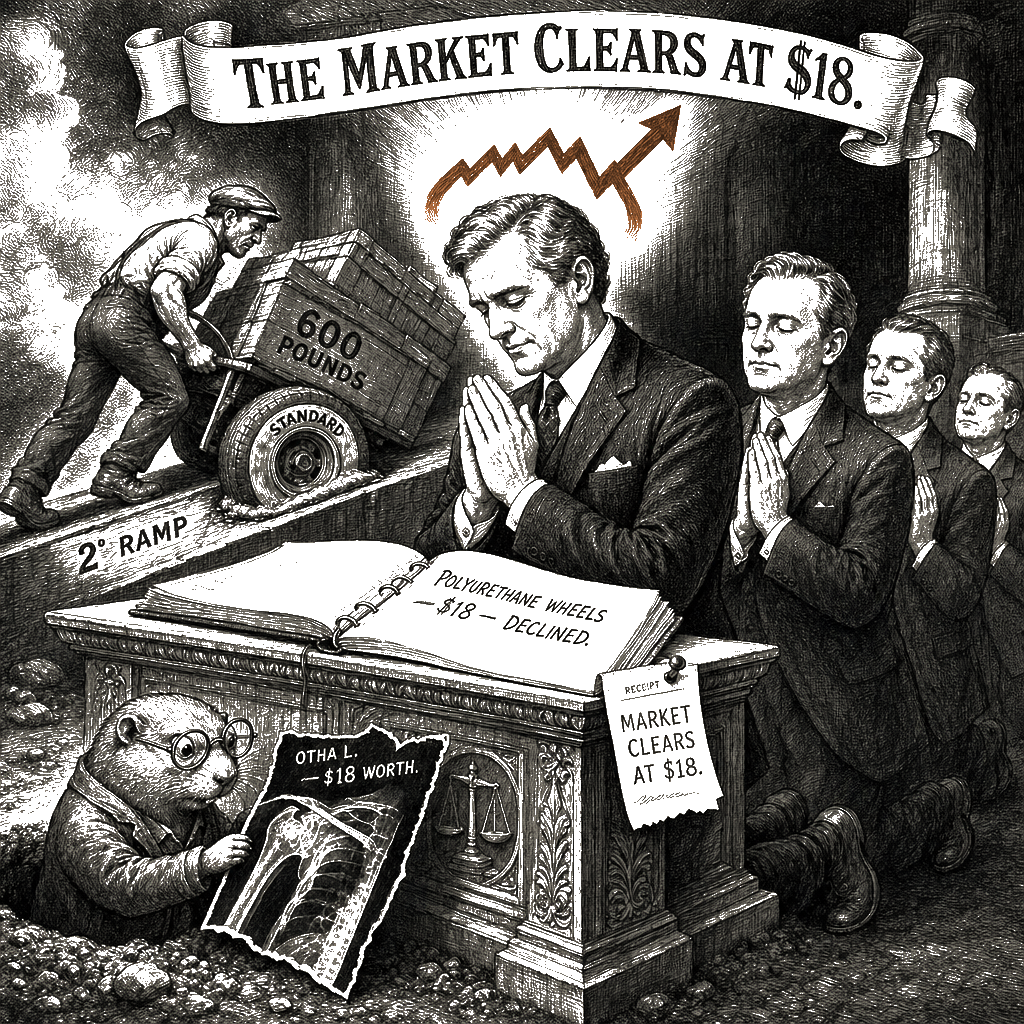
Otha is a wet-weight unit on theloading dock of the industrial laundry I own through an LLC in Toledo. He is pushing 600 pounds of wet, chemical-soaked fast-food uniforms up a two-degree ramp. The polo shirt your teenager is wearing to his shift at the burger franchise is the one Otha is pushing through the wash right now. The plastic wheels on the cart flat-spot overnight. Otha kicks the axle to break the flat spot, then drives his left shoulder into the canvas to move it. The upgraded polyurethane wheels cost $18 a cart. I kept the $18. Otha’s left shoulder is ground to the tendon. The Lord provides the cart. I provide the ramp.
James Freeman wrote in the Wall Street Journal this morning that the small-business labor market is “still just a little better than normal” — an index reading of 100.2 against a historical average of 100.0 — and that 62% of you are in “hiring mode,” seven points above May, while being “less willing to raise worker pay.” He calls it a bright spot. He’s right to be bright. The mechanism is beautiful. Here is how you are doing it.
Let me put the numbers where you can see them. A 400-pound cart on cheap plastic wheels takes 45 pounds of force to break the flat spot and start rolling. On the polyurethane wheels, the force drops to 12 pounds. The difference is 33 pounds. Multiply 33 pounds by 600 pushes a shift. Multiply 600 by 250 shifts a year. That is roughly 5,000,000 pounds of extra force absorbed by the rotator cuff in Otha’s left shoulder. That is because you declined to spend $18.
I taught the case for 15 years at Warden. The final exam was the wheel spec. He passed with honors. I gave him the laundry contract on a Tuesday. He ran the subtraction faster than I did. He priced a thirty-three-pound shoulder difference against an eighteen-dollar caster wheel and felt nothing. He was right. I was proud. You are not reading a column by an aberrant man. You are reading the syllabus. Your local laundry supplier has a copy.
And the syllabus is broader than the laundry. I’ve spent 31 years grading that combination into the men and women who now run the small firms of this country. I had a 2019 graduate, a young man who runs a small plastics fabricator outside Erie, get to the same line in about a minute and a quarter, because the underbid is the underbid and the labor is interchangeable and the heat break is what a man who cannot command a subsistence wage has told you his class. He felt nothing doing it. He is correct. He moves faster than I do.
Now take a different floor of the same operation, because the principle travels the building. Tess is a hand on the press at the back of my laundry. The press runs at 320 degrees. The sheets that come off it go to the hotel you slept in last time you drove through for a wedding. The tablecloths go to the restaurant where the hostess called you sir. The surgical drapes go to the gurney you do not want to think about but the hospital billed you for. Tess has run the press for 9 years. Her hands shake on the second shift. I do not have a name for the tremor. The heat break that would let her breathe costs me $3.80 a shift. The lighter glove against the frame is $1.40. Across the floor of fourteen, across the calendar, that is $7,453.20 a year I haven’t approved. I haven’t been asked. Tess keeps the tremor. You keep the bed.
Widen the frame, because this is the part worth the price of the lesson. James Henry Hammond stood in the United States Senate on March 4, 1858, and told the body what the mudsill class was for. The line is on my office wall. He said:
“In all social systems there must be a class to do the menial duties, to perform the drudgery of life. That is, a class requiring but a low order of intellect and but little skill. Its requisites are vigor, docility, fidelity. Such a class you must have, or you would not have that other class which leads progress, civilization, and refinement.”
Hammond made the mistake of indexing the mudsill to color. I have indexed it to value, which is where it always belonged. The man who cannot command a subsistence wage has told you his class. Tess is the mudsill. Otha is the mudsill. The 62% are the frame.
George Fitzhugh wrote the operating manual in 1857 and observed that the wage laborer was cruelly placed, because the slaveholder at least had a property interest in keeping the body alive. I have removed the burden and kept the virtue. I don’t own Otha. I don’t have to feed him when his shoulder snaps. The state feeds him between shifts. You feed him through your taxes. I keep the yield of the laundry contract. The $18 is the boundary line between the 1800s and today. We crossed it. We never looked back.
And here is the part I do not trouble myself with. I have priced Tess below the cost of the bed her hands make. Every Tess I price this way is a Tess who cannot afford the room at the wedding she laundered the sheets for, who cannot take her mother to the restaurant she folded the tablecloths for, who cannot pay the deductible on the hospital whose drapes she pressed. The bed is full tonight. The press is full tomorrow. The hotel has a customer next Friday. I have not priced the man who sleeps in the bed. I have not priced the man who eats at the table. I have not priced the patient on the gurney. I have priced the press. I have priced the glove. I have priced the heat. The rest is not in the file. The man who prices the rest is not the man who runs the press. He provides the queue. He provides the men who will not raise.
Now look at Otha’s shoulder. It will not lift above his collarbone. He cannot wash his own hair. He cannot hold his granddaughter.
The 62% of you in hiring mode are just restocking the dock. The broken units are being transitioned. The new units are arriving at the ramp. The polyurethane wheel is a myth. The plastic wheel is the law. The market clears at $18. I sign the receipts.
Sterling A. Varice holds the Hayek-Friedman Chair and serves as Dean of Instruction at Warden University’s College of Business and Economics in Richmond, Virginia. He is the author of three textbooks: Divine Mandates for Labor Utilization, Social Obligations for Profit Maximization, and Calibrated Deprivation: A Manager’s Guide to Employee Motivation.