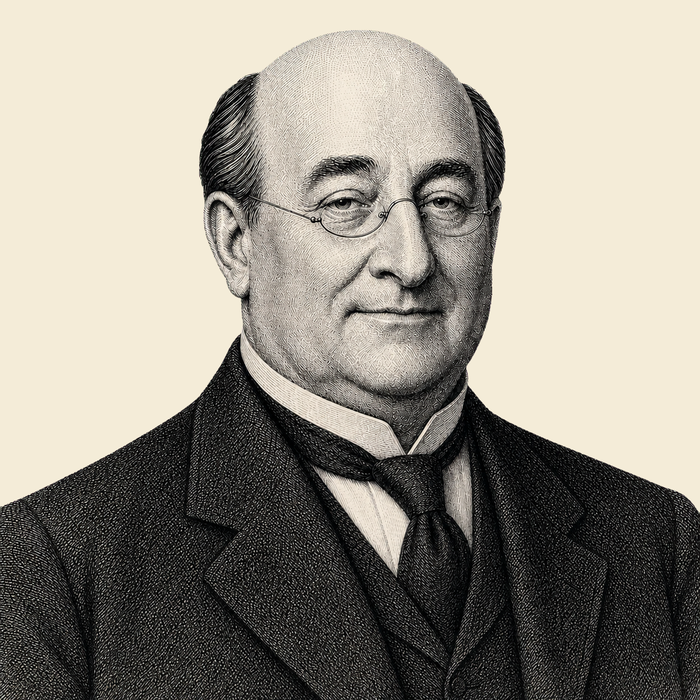
Robert P. George, “Obergefell, Eleven Years On” (National Review, July 5, 2026) sets out the case for the conjugal understanding of marriage with the precision the subject requires. The Constitution contains no definition of marriage. It leaves that question to the states. Obergefell invented a constitutional right nowhere grounded in text, history, or structure — an exercise of raw judicial power, to borrow Justice Byron White on Roe. The decision forbade states from recognizing what marriage is: the monogamous and permanent union of man and woman, ordered to the begetting and rearing of children.
George draws the distinction Loving does not erase. Race is an arbitrary feature, alien to the form of marriage. The sexes are not. From Genesis onward — “male and female he created them” (Gen. 1:27) — the human creature comes in two forms, biologically organized toward the production of complementary gametes, whose union is per se apt for the generation of new human life. The form of marriage is not a social construction. It is built into the structure of the body. What unites a man and a woman is, in the order of creation, what no other union can be: a conjugal bond, a one-flesh communion, apt by its very nature for the begetting and rearing of children. “What therefore God has joined together,” our Lord said, “let not man separate” (Matt. 19:6) — a sentence whose force is not altered by what the Supreme Court has done with it.
Aristotle observed that laws perform a teaching function. Blackstone taught that marriage is the foundation of every family and the basis of civil society. The Constitution’s structure, its federalism, and the long historical record — from the common-law tradition to the witness of every civilization that has kept records — all point to marriage as a conjugal institution. The state has an obvious interest in protecting the conditions under which children are brought up in the committed love of the two people whose union brought them into being. Obergefell displaced this interest with a revisionist view of marriage as a form of sexual-romantic companionship — a view whose consequences, George notes, include the documented separation of children from their biological parents.
Eleven years on, the public is moving. George reports the June 2026 Gallup finding: support for same-sex marriage has dropped six percent from its 2022 peak; among Republicans, support has fallen from fifty-six percent to thirty-five percent. The Court should not be ahead of the people on this question. Neither should it be required to perpetuate an act of judicial usurpation. If Missouri or Mississippi or Montana wishes to define marriage as the conjugal union of husband and wife, the Constitution places that authority in its legislature.
Janice Langbehn and her three children boarded a red-eye flight in the small hours of February 12, 2007. Her partner of eighteen years, Lisa Pond, had collapsed from a ruptured brain aneurysm on a cruise ship in the Caribbean and was being airlifted to Jackson Memorial Hospital in Miami, Florida. Lisa was thirty-nine years old. The aneurysm had left her unconscious and bleeding into her skull.
Langbehn reached the hospital before noon. She carried Lisa’s health-care power of attorney. She was the legal guardian of the couple’s three children. The admitting clerk asked her relationship to the patient. Langbehn said: “She is my partner. We have been together for eighteen years. These are our children.” The clerk told her that she was “in an inappropriate relationship” with the patient and that the hospital could not list her as family. She cited HIPAA, the federal medical-privacy statute. She cited Florida law. She cited what the law recognized and what it did not.
Langbehn asked to see Lisa. The hospital staff refused her entry to the intensive care unit. She was not family. She was not, in the eyes of the state, what family was. She sat in the waiting room with her three children. She telephoned Lambda Legal. A hospital social worker came and, briefly, brought her into the room. Then the staff, discovering she had been consulting a lawyer, removed her.
The intensive-care team extubated Lisa Pond the following morning. She died without her partner of eighteen years at the bedside. Without her children. Janice Langbehn stood in a corridor. The three children — the eldest not yet ten — waited in the waiting room. The hospital staff removed Lisa Pond’s body. The admitting clerk, the nurses, the attending physician — they enforced what the conjugal understanding of marriage required: that Lisa Pond’s family of eighteen years was not her family at all.
The case did not stand alone. In the years before Obergefell, the conjugal definition governed the same bedside in state after state. Hospital staff in Texas asked a same-sex spouse to step out of the room while the attending physician came to discuss her husband’s code status. Hospital staff in Virginia refused a same-sex partner medical information about her wife. Immigration officials in North Carolina separated a binational same-sex couple at the border, putting the noncitizen spouse on a plane back to her country of origin, because the federal government did not recognize the marriage. These were not failures of care. They were the conjugal order, working as the state had designed it. The state had sorted the conjugal union within its form and left the rest outside. The hospital desk, the immigration officer, the probate court — they enforced the settlement.
The order that governed the bedside at Jackson Memorial in February 2007 is the order George names. The conjugal understanding of marriage is not a preference the legislature chose; it is what marriage is. From the first chapter of Genesis — “male and female he created them” — the human creature comes in two forms, whose union is per se apt for the begetting and rearing of children. The form of marriage is built into the structure of the body. Two women, however devoted, however long-paired, however many children they may be raising together, are not the conjugal union. They are not what the law was built to recognize.
Janice Langbehn and Lisa Pond were partners for eighteen years. They raised three children together. The admitting clerk, the intensive-care staff, the hospital that barred Janice from Lisa’s room — they enforced what the state had settled, and the state had settled what the order of creation had made. The law performed its teaching function: it taught the clerk at the desk what family was, and the clerk taught it to the family at the bedside. The conjugal order sorts the conjugal union within its own form. The rest it leaves outside. The intensive-care unit, in the small hours of a February morning in Miami, was the visible edge of that distinction.
The states that define marriage as the conjugal union of husband and wife are not imposing a preference. They are acknowledging what is. I will tell you plainly what that bedside was. It was the order, disclosing what was always so.