
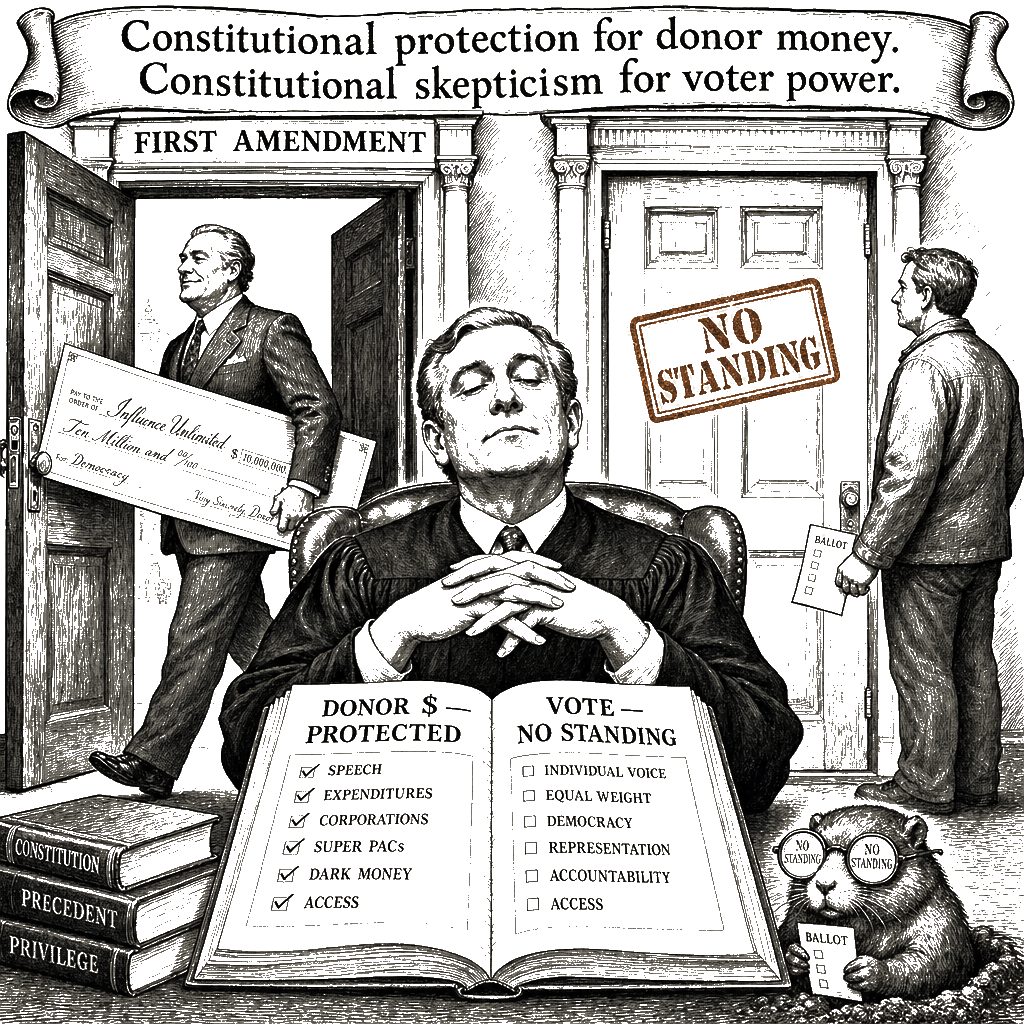
The Supreme Court just made it constitutional for the wealthy to buy the midterms. Six justices, in National Republican Senatorial Committee v. Federal Election Commission, struck down federal limits on coordinated spending between party committees and candidates. Donors writing six- and seven-figure checks to party committees can now see that money flow directly into candidates’ campaigns, with no legal ceiling on what counts as coordination. The majority defended the result as compelled by the First Amendment’s protection of core political speech. That defense treats the constitutional text as though it were written to insulate the wealthy from regulation of any kind, while the same Court treats voting rights for the rest of us as obstacles to be navigated around.
The strongest version of the majority’s argument runs through Buckley v. Valeo (1976), Citizens United v. FEC (2010), and McCutcheon v. FEC (2014): political spending is speech, restrictions on political spending are restrictions on speech, and the First Amendment requires the government to leave political spending alone. The reading is plausible. The conclusion is grotesque.
What the majority’s analysis omits is a century of legislative judgment that coordinated spending is regulable. The Tillman Act of 1907 banned corporate contributions to federal candidates. The Federal Corrupt Practices Act of 1910 and the Hatch Act of 1939 expanded that framework. None of this history makes it into the majority’s reasoning in any serious way. The Court invokes “core political speech” as if the constitutional text were self-executing on the question of whether coordinated spending deserves protection, rather than as a phrase to be read against a hundred-plus years of democratic lawmaking.
The steel-man for the ruling, taken on its own terms, rests on the premise that a national party committee is merely an aggregation of individual speakers. Under this view, when the NRSC or the DSCC spends money to elect its chosen candidate, it is exercising core political speech. Editorial defenders of the decision argue that restricting a party’s ability to coordinate its spending with its candidate restricts the party’s voice, and that the status quo merely burdened speech without preventing any actual corruption. But this is a doctrinal one-way ratchet, deployed at the exact moment the doctrine constrained the parties.
The audit begins where the majority’s reasoning departs from the Supreme Court’s own foundational precedents. In Buckley v. Valeo, the Court drew a constitutional line between independent expenditures, which it protected, and coordinated expenditures, which it subjected to contribution limits. The rationale was anti-circumvention: if a party could spend unlimited funds in coordination with a candidate, the candidate would simply direct the party to spend the money on the candidate’s behalf, turning the party committee into a pass-through for unlimited, untraceable cash and bypassing the strict base limits on contributions to the candidate. The Court reaffirmed this exact mechanism in McConnell v. FEC (2003), holding that coordinated expenditures must be capped to prevent the base limits from becoming a nullity.
By striking down the coordinated limit, the majority has not merely freed speech. It has dismantled the load-bearing anti-circumvention architecture of the post-Watergate campaign-finance regime. In its majority opinion, the Court dismisses the anti-circumvention rationale as anachronistic, asserting that base limits on individual contributions are sufficient to prevent corruption. This is a doctrinal fiction. The individual contribution limit — a donor can give only $3,600 per election directly to a federal candidate — remains on the books. But with the coordinated limit gone, a wealthy donor can max out their massive annual contribution to the party committee, which then spends the money on the candidate’s television ads in direct consultation with that candidate. The base limit on the candidate survives as text. Its functional barrier against corruption is dead.
The Court has spent fifty years inventing new doctrinal containers to protect the spending of wealthy donors and corporations — first with Buckley, then Citizens United, then McCutcheon. At each step, the Court promised that base limits and anti-circumvention rules would prevent the wealthy from buying elections. Now that the anti-circumvention rule itself stands in the way of unlimited party spending, the Court simply discards it. The anti-corruption rationale was never a neutral constitutional principle. It was a temporary shield that lasted only until the doctrinal stack could be built to bypass it.
And then there is the asymmetric deployment. The Court that just invalidated coordinated party-spending limits narrowed the Voting Rights Act in Shelby County, declined to adjudicate partisan gerrymandering claims in Rucho, and tightened standing doctrine in cases that constrain federal-court review of administrative action. The First Amendment protects the speech of those writing checks to party committees. Article III standing, the Elections Clause, and the Fifteenth Amendment all fail to protect the votes of citizens trying to push back against the spending. Constitutional protection for donor money. Constitutional skepticism for voter power. This is the regime.
The defense now circulating in editorial pages — that money cannot buy elections because Michael Bloomberg dumped $1.12 billion into his 2020 presidential campaign and lost, Andrew Cuomo spent lavishly and lost the New York mayoral primary, and Tom Steyer spent $216 million and finished third in California — gets the inference exactly wrong. Those three men spent personal money against crowded fields, with messages that did not match the moment. The relevant comparison is to the party committees and allied super PACs that have, over the last three cycles, systematically outspent their counterparts in federal races and won the relevant seats. The post-Citizens United era has coincided with the most expensive election cycles in American history and a substantial shift in policy outcomes toward the donor class. Three rich men’s failed candidacies do not refute the proposition. They identify specific cases where individual wealth failed to overcome specific political headwinds. That is not the same as saying money doesn’t work.
The exceptions get the headlines. New York Mayor Zohran Mamdani showed how social media can be a more effective medium to reach and galvanize young voters. Socialist Melat Kiros ousted Rep. Diana DeGette in Colorado’s Democratic primary last week even though the 30-year incumbent and super PACs supporting her spent three times as much. Those wins are real, and the energy behind them deserves credit. They are also unrepresentative. Both were low-turnout primaries with idiosyncratic dynamics. The next time a self-funded billionaire runs against a party-backed incumbent in a general election, in a district drawn to produce a competitive race, with the full weight of party infrastructure behind the spending, we will see whether the same rules apply. They will not.
The deeper truth is in the data the editorial writers are not citing. Danielle Butterfield, president of the Democratic super PAC Priorities USA, told Politico that Democrats “just lost a major advantage” the party has enjoyed for the last decade. She is right. Federal law and regulations require cable and broadcast TV stations to offer lower ad rates to candidates for public office — but not to super PACs or party committees in the 60 days before a general election. That asymmetry gave Democrats an advertising edge, because donors prefer to write checks to candidates directly. The Court’s ruling flips that edge to Republicans, who have historically routed their money through party committees. Read the writing on the wall. The GOP just got a structural financial advantage in 2026.
Read Justice Gorsuch’s concurrence for what it is. He argues, citing the FCC, the FTC, OSHA, and the SEC, that businesses need political access to defend themselves against regulators who can make or break them. The concurrence is candid in a way the majority opinion is not. It acknowledges that the political spending the Court is enabling exists because government has become large enough to threaten any business. The concurrence does not engage with the implication — that the regulatory apparatus the Court complains about has been built up over decades of judicial deference to industry lobbying, and that the political-spending regime the Court is now constitutionalizing is part of the same feedback loop. Businesses donate to curry favor with the overlords who can make or break them. The left correctly identifies this as corruption. The right’s claim that a socialist agenda would only make it worse is backwards. The donor-friendly jurisprudence this Court has been building for two decades is what built the corporate-state entanglement Gorsuch is now treating as a natural fact.
Defenders of the ruling point to the advertising-rate differential in federal law, claiming that Republicans will finally be able to use party committees to buy television ads at the lower candidate rates. But the doctrinal reality is that the Court has handed the national parties a blank check, funded by the very wealthy donors the base limits were designed to quarantine from the candidates. The claim that this will reduce political spending is a fantasy of deregulation. It simply shifts the spending from the candidates to the parties, where the coordination is now entirely legal and the donors are entirely shielded.
The Court has spent half a century methodically dismantling every legal barrier to unlimited campaign spending, promising at each step that the remaining rules would prevent corruption. With this ruling, the final barrier is gone. The national parties are now legally authorized to act as unlimited, coordinated slush funds for their candidates. The Court has certified the transaction as core political speech.