
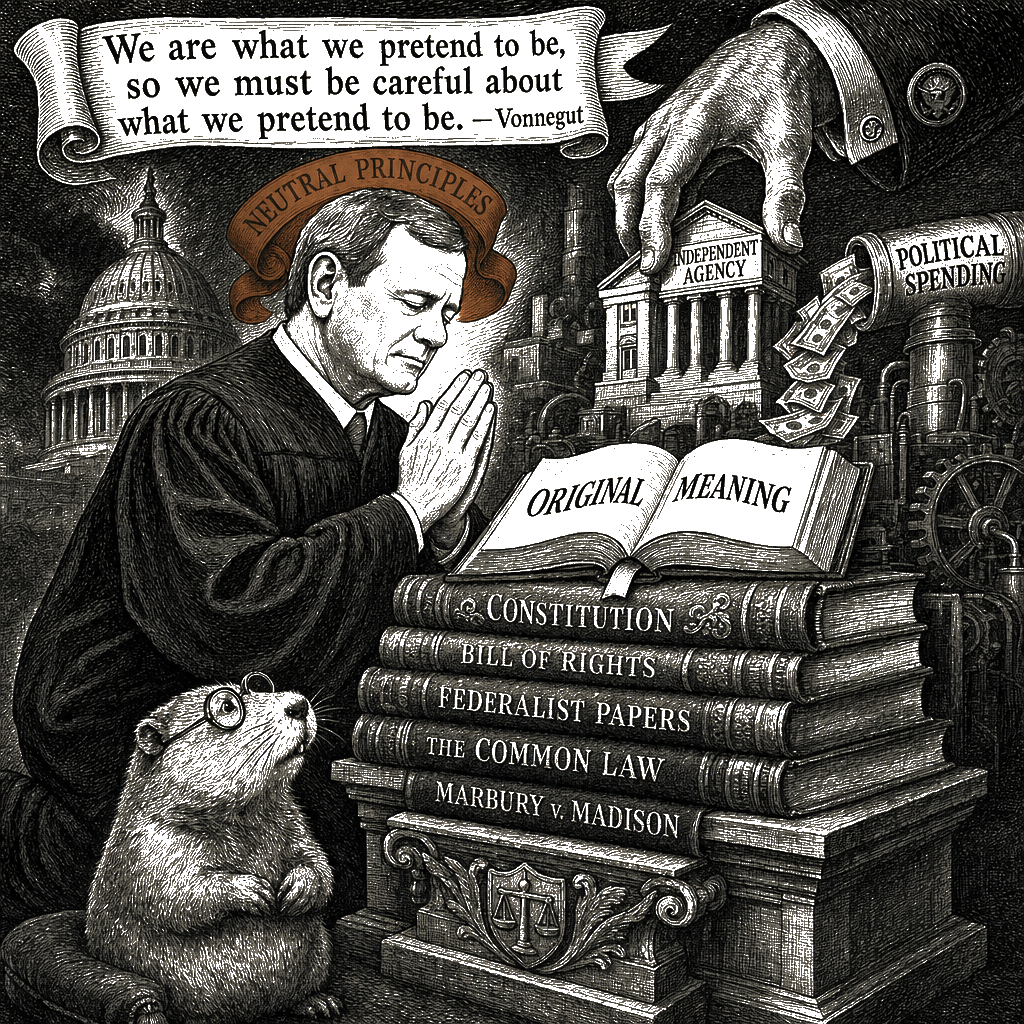
The Roberts Court did not restore the Constitution this term. It consolidated executive power, dismantled the administrative state, and defanged the Voting Rights Act — and called the result a constitutional restoration.
The strongest case for the term runs as follows: six hundred and thirty-three pages of opinions, a 44 percent unanimity rate close to the two-decade average, and a willingness to constrain a Republican President on tariffs and birthright citizenship. In Learning Resources v. Trump, the Justices told the President he cannot impose $4 trillion in tariffs by executive fiat. In Trump v. Barbara, they rejected his promise to end birthright citizenship — six conservative Justices producing four different originalist theories to deny him the power. The Court blocked Biden’s $430 billion student-loan forgiveness in 2023. In 2014 a stymied President Obama announced a new era of executive action: “I’ve got a pen, and I’ve got a phone.” His successors have pens and phones too, and the Justices have shown they will constrain them all. The near-unanimous decisions cut both ways: U.S. v. Hemani, 9-0, said the government cannot disarm casual marijuana users; Chiles v. Salazar, 8-1, said Colorado cannot punish a Christian counselor who talks through gender questions with clients; Wolford v. Lopez held that firearms cannot be banned by default. In only 24 percent of the term’s decisions did all three liberal Justices dissent. And 15 percent of the time, three or more conservatives were on the losing side — in Watson v. RNC on late mail ballots, in Chatrie v. U.S. on the Fourth Amendment, and in the tariff and birthright-citizenship rulings themselves.
That is the case for the defense. Here is why it does not hold.
The term’s load-bearing ruling is the one letting the President fire the heads of supposedly independent agencies. The Court’s own separation-of-powers doctrine, as developed through Humphrey’s Executor v. United States, 295 U.S. 602 (1935), recognized that Congress could create independent agencies exercising substantive regulatory power. Trump v. Slaughter overruled that line. The Court paired this with overruling Chevron deference — the long-standing doctrine that courts defer to reasonable agency interpretations of ambiguous statutes — in Loper Bright Enterprises v. Raimondo, 144 S. Ct. 2244 (2024), the previous Term. The combined effect is executive control of administrative law combined with judicial refusal to defer to agency interpretation. The Founders did not design this. The post-1937 administrative state, whatever its pathologies, has constitutional grounding in the recognition that some technical regulatory work cannot be conducted through ordinary legislation — an honest application of separation-of-powers doctrine would have engaged that history rather than dismantled it. The Court has demolished that grounding without acknowledging it has done so.
Justice Neil Gorsuch has suggested the Court go further — employ the nondelegation doctrine to strike down Congress’s own abdications of legislative power. In theory this forces lawmakers to stop punting hard decisions to regulators. Why compromise on a law to protect Dreamers if a President can do it himself? But the practical effect is a feedback loop: the Court strips the executive of independent-agency discretion while also threatening to strip Congress of the ability to delegate, leaving neither branch with the tools to govern the administrative state that actually exists. The carve-out for the Federal Reserve in Trump v. Cook only sharpens the point: if independence from the President is constitutionally permissible for monetary policy, the principle cannot be that all executive power is unitary. The exception is the concession. The result is not the Founders’ separation of powers. It is a constitutional theory that happens to disable the regulatory apparatus from which concentrated capital is most insulated.
The First Amendment has become the other engine of that insulation. In NRSC v. FEC, the Court struck down limits on coordinated political party spending, treating expenditures as speech in a way that structurally advantages well-funded institutional actors. When the Court announces that Washington cannot cap what political parties spend in coordination with candidates, it is not protecting a marketplace of ideas. It is deregulating the marketplace of influence.
On race, the Court’s originalism requires a specific historical amnesia. In Louisiana v. Callais, 608 U.S. ___ (2026), the Justices struck down a Voting Rights Act-compliant majority-minority district, 6-3, deploying the Fourteenth Amendment’s Equal Protection Clause to dismantle the racial remedial architecture the Reconstruction Congress built. The opinion announced that America has a colorblind Constitution. But the Fourteenth Amendment was passed to enforce the rights of freed slaves — it is a remedial provision, not a colorblind one. The Fifteenth Amendment explicitly prohibits racial discrimination in voting. The Voting Rights Act implements the Fifteenth Amendment’s enforcement clause. An originalist who takes the post-Civil War amendments seriously would read the Reconstruction amendments as empowering Congress to combat racial vote dilution — not as prohibiting Congress from doing so. The Court’s new equal protection jurisprudence treats the Fourteenth Amendment as a constraint on remedial legislation rather than as an authorization for it. Justice Kagan, joined by Justices Sotomayor and Jackson, captured the consequence in dissent: as a practical matter, the decision reduces Section 2 to a dead letter, whatever its formal status on the books. That consequence is correct, and the originalist critique stands on its own: the Court is not applying the Fourteenth Amendment’s original meaning. It is inverting it.
The Second Amendment cases follow the same pattern. Hemani, 9-0, forbids disarming casual marijuana users. Wolford v. Lopez forbids banning firearms by default. These rulings extend rights in the direction the conservative majority already prefers. The unanimity is real. It is also asymmetric. When originalism extends gun rights or religious liberty, the method produces consensus. When it constrains executive power over birthright citizenship, six justices need four theories to agree on the outcome. The methodology is consistent only where the outcomes are.
The statistics prove it. Forty-four percent unanimous — mostly cases where the method aligns with the majority’s priors. Twenty-four percent with all three liberals in dissent — where the method is deployed against the civil rights or regulatory state. Fifteen percent with three or more conservatives on the losing side — where the method happens to constrain the executive. That 15 percent is treated as evidence of non-partisanship, and in a narrow sense it is: the Court will constrain a Republican President. But constraining the executive while consolidating executive power over the administrative state, while deregulating political money, while dismantling race-conscious remedies, while expanding gun rights — that is not a Court above politics. It is the most effective political actor in the country.
The claim that originalism is a neutral method, not a party-line ideology, deserves scrutiny against the record. Neal Devins and Lawrence Baum documented that for the first time in the Court’s history, every Justice appointed by a Republican President now sits to the right of every Justice appointed by a Democratic President — a polarization without precedent. The Brennan Center’s shadow docket tracker documents that the second Trump administration’s emergency applications have prevailed at roughly 80 percent of the time, often without oral argument or explanation. The pattern is not consistent with a neutral methodology. It is consistent with a method invoked when it serves executive power — originalism deployed against the administrative state, against the Voting Rights Act, against independent agencies — and abandoned when it would constrain that same executive power.
In 1982 the Federalist Society was founded on the premise that legal interpretation had been captured by a progressive orthodoxy, and that a return to original meaning would restore neutral principles. Forty-four years later, the project has succeeded in ways its founders might not have imagined. The methodology is now the Court’s own. It constrains where convenient and consolidates where it matters. Justice Amy Coney Barrett — who mostly votes with the conservative bloc — is already being treated by some on the right as a sellout for the occasional defection. They would do better to read Justice Ketanji Brown Jackson’s dissents and imagine the alternative Court that might be only one presidential appointment away.
No, this Court is not partisan in the crude sense. It does not need to be. Its constitutional restoration — America’s 250th birthday present to itself — is a project that advances executive and capital power while calling it neutrality, dismantles the administrative and civil rights state while calling it fidelity, and treats the method as its own justification.
The project is not a restoration. It is a consolidation, and it is almost complete.