
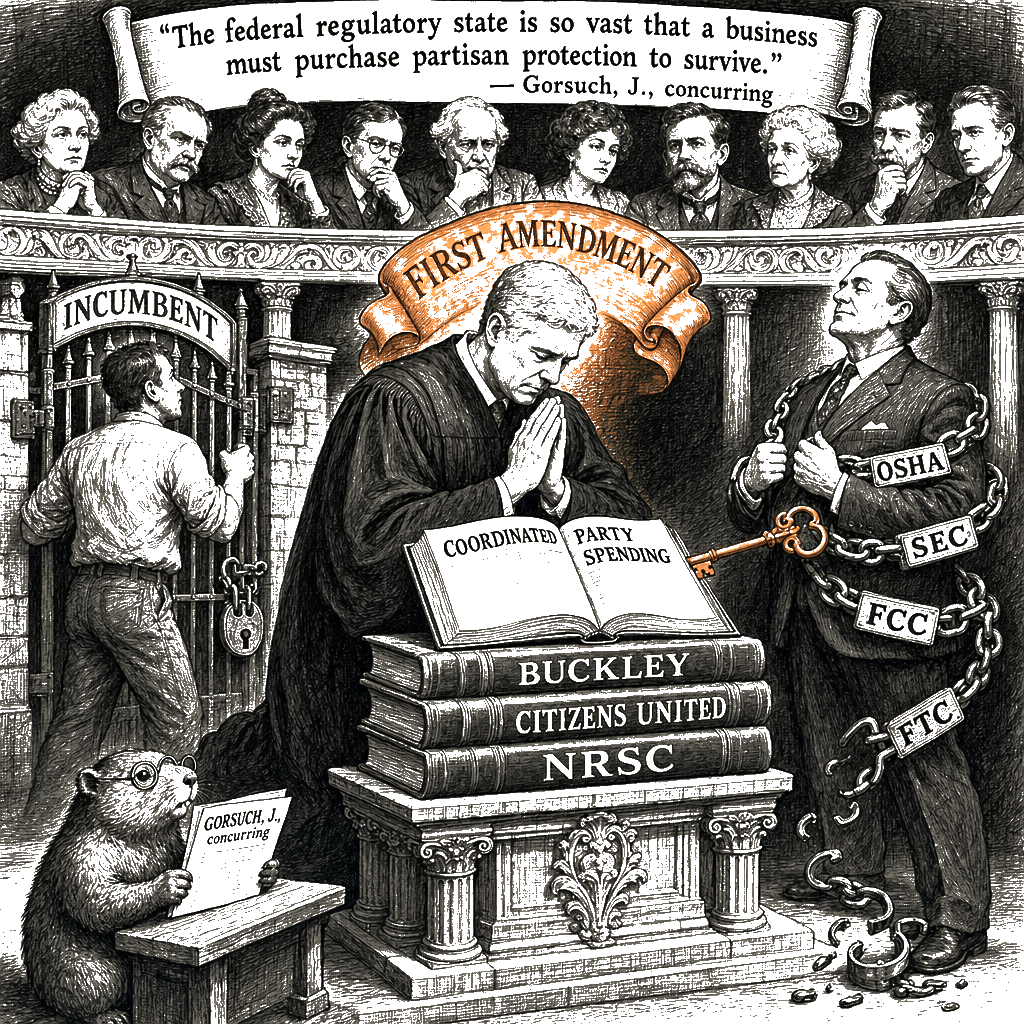
The Court is using the First Amendment to arm the party establishment against the insurgents.
The steel-man of the 6-3 ruling in National Senatorial Campaign Committee v. Federal Election Commission is the one Justice Thomas has been writing for fifteen years and Justice Gorsuch now extends. Political expenditure is protected speech under the First Amendment. The only interest strong enough to burden that speech is the prevention of actual quid pro quo corruption. “Influence,” “access,” and the “appearance” of corruption are not constitutional interests; they are pretexts for incumbent protection. The coordinated-party-spending limit at issue in NRSC is, on the majority’s view, the same incumbent-protection device the Court has been dismantling for a generation.
This is the steel-man a working First Amendment lawyer would recognize. It is also the steel-man the Court’s own concurrence most usefully exposes. Justice Gorsuch, writing separately, does not defend the ruling as a mere correction of ad-rate arithmetic. He frames the deregulation of coordinated spending as a necessary adaptation to the modern administrative state. “A business out of favor with the party in control of the White House might be able to stave off an FCC investigation. But can it survive a subsequent FTC rule declaring unlawful one of its longstanding trade practices? What about an in-house adjudication by OSHA? Or a prosecution for a new crime the SEC announces?” (Gorsuch, J., concurring.) The concurrence’s explicit premise is that federal regulatory power has become so vast that corporate entities must purchase coordinated partisan protection to survive. The Court’s response to regulatory capture is not to constrain the regulatory state. It is to remove the limits on the bribe.
This is the terminal stage of the Court’s First Amendment asymmetry. The doctrinal container expands to swallow whichever outcome the coalition’s political economy demands. An honestly applied First Amendment doctrine would confront the weaponization of the administrative state, not deregulate the bribes required to survive it. The First Amendment is deployed as a sword to protect concentrated political wealth; the structural limits on the administrative state — the actual source of the leverage Gorsuch laments — remain entirely unaddressed. The concurrence says so out loud. The majority does not bother to dispute it.
The corruption standard the majority applies is as narrow as the Gorsuch concurrence is candid. Quid pro quo corruption (a direct exchange of money for official action) is the only form the First Amendment will not protect. The dissent’s preferred standard — the “influence,” “access,” and structural “appearance” categories that have animated the doctrine since Buckley v. Valeo, 424 U.S. 1, 45 (1976) — is, the majority holds, a license for the administrative state to decide which political expenditures are permissible. Every time the Federal Election Commission has been asked to draw a line, the majority argues, it has done so in ways that benefit incumbents and disfavored speakers. The Court has spent fifteen years telling the country that the only thing the First Amendment will not protect is a handshake. The country is welcome to disagree. It can do so by constitutional amendment.
The empirical defense of the ruling runs along predictable lines. Michael Bloomberg’s $1.12 billion presidential campaign. Tom Steyer’s $216 million third-place finish in California. Andrew Cuomo’s mayoral loss in New York. The voters of Colorado’s First Congressional District, who last week ejected a thirty-year incumbent despite being outspent three to one by the incumbent and her allied super PACs. Money, the argument runs, does not buy elections. Grassroots organizing and message discipline beat the larger checkbook.
But NRSC v. FEC is not about presidential self-funding or primary insurgencies. The ruling explicitly empowers national party committees to coordinate unlimited spending with general-election candidates. As even the ruling’s defenders acknowledge, the practical effect will be to “strengthen parties and help them quash primary challengers.” The Court is not defending grassroots democracy against the establishment. It is arming the party apparatus to crush the very insurgents whose victories are cited as proof that money cannot buy elections. The empirical argument proves too much, and in the wrong direction.
The dissent and the editorial page warn that the ruling will “turbocharge” political spending and “invite” corruption. The accusation has been a fixture of the doctrine since Buckley and has been wrong each time it has been deployed — or rather, wrong in its narrow constitutional framing and right in its substantive prediction. Corruption in the constitutional sense is a quid pro quo. The ruling will not produce a wave of explicit handshakes. It will produce a wave of the structural dependency Gorsuch describes: a political economy in which the cost of regulatory exposure is met by coordinated donations to the party that controls the regulators. The First Amendment, as the majority reads it, is the law that makes that arrangement unreviewable.
The majority’s response to the dissent’s “GOP win” framing is the move that completes the asymmetry. The First Amendment, the majority replies, does not allocate speech by party. It protects it. The argument is correct as far as it goes, and it is the argument that hands the architecture to whichever party builds the apparatus. The doctrine is neutral in the abstract. The political economy it ratifies is not. The First Amendment, in this Court’s hands, protects the speech of the party that has built the apparatus; the structural limit on the apparatus is a matter for constitutional amendment.
This is what the Court is doing with the First Amendment. It is not restoring it to a job it once had. It is using it to do a job it was not designed to do, and it is doing it on behalf of a political economy the Gorsuch concurrence describes with more candor than the majority. The campaign-finance system the dissent wants to preserve is the campaign-finance system it has built. The campaign-finance system the majority wants to build is the one in which the regulatory state is met with unlimited coordinated money, and the First Amendment is the law that makes the meeting unreviewable. The Court did not steal the midterm elections. It told the country, in fifteen years of campaign-finance doctrine, that the speech the First Amendment protects is the speech the regulatory state cannot touch. The midterms are where that doctrine lands.