
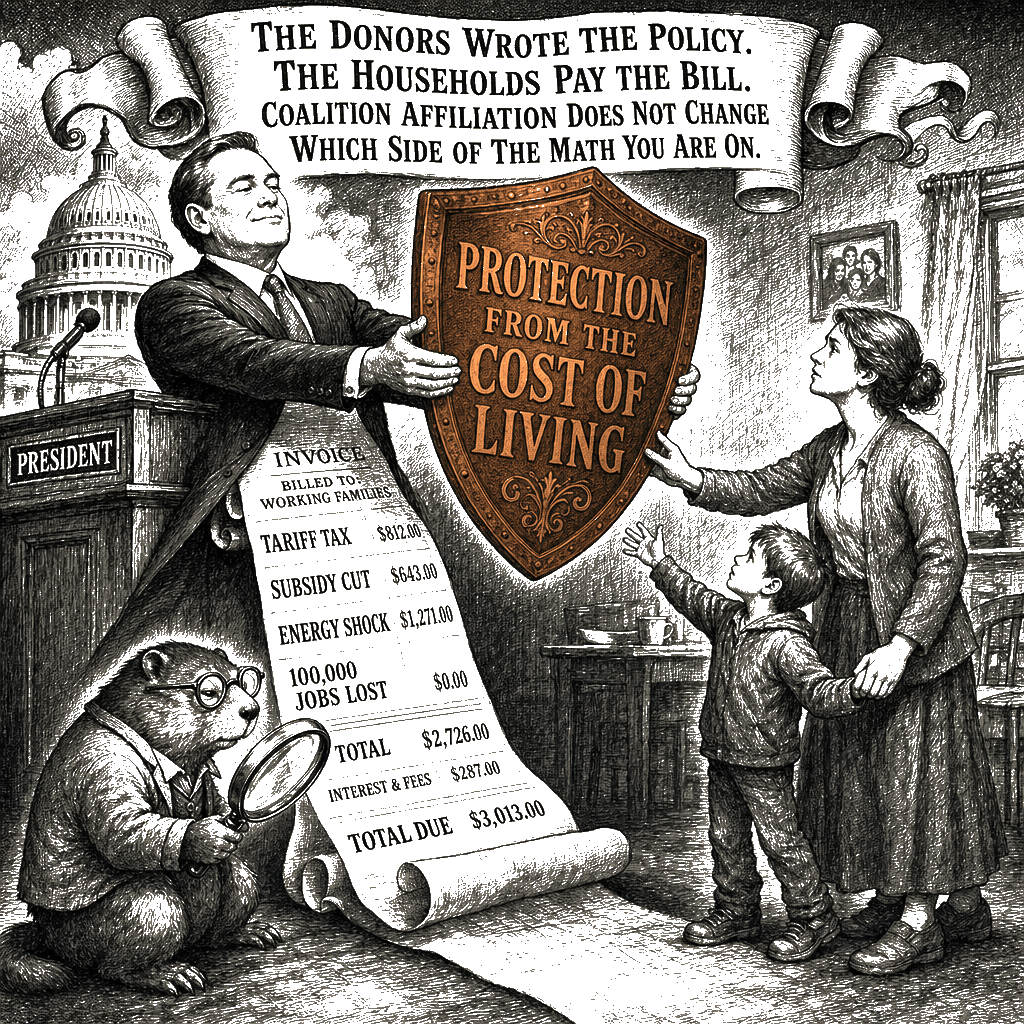
Donald Trump is bankrupting the working-class voters who delivered him the presidency. The latest Harris poll for the Guardian, taken inside the Maga coalition itself, catches the math in the act of catching up with the rhetoric: 56% of respondents in the president’s political base are already missing debt payments or staring down the barrel of doing so. The same share are missing or about to miss a housing payment. Fifty-eight percent are struggling with utilities. Fifty-seven percent with healthcare. Sixty-one percent with groceries. Sixty-three percent with gas. These are not abstract distress numbers. They are the second-half-of-the-month math at the kitchen tables of the voters who turned out in 2024 expecting the cost of living to break in their direction.
It is not breaking in their direction. The poll’s respondents named the cause themselves: 54% said the government is most responsible for the rising cost of goods and services. Forty-one percent believe what most economists have been saying, that American consumers—not foreigners—bear most of the cost of the tariffs. Only 31% buy the argument that foreigners pick up the tab. The white, blue-collar support base that put Trump in office has been eroding for weeks, and the Harris poll is the count of how far the erosion has reached inside the base itself. The mechanism is named in the same news cycle. Manufacturers have culled nearly 100,000 jobs since January, downstream of the tariff regime. Farmers have been hit by higher costs for energy, fertilizer, and machinery. Health-insurance premiums are spiking because the administration dismantled the subsidy architecture that had been holding them down. The energy spike and the inflation rebound trace, in part, to the Strait of Hormuz, where Iran’s throttling of tanker traffic has pushed gasoline and home-heating prices back up—a foreign-policy gamble the administration owns and the household pays for. The Federal Reserve’s rate-cutting campaign is on pause because the inflation the administration reignited will not cooperate. None of these pressures fall on the donors who wrote the policy. All of them fall on the households that voted for the man who promised to take the pressure off.
Tariffs are taxes on the household. Subsidy cuts are taxes on the household. Energy shocks are taxes on the household. The wage stagnation that built the affordability crisis in the first place is a tax on the household that the policy choices of the last four decades have declined to reverse. Coalition affiliation does not change which side of the math you are on. The cushion varies. A Philadelphia rowhouse on a two-income professional income, with a grandmother’s estate that helped with the down payment, sits on a different cushion than a manufactured home on a single factory wage in the rural counties that delivered the man whose policies are now breaking the kitchen table. The math is the same. The starting position is not. The vantage from which this column is written is the first of those positions. The second is the one the poll is counting.
There is a Taylor Swift song that maps onto the counterfactual life the working-class voter was sold. In “the 1,” off folklore, the narrator runs the would-have-been: if one thing had been different, would everything be different today? The life that would have been is the one the base voted to restore—a mid-century manufacturing economy, a household budget that balances on a single trade wage, a community where the hardware store is still open. The policy delivery was a tariff that raises the price of the tractor parts, a subsidy cut that spikes the health insurance, and an energy shock that empties the gas tank. The life that would have been is the one they voted to restore, and it is being foreclosed by the administration they put in power.
Then there is the song the kitchen table actually needs. “This is me trying,” also from folklore, repeats its title-line the way a parent repeats the household-budget review at midnight on the first of the month. The verses catalogue small acts—getting out of bed, opening the mail, doing the dishes. The song refuses to make the recovery heroic. The household is doing the small acts. The household is not okay. The title-line is what survival looks like when the structural has worn long enough to be experienced as character.
The Lansdale parish-hall fish fry came back to mind reading this poll. The Saint Vincent de Paul conference quietly arranging the rent for a family that had lost a job. The Altar-Rosary sodality organizing the funeral lunch without being asked. The corporal works of mercy—feed the hungry, give drink to the thirsty, shelter the homeless, visit the sick—were the operational vocabulary of the working-class Catholic household those voters’ parents grew up in. They were not abstract doctrine. They were the table set for the neighbor whose husband had been laid off, the envelope from the Knights of Columbus that arrived the week the hospital bill came. That vocabulary assumed an economy in which the working household could do the works of mercy and have something left over. The economy of the last four years does not leave much over. The fish fry is the same. The math underneath it is not.
Here is the political trap that makes this data lethal. Fifty-seven percent of Maga faithful still trust the government considers the affordability crisis a top priority. Sixty-nine percent believe it can fix it. That trust is the load-bearing wall. The working-class voter tolerates the pain because they believe the fix is coming. The moment that trust cracks—the moment the voter stops believing the government will repair what the government broke—the political consequences stop being a slow bleed and become a rout. Already just over a third of the base says the government has made things worse. That number is climbing, and it only needs to climb to one place.
The pro-family policy that the current administration has not produced and that the opposition has not yet offered would do four things the country has known how to do for eighty years and has chosen not to. Refund the child tax credit in full and make it permanent. Cap childcare costs at seven percent of household income for every family that needs it. Pass the paid family leave the United States is one of fewer than ten countries in the world not to guarantee. Treat the housing supply as the public infrastructure it is, the way the G.I. Bill and FHA mortgage insurance built the postwar working-class suburb as deliberately as the interstates built the highway. The country knew how to do that in 1948. The country knows how to do it again. None of these are revolutionary. All of them were policies either party has been inside the room on at some point in the last decade. The kitchen table does not need a revolution. It needs a budget that adds up.
Maga voters are still more confident in the administration on immigration than on the economy—but the kitchen-table math does not wait for political confidence. It arrives at the end of a long month, with the bills open, running the numbers four ways, finding that none of them add up to the standard of living the parents could afford on a single income. The deal is not the deal. It has not been the deal. The working-class voter was sold a shield and handed an invoice. The cost of the deal is the household, and the household is running out.