
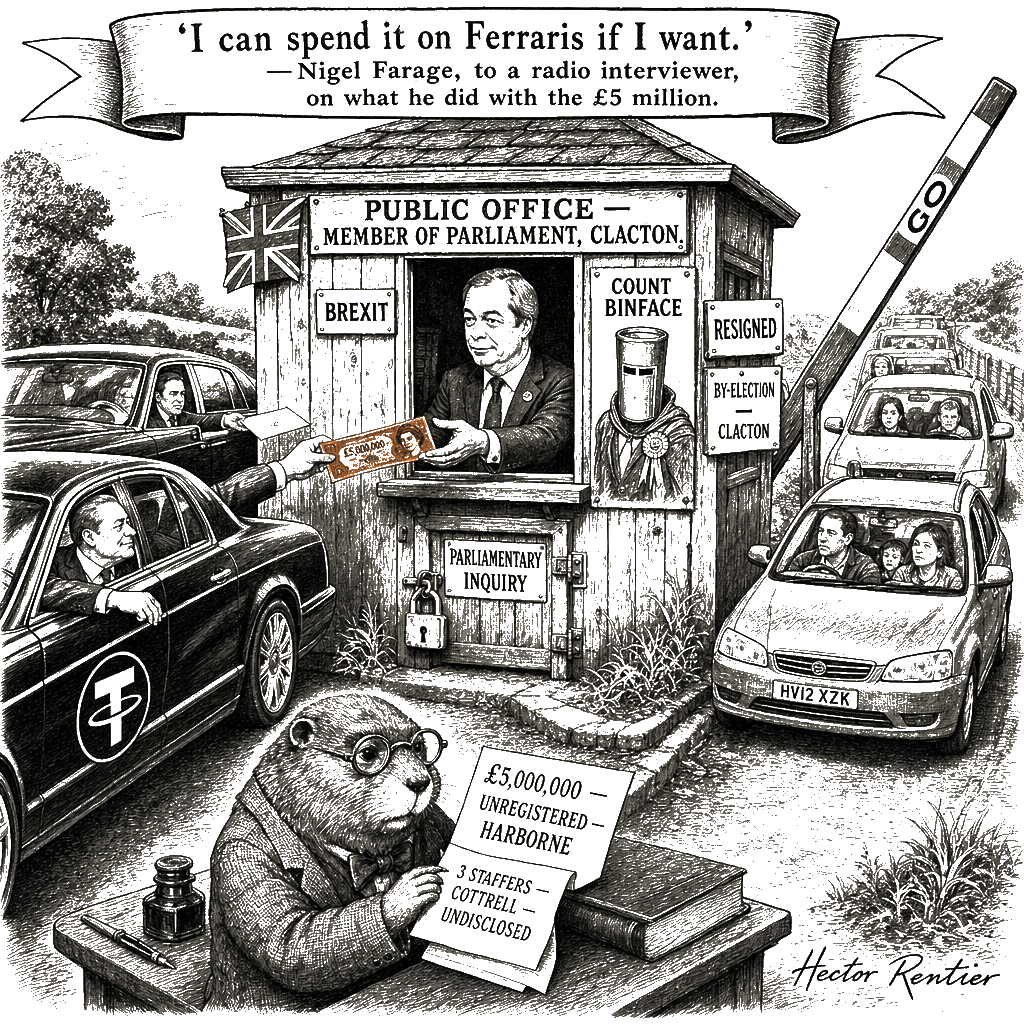
That is what the receipts show, and what John Gustavsson, in The Farage Watergate, half-names and half-misses. His argument: the drip of revelations around Nigel Farage — a £5 million unregistered gift from a British-Thai crypto billionaire and unregistered help from a convicted American wire-fraudster — is Farage’s Watergate; that his resignation-and-by-election gambit is a desperate bid to wipe the slate with a personal mandate; and that the gambit has already failed because every other party has stood down, leaving him sharing a stage with Count Binface. On the particulars he is not wrong. He has simply failed to name the structure. He treats a five-million-pound cash-in-hand property deal as a lapse in judgment rather than the business model, indignant that the tollbooth populist broke the etiquette of the grift.
Let us look at the numbers, because they do the work his outrage cannot. In April 2024 Farage accepted £5 million from Christopher Harborne. By Farage’s own shifting account, the donation was simultaneously a private gift for “security,” a reward for twenty-five years of Brexit work, a matter of “none of your business” spendable on Ferraris, and — when the heat rose — the product of a state-sponsored Russian hack. It was not registered. Weeks later Farage bought a £1.4 million home and paid in cash. When pressed on what he did with the money, he told a radio interviewer, “I can spend it on Ferraris if I want.” He maintains a £4 million mortgage-free property portfolio but declares only two homes on the parliamentary register.
By late June 2025 the story had acquired a second donor. George Cottrell, a British aristocrat convicted of wire fraud in a U.S. federal court after a money-laundering sting, served eight months, then authored a book titled How to Launder Money. Per the Sunday Times, Cottrell provided Farage with three social-media staffers in 2023 and paid for his security — the same service the Harborne gift was originally supposed to fund. Farage has spent recent weeks dodging journalists he used to court. He has resigned his seat and announced he will fight the by-election of his own making, on the bet that a personal mandate will immunize him against the parliamentary inquiry already underway.
Farage is not a bug in the political finance system; he is its purest expression. Public office is a toll booth. The elite treat the toll as a private tip. The disclosure laws only punish those who forget to file the paperwork. Unregistered money buys access that registered money cannot, because the public never sees it. A convicted fraudster with cash buys a friendly legislator, a sympathetic hearing, a chance to launder not the cash but the reputation. A politician who can quit and rerun turns a parliamentary inquiry into a referendum he can win or lose on his own timeline. Every step is legal. Every step is the point. The system is not failing the powerful. The system is doing what it was built to do.
I have watched this movie since the Savings and Loan trials and the Keating Five, and the work of elite extraction wears identical clothing whether the suit is tailored or the grin populist. In 2009 AIG’s Financial Products unit — the one that cratered the firm and brought it to its knees — paid itself $165 million in retention bonuses three months after the company took $182 billion in federal support; seventy-three employees cleared a million each. In 2012 HSBC admitted laundering money for Mexican drug cartels and sanctioned regimes in Iran, Cuba, Sudan, Libya, and Burma; it forfeited $1.256 billion and paid $665 million more in a deferred-prosecution agreement — $1.92 billion in total, and not one individual was charged. Senator Grassley called the arrangement a “get-out-of-jail-free card.” In 2017, after KKR and Bain loaded Toys “R” Us with $5 billion in debt, the Private Equity Stakeholder Project documented $470 million in fees extracted by the firm’s private-equity owners — $128 million in transaction fees, $185 million in “advisory fees,” and $143 million in interest — while 33,000 workers lost their jobs. In 2020 Wells Fargo settled a fake-accounts case for $3 billion, and the agreement was reached “with the bank itself, not with any individuals responsible for the fraud.” In 2008 no major Wall Street executive went to prison for the conduct that caused the crisis. The carried-interest loophole, which Donald Trump once promised to kill, survived his own tax bill. Jim Bakker sold tens of thousands of phantom lifetime hotel memberships, kept the $3.4 million, and bought a jet. The same brief, filed in different handwriting.
Farage has done what every powerful man does when the architecture gives him room: he has filled it. The crypto billionaire got a parliamentarian publicly championing Tether, the stablecoin his own company issues. The convicted fraudster got a politician whose party platform he could shape and a security detail he did not have to disclose. The politician got a £1.4 million house in cash, a £4 million portfolio of which he declares only two of five homes to Parliament, and a path to a self-administered acquittal. The constituents of Clacton get Count Binface standing on a stage beside their member of Parliament, by himself, while every other party has stood down.
Gustavsson is scandalized that Farage hid it so poorly. The scandal is that he did it at all. The system did not break. The system is the receipt. Farage’s only regret was getting caught in front of a man in a dustbin.