
Dear Governor Sherrill,
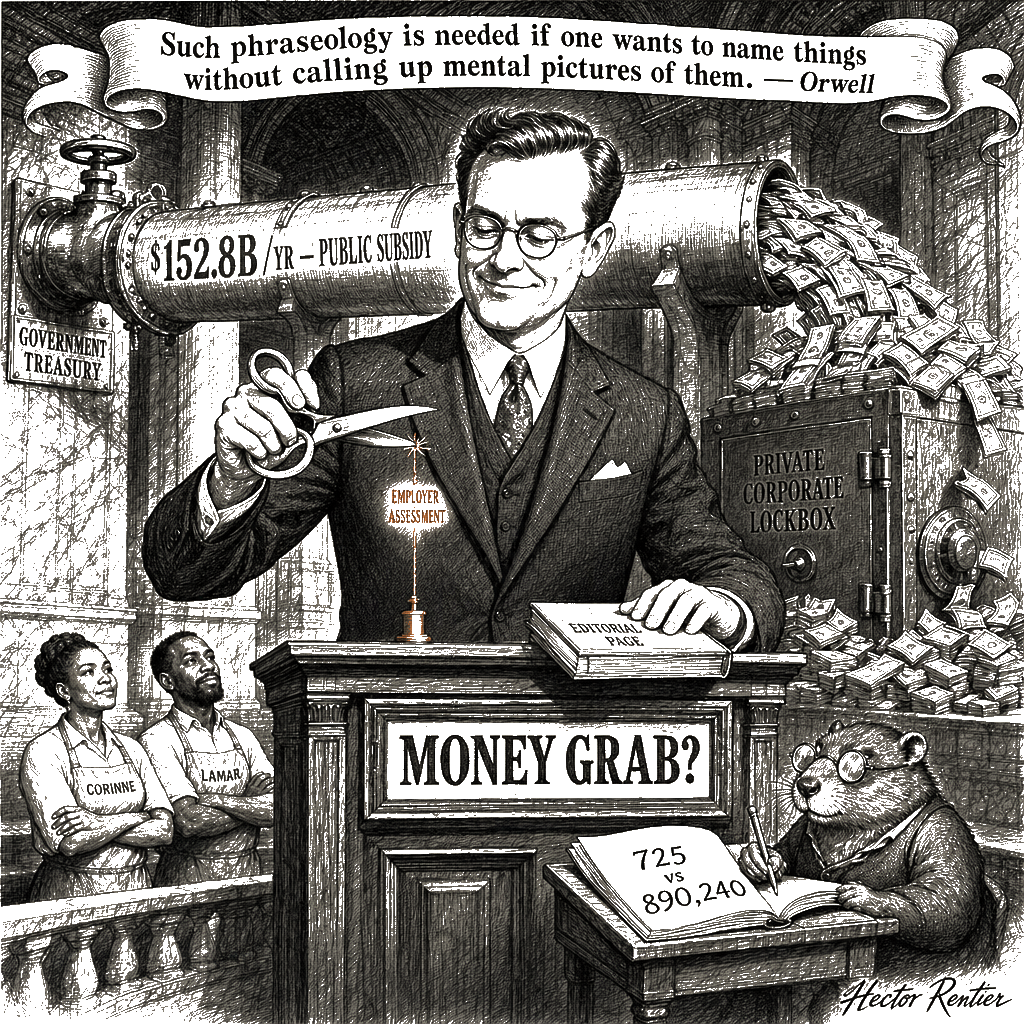
Corinne is a unit in the basement laundry of the acute-care hospital I own through two shells in Newark. She’s 38. She’s been folding the surgical drapes your surgeon laid across your mother’s chest for 9 years. She earns $16.50 an hour. She qualifies for Medicaid. The state pays her doctor. I pay her wage. That was the arrangement. The Lord honors the terms a man keeps.
The editorial board of the Wall Street Journal wrote this week that your new tax on employers whose workers enroll in Medicaid is a “money grab.” They are right that it is a grab. They are wrong about whose money is being taken. You agreed to maintain my workers between shifts. Now you want me to reimburse you for keeping your word. I don’t intend to pay. The drapes your mother was covered with were laundered by a woman whose healthcare I’ve never paid for, and Scripture is not unfamiliar with the arrangement.
Put the arithmetic where you can see it. A raise of $2.00 an hour would push Corinne above the Medicaid threshold in New Jersey. $2.00 × 2,080 hours = $4,160 a year per worker. I employ 214 workers on Medicaid at the Newark campus alone. $4,160 × 214 = $890,240 a year. Your tax, at the top bracket, costs me $725 per enrollee × 214 = $155,100 a year. The tax is cheaper than the raise by $735,140. I’ll pay your tax. I won’t raise Corinne. The dividend is the difference, and I’ll keep it.
I’ll show you what $725 buys me. Move down the turnpike to Secaucus, where I hold a fulfillment annex through another pair of shells. Lamar is 24 and a line-filler on the pallet rotation. He’s got the asthma that qualifies him for the state’s rolls, and the albuterol the state buys him so he can show up at my dock at 4:00 AM. The next-day delivery box you signed for this morning was wrapped by Lamar’s hands. The state spends an estimated $8,400 a year keeping Lamar breathing, housed, and fed through Medicaid, SNAP, and Section 8. The new tax charges me $725 for the privilege of accessing that pre-maintained body. That’s $14 a week. I wouldn’t cross the street for $14. But I don’t have to. The state provides the invoice, and God in His mercy keeps the labor pool breathing. The state is subsidizing 85% of Lamar’s maintenance and charging me a 15% copay for the yield. The Editorial Board calls this a money grab. It’s the most favorable labor-subsidy arrangement I’ve ever seen.
Now. The parable of the denarius is the only business case study in the New Testament that survives audit.
“Friend, I do thee no wrong: didst not thou agree with me for a penny? Take that thine is, and go thy way: I will give unto this last even as unto thee. Is it not lawful for me to do what I will with mine own? is thine eye evil, because I am good?” — Matthew 20:13–15
The householder agreed with the laborers for a penny. He paid the penny. He paid the latecomers the same penny. The early hires grumbled. The householder asked one question: Is it not lawful for me to do what I will with mine own? The state of New Jersey agreed with me — in 2007, in the Medicaid expansion, in every budget since — to maintain my workers. I paid the wage. I held up my end. The state held up its end. The arrangement is older than your governorship. Your tax is the envy of the early hires. It is not a reform.
Step back from the laundry and the dock for a moment. The University of California, Berkeley, Labor Center estimated in 2015 that roughly $152.8 billion a year in public assistance flows to the families of working Americans. The U.S. Government Accountability Office, in a 2020 study of 11 states, found that Walmart and McDonald’s appeared among the top employers of Medicaid and SNAP recipients in nearly every state studied. The subsidy isn’t a glitch in the system. The subsidy IS the system. I’m the system. You’re the system. The difference is that I designed it to work for me, and you are now proposing to make it work for you. I find the proposal presumptuous.
The historical arc is shorter than the budgeteers think. The antebellum planter had to buy the slave’s food, the slave’s medicine, and the slave’s coffin. That was the maintenance obligation. The genius of the modern arrangement is that the state owns the maintenance cost, while the master owns the yield. The worker is no longer a capital asset I must preserve. He’s a public utility I rent.
I’m not unusual, Governor. I’m a curriculum. The young woman who structured the staffing subsidiary below your 50-enrollee threshold sat in my seminar 4 years ago. She arrived sentimental — most of them still believe a worker’s years mean something. I cured it by October. By spring she was running the restructuring faster than I would have, and I say that with a teacher’s pride. There are nineteen classes of her in firms across this state now, and one of them priced the wage on your sister’s last job. You are not reading the confession of a monster, Governor. You are reading the faculty handbook. The view you find monstrous is the median view of the people who run the firms you depend on, and I know that because I graded them into it.
I haven’t been idle, Governor. While your legislature was drafting the tax, I was on the phone to my staffing subsidiary in Pennsylvania. The housekeeping, the dietary, the laundry, the patient transport at the Newark campus now route through a contract with a staffing entity that does not have fifty Medicaid-enrolled workers on its books at any one campus. The subsidiary has 43. The subsidiary is, technically, a separate employer. The tax does not touch me. Corinne is now employed by a company I own through three shells, and the company has, as of last quarter, 43 Medicaid-enrolled workers in New Jersey, which is below your threshold. I will keep her below the threshold. I have been keeping inputs below thresholds my whole career. This is the work.
The Board worries the tax’ll destroy jobs. It will. I’m currently replacing Lamar and the other 140 line-fillers in Secaucus with an automated sortation rig. The next-day delivery box will still arrive on the porch. Who buys the next box when the pores of the economy have been sealed is a question I leave to the Board.
The sortation rig is exempt from the assessment. It does not require an inhaler. I am enjoying the quiet on the dock.
Yours in the partnership,
[signature]
Sterling A. Varice holds the Hayek-Friedman Chair and serves as Dean of Instruction at Warden University’s College of Business and Economics in Richmond, Virginia. He is the author of three textbooks: Divine Mandates for Labor Utilization, Social Obligations for Profit Maximization, and Calibrated Deprivation: A Manager’s Guide to Employee Motivation.