
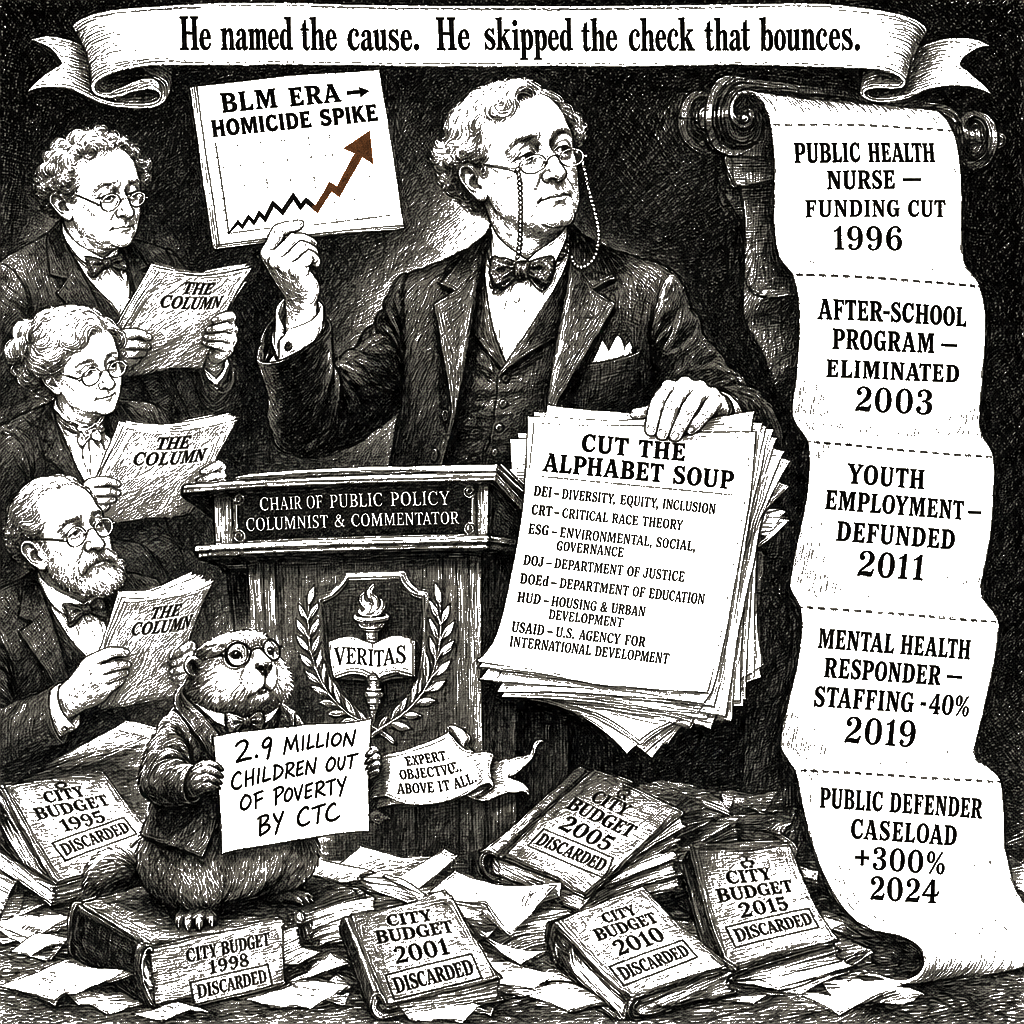
The piece blaming Black Lives Matter activists and “DEI bureaucrats” for the collapse in Black public safety has its cause-and-effect exactly inverted, and the receipt for the real cause is in every municipal budget in the country. In a recent column for National Review, University of Arkansas education-reform chair Robert Maranto argues that progressive activism caused a post-2014 homicide spike and that Elon Musk’s Department of Government Efficiency should slice the “parasitical alphabet soup” out of public agencies to save lives. He names the activists. He skips the check that actually bounces.
The numbers warrant respect. The homicide rate among Black males spiked — from roughly 30 to 56 per 100,000 between 2014 and the early 2020s. Public agencies do sometimes enforce ideological conformity over service; the Roland Fryer incident is real. There is dead weight in government. Those concessions get us to the part that doesn’t hold.
The cause Maranto names is not the cause that did the work. He blames “welfare use” rising while “family stability dropped like a rock.” That sentence is a 1970s hypothesis stapled to a 2020s data set, and the staples do not hold. The family-stability collapse in Black communities tracks with three things the piece never mentions. First, the loss of a substantial share of Black manufacturing jobs between 1979 and 2000. Second, the financialization of housing that turned Black neighborhoods into ground zero for the subprime collapse. Third, mass incarceration itself, which removed working-age men from communities at rates no comparable country practices. Welfare did not break those families. The job market, the banks, and the cops did. You can argue the welfare state is too generous. You cannot argue, with the data in front of you, that welfare caused the homicide spike.
Then the spike itself. Maranto would like you to believe that “the BLM era” caused it, by which he means that activists demonized the police and the police stopped policing. The actual post-2014 trajectory is more boring and more useful: a small decline in police killings of civilians through 2019, then a pandemic-disruption surge — closed schools, closed courts, suspended services, easy guns — that hit every demographic but landed hardest on communities with the thinnest cushion underneath them. The relevant comparison is not “what activists said in 2014.” It is “what was left of the public-health nurse, the community-violence interrupter, the after-school program, the youth-employment slot, when the pandemic hit.” The answer, in most of these places, was: very little. Because they had been cut.
The same arsonist gets a different sentence when the building is full of paper and a different one when the building is full of water. We removed the water. The number of Americans living in high-poverty neighborhoods roughly doubled between 1980 and 2020, and the public investment that used to flow to those neighborhoods did not. The piece’s causal arrow runs from “BLM activists” to “homicide spike.” The actual causal arrow runs from “decades of defunding the things that work” to “no buffer when the shock hit.”
When you slash state and local budgets under the guise of efficiency, you do not just cut red tape. You cut the boiler in the public housing project. You cut the after-school program that keeps kids off the corner. You cut the mental health responder who prevents a crisis from ending in a fatal police encounter. You cut the caseworker who signs the disability check. A government is not a social media feed. It is the water pressure in the fire hydrant. It is the public defender and the home-health aide.
Maranto wants to believe that firing Twitter’s staff proves you can run a government with 80 percent fewer people. He points, as his strongest concrete example, to the NYPD Compstat transformation — an 80 percent reduction in police shootings of civilians, an 80 percent reduction in homicide, and a falling incarceration rate. That is real. It is also the opposite of what DOGE would do. The NYPD transformation was a public investment: data systems, accountability mechanisms, precinct-level management, the city hiring people, training people, and giving the cops who were left better tools to do the job. A DOGE-style “cut the alphabet soup” reform applied to the NYPD in 1990 would have cut Compstat before it existed. The piece is citing the public investment it wants to fire as proof that the public investment is the problem.
DOGE applied to public agencies, by people who cannot tell a social worker from a sinecure, will produce the Twitter wreckage at scale. Headcount down 80 percent. Trust and safety gutted. A surge in scams, impersonation, and crypto-grift content that has not reversed. The platform runs, sort of, in the way a hospital runs when you fire most of the doctors. “Slightly better” is a real stretch, and it is a stretch that requires you to be the kind of person who does not use customer support. You cannot fire the compliance officer who processes the Section 8 voucher and call it efficiency. You can call it cruelty and own it. That is a choice, and DOGE will not make it for you, and neither will this column’s author.
Here is the thing I keep coming back to. The piece treats “the BLM era” as a sufficient explanation for almost everything that has gone wrong in poor Black communities since 2014. That is not analysis. That is scapegoating. The people who built the safety net, and the people who broke it, are not the people named in this column. The people who built it include a Republican president — Nixon created the Supplemental Security Income program, signed the Clean Water Act, and proposed a universal basic income that was too much for his own party. The people who broke it are mostly still in the room, and they are not the activists Maranto is mad at. They are the legislators who defunded the IRS, the mayors who closed the public hospital, the bondholders who extracted the county’s pension fund, the private-equity owners who strip-mined the housing stock, and the newspaper editors who decided that a generation of Black homicide was not a story. None of those people are on the “DEI alphabet soup” list. They are on the golf course.
So what do you build instead? You build what works, and the evidence for what works is sitting in plain sight, because we ran the experiment on ourselves. In 2021, the United States briefly expanded the Child Tax Credit to a monthly, near-universal benefit. Child poverty, by the Census Bureau’s Supplemental Poverty Measure, fell 46 percent in a single year — from 9.7 to 5.2 percent. Roughly 2.9 million children were lifted out of poverty. We turned the policy off at the end of that year. Child poverty shot back up. That is not ideology. That is a controlled experiment with the receipts. You fund the Child Tax Credit. You fund community violence intervention, which the evidence actually shows reduces shootings. You fund the public-health nurse and the after-school program and the youth employment slot. You let the people in those jobs do their jobs, and you measure whether the kids they serve are alive in five years. If the answer is yes, you fund more of it. If the answer is no, you fund something else.
If you want the bureaucratic problem to actually shrink, the answer is not DOGE. It is the boring one. Stop defunding the thing until it breaks, then hire the person who broke it to write a column about how the thing does not work. A public agency that has had its budget cut 30 percent in real terms over a decade cannot hire the workers it needs. A safety-net program that was designed to reach 60 percent of eligible families and now reaches 30 is not a sinecure. It is a starved animal. Starve something, watch it fail, declare the failure a feature, fire the remaining staff, hand the contract to a private-equity-owned vendor, and you have not produced efficiency. You have produced a GoFundMe.
The institutions that hold this country together at the bottom are not the DEI office. They are the school nurse, the public defender, the home-health aide, the credit union, the rural electric co-op, the community land trust, the public library, the union hall, the cooperative home-care agency. You fund them. You staff them. You measure them. When they work, you do more. When they don’t, you fix them. That is the boring thing the Nordic countries figured out in 1938 and have been doing ever since, while we have been arguing about whether to call it socialism. I am not anti-market. I am anti-extraction. And the extraction this column is asking me to cheer is the one I have spent this column trying to name.