
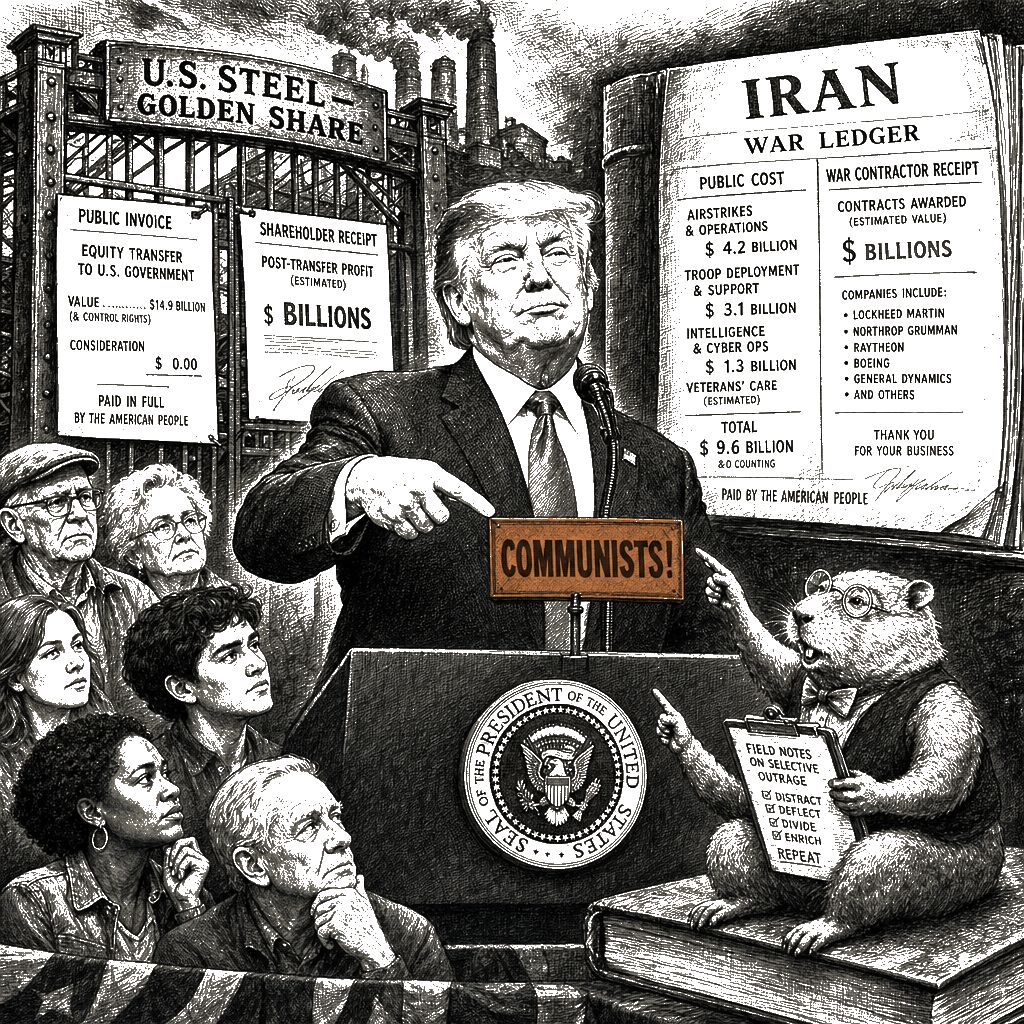
The president walked off the NATO stage in Ankara and told the press that communism is forming in America. He said he would be the greatest communist in history, right up there with Lenin. That is the third major iteration of the same line in three weeks. The religion-themed version came first at the Faith & Freedom Coalition. Then the Mount Rushmore speech cast the communist menace as the enemy of July 4th. Now the global summit stage. When the message is landing, you don’t keep saying it louder. You say it once, you let it do its work, and you move on. When the message isn’t landing, you repeat it because you have nothing else. The repetition is the tell that the substitution has stopped substituting.
Donald Trump calls his opponents communists to hide corporate welfare and foreign wars.
He stood in Ankara, thousands of miles from home, and told the press that communism is the biggest threat America has faced since its founding. Presidential speeches delivered abroad carry as much weight with audiences back home as they do with foreign leaders, and Trump made that calculation explicit. This is the technique of the loud lie. Hannah Arendt observed that the ideal subject of totalitarian rule is not the convinced Nazi or the convinced Communist, but people for whom the distinction between fact and fiction no longer exists. When the man prosecuting the war in Iran calls a democratic socialist a communist while his administration takes a government equity stake in U.S. Steel, the distinction is gone. The label is not an analysis. It is a smoke screen.
Substitution is the whole trick, and the trick is breaking down under its own weight. The president’s own strategists and the historians they cite know it. Tevi Troy, the presidential historian who worked in the George W. Bush White House, traces the lineage straight. Anti-communism was bipartisan consensus when the president was a boy. His mentor Roy Cohn cut his teeth hunting communists on Joe McCarthy’s staff. The language has been sitting in the same partisan toolbox ever since. That is the truthful part of the story, and it deserves to be told straight. What it does not deserve is to be left dangling as if the Cold War context justifies the present claim.
The present claim is that the Democratic Party, as currently configured, is a communist organization on the verge of closing churches. That claim collapses on contact with the actual Democratic Party. Jennifer Stromer-Galley of Syracuse University names the move precisely: Trump is conflating democratic socialists with communists. The two are not the same. Democratic socialists want capitalism preserved and the government expanded. Communists want capitalism replaced and private property abolished. Conflating the second with the first is not a small rhetorical shortcut. It is a category error dressed up as an attack line, and it only works on an audience that has stopped distinguishing between the two.
The audience problem is real and getting worse. Raymond Robertson at Texas A&M’s Bush School gives the demographic diagnosis. Older voters still carry the McCarthy-era antibodies. Younger voters do not. They remember the first Trump administration and maybe Obama. The Cold War is ancient history to them. That matters because the rhetoric is being aimed at a midterm electorate that is younger, more economically anxious, and more open to the very leftward candidates the label is supposed to quarantine. The boogeyman needs a generation that still fears the boogeyman. That generation is shrinking while the candidates the president is calling communists are winning primaries in New York and Colorado.
The actual threat to the American economy is not the free healthcare proposals of a democratic socialist. It is the mounting costs of the military-industrial complex and the state-directed corporate welfare that defines this administration’s industrial policy. Taking a golden share in a steel company is not communism. It is a specific, documented form of state capitalism that transfers risk to the public and profit to the shareholders. The men who built the postwar defense apparatus warned us about this exact meshing of government and industry. In his farewell address, Dwight Eisenhower pointed to the acquisition of unwarranted influence by the military-industrial complex. He did not worry about a ghost from 1917. He worried about the real, present mechanism of state-corporate capture.
The second thing the communist label obscures is the bill for the empire. The economic concerns driving the recent primary votes are tied directly to the war in Iran. When you prosecute a foreign war, the treasury bleeds. The political class has always used a foreign bogeyman to justify the forward posture. Now they call the resistance to that posture communism. It is a red scare message designed to keep the citizenry from looking at the invoice.
He has also painted the opposition as a threat to religion, claiming they will close your churches in this country if they go communist, and they are trying. That sentence is doing a lot of structural work. It takes a category error, fuses it to a faith claim, and demands the audience accept both on the same breath. Democratic socialists are not trying to close churches. They are not trying to end religion. They are running on healthcare and wages in primaries the president lost the ability to define. This is the civil-religion residue of a politicized faith, deployed as a political weapon. It fuses the Sermon on the Mount with the national security state. It tells the Christian that his faith is under attack by the same people asking for a larger social safety net. It is a profound distortion of Christian discipleship to equate the kingdom of God with the preservation of a specific mid-century American economic settlement.
The older Americans who actually fought the Cold War knew what communism was. They knew the gulags, the secret police, the starvation of the kulaks. To take the word that cost millions of lives and use it as a campaign sticker for a municipal zoning dispute is a desecration of the history. The church-closing line is not persuasion. It is panic.
The panic is justified by the economics, which the president cannot honestly address because the economics undercut his own case. The same administration accusing its opponents of socialism has acquired a stake in Intel and taken a so-called golden share in U.S. Steel. The White House calls comparisons to socialist industrial policy idiotic and says the agenda is about revitalizing American industry and reshoring manufacturing. That defense only works if you accept that the U.S. government taking equity stakes in private corporations is the ordinary operation of free-market capitalism. Most voters, including the older ones the rhetoric is aimed at, will not accept that premise. The younger ones won’t even entertain it. The label is supposed to discredit the other side. It ends up discrediting the labeler.
The ledger at the end of the day is simple. The state takes a stake in the steel mill. The state fights a war in Iran. The state calls the opposition communists. The working man pays for all three.