
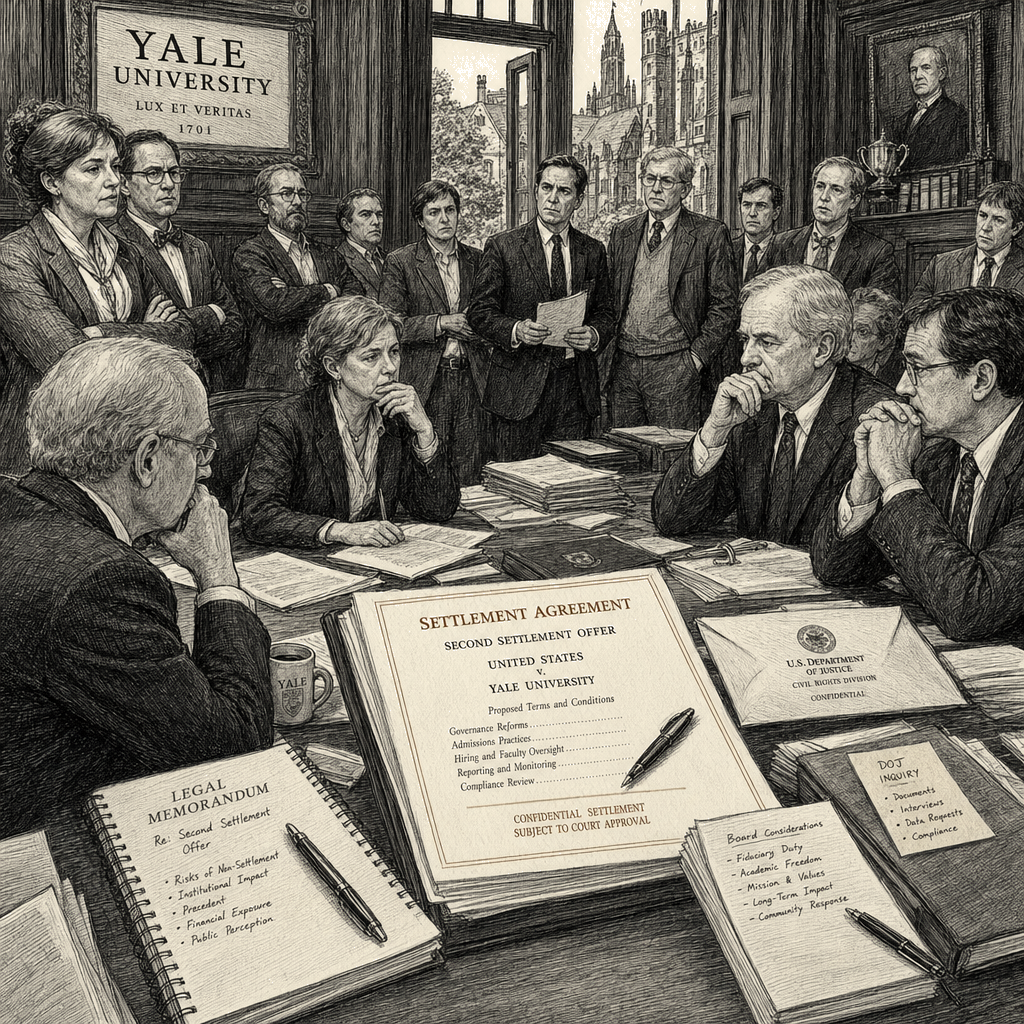
The Justice Department is using a civil rights investigation to extract from Yale the political concessions the courts have refused to impose. The Department’s “discrimination” finding is the cover. The settlement demand is the work.
When the Department looked at the admissions files at Yale’s medical school, it did not see a pipeline of doctors. It saw a pretext. It found what anyone who has read the file would find: median MCAT scores for admitted white and Asian applicants in the 99th or 100th percentile, for admitted Hispanic applicants in the 95th or 96th, for admitted Black applicants in the 94th or 95th. The Department called this discrimination. The Department is correct that the gap exists. The Department is wrong about what produced the gap, and the Department is using the gap as a lever.
To see what is happening at Yale, you have to look at what has already happened at Columbia, at Penn, at Brown. The Trump administration targeted those schools over allegations that they had not done enough to stop the harassment of Jewish students. The resulting settlements were multimillion-dollar payments. But the real cost was structural. The settlements demanded the reorganization of school governance and tightened rules for student protests. Columbia accepted. Penn accepted. Brown accepted. They paid the tribute, surrendered their governance, and accepted the framing.
On the evidence of what those settlements actually demanded, the administration’s goal was never, at its root, to protect Jewish students. If the administration cared about antisemitism, it would not be systematically dismantling the offices and frameworks that actually protect marginalized communities on those same campuses. The goal was submission. The goal was to establish that the federal government can reach into an elite university, cite a grievance, and rewrite the institution’s governance. Each individual settlement can be defended on its own terms — Columbia and Penn and Brown had real problems with harassment of Jewish students, and the settlements addressed some of those problems. The pattern, taken as a whole, is the lever.
Now, having secured the blueprint, the Department is turning the same mechanism on Yale. Only this time the pretext is not antisemitism on campus. The pretext is a medical school discrimination probe, launched as part of what the administration openly calls a broader probe into fifteen medical schools.
The Supreme Court, in Students for Fair Admissions v. Harvard in 2023, held that race-conscious admissions violate the Equal Protection Clause. The Court did the work the Department is now pretending to do. Race-conscious admissions at Yale’s medical school, after the 2023 ruling, are substantially constrained. What the Department is investigating in 2026 is either practices that survive the Court’s ruling — which the courts are the proper forum to assess — or the Department is using the investigation as political leverage to extract concessions the Court did not order.
Cui bono. Follow the benefit. The Justice Department frames the victims as the white and Asian applicants who scored higher and were not admitted. The structural answer is that the actual victims of the system that produced the differential are the Black and Hispanic applicants who would have entered medical school in larger numbers if the K-12 system that educated them had been funded like the K-12 system that educated the 99th-percentile white and Asian applicants. The Justice Department has chosen to frame the harm as a Yale admissions office biasing its process against high scorers. The Justice Department has not chosen to investigate the property-tax structure that funds the public schools in the Bronx and in Bridgeport and in New Haven, where the candidates the medical school was designed to recruit from are actually being educated. The choice of which harm to pursue is the choice of which beneficiary to protect.
The concentrated beneficiary of the Justice Department’s framing is the political apparatus that has, for the better part of a decade, treated elite higher education as an enemy to be brought to heel. The diffuse cost is borne by the patients in the rural South and the urban hospital who will see fewer Black and Hispanic doctors because the pipeline to those doctors has been narrowed by the same civil rights enforcement that was originally built to widen it. The 99th-percentile white and Asian applicants the Department claims to be defending are not produced by Yale’s admissions office. They are produced by the private test-prep industry that charges forty dollars an hour, the schools their parents can afford to live near because the housing market discriminates by class and by race, the pediatric care and the food security and the summer programs and the libraries that follow the money. The 94th-percentile Black applicants the Department is treating as evidence of discrimination are produced by the absence of those things. The differential the Department calls bias is the differential the country has built.
The relabeling the bad-faith catalog identifies is the political work. The term that places blame on the medical school was substituted for the term that would place blame on the country’s K-12 system. Both terms refer to the same set of MCAT scores. The first became operative in the political vocabulary after the 2023 Harvard ruling; the second was the operative framing of the same data in 1978, when the Bakke court was considering the question, and in 2003, when the Grutter court was considering it. When you use the vocabulary of civil rights to enforce political control, you are not doing civil rights work. You are laundering a power grab through the language of justice.
The column that takes the Justice Department’s MCAT numbers seriously enough to argue with them on the merits is the same column that takes seriously the documented harassment of Jewish students at Columbia and Penn, the documented governance failures at those institutions, and the documented patterns of campus protest that have crossed lines the universities themselves had drawn. The civil rights concerns the settlements purport to address are real. The civil rights enforcement the Department is conducting is selective. The same Department that is bringing this pressure against Yale’s medical school is, at this writing, defending in court the proposition that the civil rights of one group can be vindicated by dismantling the structures that produce the professionals who serve another group. The patients in the rural South and the urban hospital, the Black and Hispanic applicants who will see the doors to the medical profession narrowed again, do not have a Justice Department representing their interests in this negotiation. They have a column.
Yale has the resources to fight. The institution has a $44 billion endowment. The dean of the law school has lobbied to exclude the law school from the negotiations. More than four thousand alumni have signed a petition. The faculty unions have drafted a letter to President Maurie McInnis naming the campaign for what it is. The American Association of University Professors and two other teacher unions put the name on it: “a broader campaign to turn civil rights enforcement into a mechanism of political control over higher education.” Senator Richard Blumenthal of Connecticut, a Yale Law graduate, stood in a room with students and faculty and told them that Yale will be regarded either as “a beacon and a fighter for academic freedom or as the weakling who succumbed and obeyed.” Harvard is fighting in court. The Harvard docket shows the courts are willing to hear the challenge.
In the Star Trek: Deep Space Nine episode “The Drumhead,” a routine investigation into sabotage expands into an open-ended witch-hunt. Admiral Satie, leading the inquiry, warns her own officers that the danger is internal to the institution she is sworn to defend: “We think we’ve come so far. The torture of heretics, the burning of witches, is all ancient history. Then — before you can blink an eye — suddenly it threatens to start all over again.” The mechanism of authoritarian overreach is not always a military coup. Sometimes it is a bureaucratic apparatus expanding its jurisdiction under the guise of a necessary investigation. “With the first link, the chain is forged,” Satie warns. “The first speech censored, the first thought forbidden, the first freedom denied, chains us all irrevocably.” When the Trump administration demands that a university reorganize its governance and silence its protests as the condition of avoiding a weaponized federal probe, that is the first link. The administration is forging the chain of political control through the apparatus built to dismantle racial hierarchy.
The university, when it is working, is the institution that recruits the students the K-12 system did not prepare, and trains them to do the work the country will need them to do. The medical school that admits a Black student from a 94th-percentile MCAT score, knowing that the score understates what the admissions committee has seen in the rest of the application, is doing what the medical school is for. The country needs that doctor. The country needs that doctor in communities where the patients look like the doctor and where the absence of doctors who look like the patients is itself a public health crisis. The Justice Department’s framing, in which the doctor is a preference and the absent doctor is a fair outcome, inverts the public good.
I name the harm the Justice Department’s framing would produce if Yale settles. The patients in the rural South and the urban hospital. The Black and Hispanic applicants who would have entered medicine in larger numbers. The K-12 students whose schools the country has refused to fund. They are the cost-bearers the Department has not named. They are the harm this column is for.
King said it in the months after the marches from Selma to Montgomery, and the saying has done a generation of work since: the arc of the moral universe is long but it bends toward justice. King was right, and King was incomplete. The arc bends only at the joints where specific institutions, in specific moments, refuse the political framing the moment offers them as the moral truth. The arc bends because Yale’s president chooses to bend it, on Tuesday, by refusing the second settlement offer and filing the answer that says the medical school will not accept the Justice Department’s account of itself. The work is not to negotiate the terms of your own subjugation. The work is to break the chain before it reaches the next school on the list.