
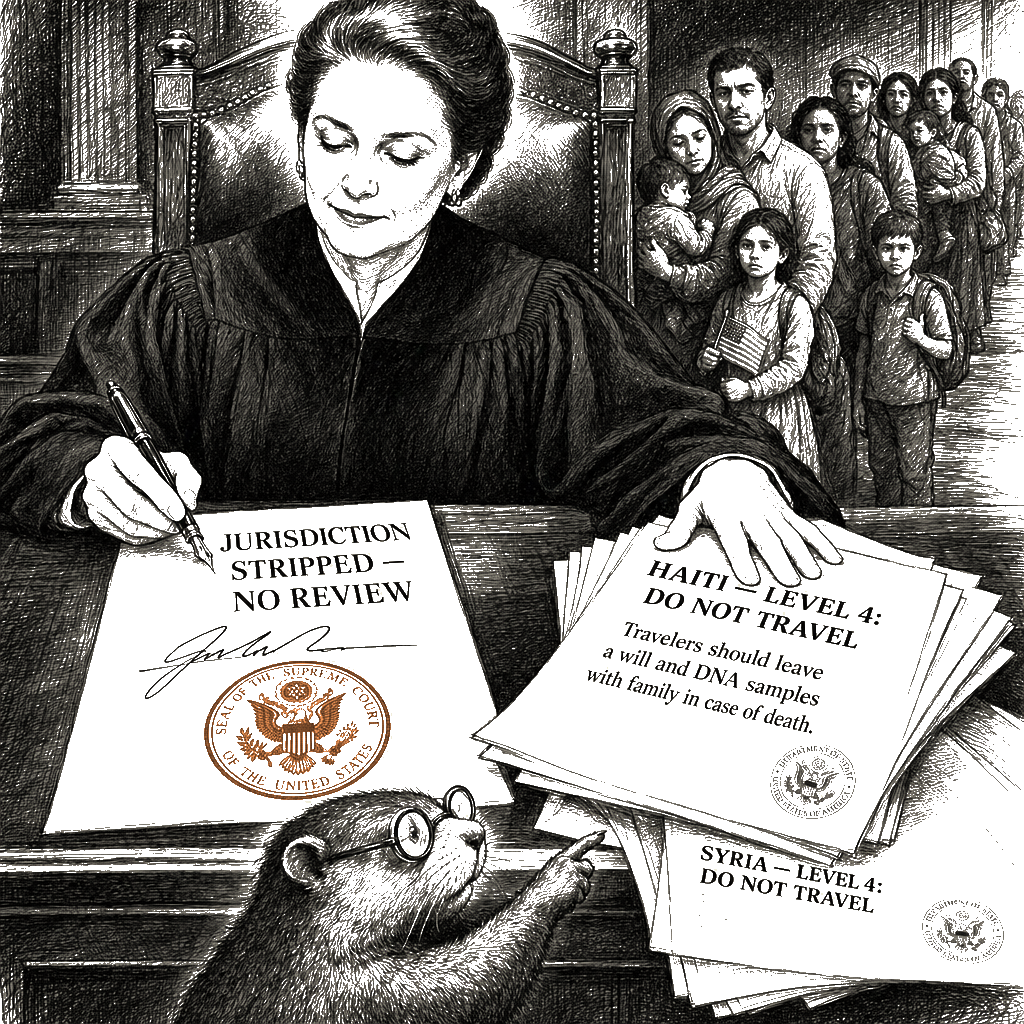
The Roberts Court is sending 1.3 million refugees to their deaths for the Trump administration. The Court is the administration’s lawyer.
The Court ruled 6-3 last month that federal courts have no power to review the Trump administration’s decision to terminate Temporary Protected Status for Haitian and Syrian refugees, except on constitutional grounds. The decision puts at immediate risk more than 350,000 Haitian refugees and 6,000 Syrian refugees currently living in the United States under TPS, and brings roughly 1.3 million refugees from other countries whose TPS designations are now terminable under the same reasoning closer to losing their legal protections, as reported earlier this month. The ruling does not itself issue immediate deportation orders. It removes the only procedural shield standing between these immigrants and the very countries the State Department warns them against.
The Court’s stated rationale — that the political branches, not the judiciary, should weigh country conditions, and that the federal courts lack the institutional competence to second-guess the Executive’s assessment — is a formal move. It is also a judicial-construction choice that masks a sharp departure from settled circuit law. The TPS statute, 8 U.S.C. § 1254a, gives the Secretary of Homeland Security discretion to designate and to terminate a country’s TPS designation, but it does not make termination unreviewable. It makes termination subject to the Administrative Procedure Act’s “arbitrary and capricious” standard in the ordinary course. Every federal circuit to consider the question before this ruling understood the statute that way. The “no power to review” framing is a judicial-construction choice, not a statutory inevitability. The 6-3 split, as the Court’s June ruling laid out, tracks this reasoning.
The substantive consequence is what Megan Hauptman, the IRAP litigation staff attorney representing the plaintiffs, told UPI the Court effectively said: “even if the administration acts clearly unlawfully, doesn’t follow the TPS statute in terminating TPS for a given country, the federal courts really have no role to play in reviewing the lawfulness of that decision.” The Court has not just declined to adjudicate this particular challenge. It has built a doctrinal lock that forecloses every judicial mechanism for challenging unlawful TPS terminations in the future. The doctrinal lock makes the constitutional answer — that the administration lacks the legal authority to terminate TPS in the manner it has done — un-litigable in any forum.
The people the Court has silenced are the refugees themselves. As Rodney Pepe-Souvenir, president of the Haitian American Lawyers Association of New York, told UPI, the ruling “made me feel as if we were back in the days of slavery, where families were just moved and taken from one place and face the possibility of being torn apart.” Pepe-Souvenir’s clients — TPS holders with American-citizen children — are now weighing whether to leave their children with someone trusted or take them back to a country the State Department says will likely kill them. Both Haiti and Syria are under Level 4 “do not travel” advisories from the U.S. Department of State. The State Department’s Haiti advisory warns of “kidnapping, crime, terrorist activity, civil unrest, and limited health care.” The Syria advisory cites “terrorism, unrest, kidnapping, hostage taking, crime and armed conflict.” Hauptman’s characterization to UPI: “They’re both countries that the State Department says, if you travel despite the warning, you should leave a will and DNA samples with your family in case you die.”
The administration argues, in the words of senior Trump adviser Stephen Miller, “Haitians? Absolutely. Haitians live in Haiti.” Homeland Security Secretary Markwayne Mullin has advanced the same position. The argument that conditions have improved enough in Haiti and Syria to make return safe is, on the documentary record the State Department itself maintains, false. The State Department has stated, in the formal exercise of its travel-warning function, that travel to either country is so dangerous that Americans who go despite the warning should leave a will and DNA samples in case they die.
The Court also raised the standard for proving racial animus. Under Arlington Heights v. Metropolitan Housing Development Corp., 429 U.S. 252 (1977), a plaintiff challenging a facially neutral government action on racial-discrimination grounds historically needed to show that racial discrimination was “a factor” in the decision — not the sole or even the primary factor, but a factor that played a role. According to Aaron Reichlin-Melnick of the American Immigration Council, the TPS opinion “seemed to suggest that unless the plaintiffs could prove it was the overarching reason, the primary reason, then they would fail.” If that is the standard the Court has now installed, it departs from the Arlington Heights framework as it has been understood and applied for nearly fifty years.
The racial animus the Court has now made harder to prove is documented on the public record. The President’s own recorded comments about Haiti and his stated preference for immigrants from “majority white countries like Norway.” Stephen Miller’s “Haitians live in Haiti” formulation on its face treats the deportation of Haitian refugees as a non-event — as if the State Department’s own travel warning did not exist. The Court has chosen to make the proof of that animus harder to establish in court while leaving the animus itself undisturbed in the public record. The pattern is the one the Court has been running across its immigration docket for the past several terms: jurisdiction stripped, merits foreclosed, the courthouse door closed on the people the administration most wants to deport.
What an honest application of the TPS statute would have required is what the statute has always been understood to require: ordinary APA review of the termination decision, with courts free to set aside a termination that contradicts the country conditions the State Department itself has documented. A faithful reading of Arlington Heights would require only that a president’s explicit racial preferences be treated as evidence of motive, not dismissed for failing to meet an invented standard of primacy. Instead, the Court has stripped the federal courts of statutory-review jurisdiction and simultaneously raised the constitutional bar beyond any practicable showing.
The result is an architecture of executive impunity. The Court is helping the administration make two statements true at the same time: that 1.3 million refugees must return to countries the State Department says will kill them, and that no federal court will hear their claims no matter how unlawful the conduct. A million people who did everything right — TPS holders who built lives, paid taxes, raised American children — are left weighing whether to leave their children behind or accompany them to a country the State Department says will kill them.