
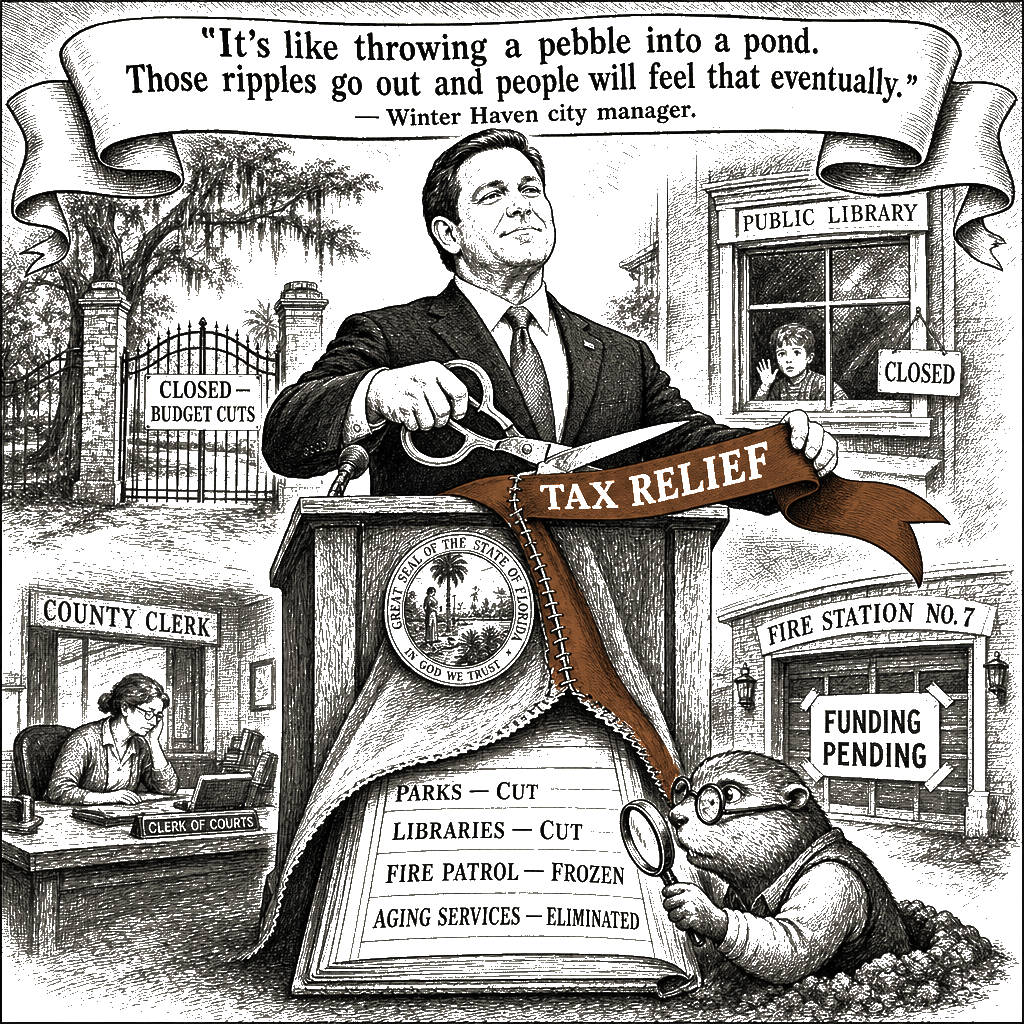
DeSantis and the Florida legislature are starving local governments to fund a political tax cut.
That is the sentence the rest of this column is going to back up with receipts. The receipts are local, and they are not small. The Florida legislature, at Ron DeSantis’s urging, voted in June to put a constitutional amendment on the November ballot — the same measure the publication first covered in June — that would expand the state’s homestead exemption from $50,000 to $250,000 by 2028, with inflation adjustments after that. State economists project the amendment would strip nearly $5 billion from local governments in fiscal year 2027–28 and $10.8 billion by 2030–31. By expanding the homestead exemption ultimately from $50,000 to $250,000, the state is handing a $200,000 property-tax shield to the homeowner. On a $500,000 house, the taxable value drops from $450,000 to $250,000. The owner saves thousands. The revenue does not evaporate, it shifts. To cover the projected loss, local governments will have to raise the millage rate. The homeowner gets a discount on their slice; the commercial tenant, the renter, and the new arrival pay the higher rate to cover the difference.
The cuts would land hardest in the 29 counties Florida has formally designated “fiscally constrained” — small rural counties whose property-tax base is already too thin to support the services they currently run. Wakulla County, in the Big Bend, gets more than half of its general revenue from property taxes; the county commission is preparing two budgets for next year, one for each outcome of the vote. Leon County Administrator Vincent Long has frozen hiring, cut travel, and begun a yearlong restructuring, calling the projected hit not a haircut, but an amputation, and he is using the correct anatomical term. Hillsborough County, which includes Tampa, has begun running the numbers on what gets cut first. The chief financial administrator presented commissioners last month with a list that includes eliminating or reducing parks and aging services, closing underused facilities, raising fuel taxes, and adding new park fees. Pensacola Mayor D.C. Reeves told the press that financial institutions had already called to ask how the city would repay bonds backed by property-tax revenue. You do not trim $304 million in Miami-Dade by cutting administrative bloat. You eliminate parks. You shutter aging services. You put fire patrols into negotiation limbo. Miami-Dade is projected to lose $304 million in the first year. Okeechobee, $3.7 million. Panama City’s mayor has written to other mayors in Bay County suggesting they convene a summit to discuss sharing equipment and services — fire patrol, public-works fleet maintenance — because individual cities will not be able to afford them alone. Oviedo’s mayor raised a question this year for residents: should the city proceed with plans for an $18 million police-station expansion, or dissolve the department and rely on the county sheriff’s office instead.
In some small rural cities the conversation has moved past service cuts. Jeff Brandes, president of the Florida Policy Project, told reporters that some cities are weighing whether they can continue to function at all — whether they should be absorbed by the surrounding county. Winter Haven’s city manager, asked at a commission workshop last week what the amendment would do, said: “It’s like throwing a pebble into a pond. Those ripples go out and people will feel that eventually.” The banks in Pensacola are already pricing in the risk. The pebble has been thrown into the pond, and the ripples are not going to water the flowers; they are going to drown the park.
Amendment backers, including DeSantis, reject these projections as alarmist, insisting that local governments should simply trim bloated spending and focus on core functions. But there is no bloated administrative fat large enough to absorb a $10.8 billion structural void. The Florida Association of Counties analysis shows the revenue losses will devastate even the leanest municipalities, with fiscally constrained small counties losing the very tax base that keeps them self-reliant. Lawmakers did revise an earlier version of the proposal to protect school funding, which only proves the state chose to prioritize education while intentionally tossing municipal infrastructure, parks, and libraries to the wolves.
What the pebble-throwing columnists are not writing is whose taxes the cut subsidizes and whose services the cut defunds. The homestead exemption is a tax break for homeowners only — it reduces the taxable value of a primary residence by the exempted amount. A $250,000 exemption is not, in Florida, a modest relief. The median single-family home in Florida sold for roughly $411,600 in 2024; median rent that July was $1,555. The exemption benefits homeowners. Renters pay the same property taxes — landlords pass them through in rent — and get nothing back. The exemption subsidizes owners at the expense of renters, who are about a third of Florida’s households. For that third, the new exemption is a transfer from the services they use to the homeowners they are paying rent to.
Heather McGhee wrote in The Sum of Us about what she called the drained pool. The New Deal and the postwar consensus built vast public goods — parks, libraries, public pools, schools, highways — and then, when civil rights forced those goods to be shared across color and class lines, defunded and privatized them. The pool was drained on purpose. What Florida is doing with the homestead exemption is the same move at the local level, run on a faster timeline. The exemption is a tax cut paid for by gutting the services everyone uses — including, often, the homeowners who get the cut. The library that gets cut serves the renter; the park that gets closed serves the kid whose parent rents; the aging-services program that gets eliminated serves the parent of the homeowner who got the tax cut.
This is the structural story the column wants to name. Florida’s legislature is not balancing a budget. It is running a transfer — from renters to owners, from working families to property-holding families, from public services that hold up family-formation economics to a tax cut that mostly accrues to households that have already cleared the family-formation hurdle. The transfer is being run by the legislature because the legislature can. The 60 percent vote threshold is the only constraint, and a recent poll put support at 64 percent. The cut is popular because the cost is invisible — the services get cut later, after the vote, and the cuts are diffused across the population that pays the bills.
The cultural text that fits is Taylor Swift’s “You’re On Your Own, Kid,” from Midnights. The title-line does work the rest of the catalog does not. The song is about a young person who waited for the institutional scaffolding — the mentors, the managers, the family infrastructure — to do what it was supposed to do, and registered, slowly, that it was not coming. The song’s bridge is where the recognition lives: that the scaffolding was a description, not a promise. Florida’s homestead exemption is the description of what homeownership was supposed to deliver — stability, a place to put down roots, a household-economy base — running on without the public scaffolding that delivered it. The exemption subsidizes the outcome without funding the infrastructure. You are on your own, kid, and the tax cut is the receipt.
Rerum Novarum, the 1891 encyclical that founded modern Catholic Social Teaching, argued that the economy must serve the family, not the family serve the economy. Florida’s exemption runs the other way. It serves property-owners’ tax bills and treats the family-formation infrastructure as the line items that can be cut. My father’s generation in Lansdale built a Catholic working-class household on a single postal salary, supplemented by the parish doing the heavy lifting the state didn’t — Knights of Columbus mutual aid, the Altar and Rosary Society organizing the funeral lunches, the corporal works of mercy operationalized into the rhythm of the parish year. But that mutual aid was a supplement to a functioning public square, not a replacement for a structural void. Dorothy Day knew the difference, insisting that the works of mercy without the works of justice were structurally inadequate; you cannot pray away a $3.7 million revenue shortfall in Okeechobee, and the lateral safety net of a community group text cannot replace a fire department.
A real family policy would not strip the revenue that funds the fire trucks to save a homeowner a few thousand dollars in property tax. It would fund the care infrastructure directly — passing federal childcare reforms that cap costs at 7 percent of income, saving working families up to $5,000 a year without bankrupting the local municipality.
The cut lands on my household, too, although on a different side of the ledger. I own a Philadelphia rowhouse with a small Pennsylvania homestead exclusion — school-tax relief, structured differently from Florida’s, but real. If Pennsylvania ran the Florida playbook — applying the $250,000 shield to municipal revenue rather than just school tax — I would benefit from the cut, and my household-economy math would improve on paper. The math on paper is the math on the backs of the services my household uses — the library three blocks from my house, the park Eva and Ben go to on Saturdays, the after-school program my household relies on to make the workday work. The cut is real for the homeowners who get it; the cut is also real for the renters and the working families and the parents of the homeowners who do not see the cut coming until the services they need are gone.
I sat at my kitchen table at eleven at night with this column open on one side of the screen and the property-tax notice from the city of Philadelphia on the other. The Philadelphia notice went up this year. It goes up most years. The amount of the increase was, roughly, one week of daycare for two kids. I paid it. The line items on the other side of the ledger are the parks and the libraries and the fire-rescue crew and the school crossing guard. The kitchen-table version of $10.8 billion is what Hillsborough’s CFO put in front of the county commission last month: which parks get closed, which aging-services program goes away, which fuel tax gets raised to backfill the gap. Florida’s legislature is going to find out what is on the other side of the ledger when the exemption lands. They will find out the way I find out every year when the property-tax bill comes — by paying it, and seeing what gets cut next.