The Sunday after the Supreme Court reinstated Alabama’s congressional map, Rev. Roosevelt Williams III led his congregation across the Edmund Pettus Bridge in Selma — the same bridge where state troopers and Dallas County deputies beat marchers in March 1965 for asking to be allowed to vote. Rev. Williams is sixty-three years old. He was not alive in 1965. He marched anyway. “We’re not having meetings to have meetings,” he told a reporter. “We’re strategizing who is going to take which neighborhoods to knock on doors.”
In Montgomery, John Knight — eighty-one, segregation survivor, Vietnam veteran — is doing the same work from a different angle, working local radio stations and the owners of minivans who can drive voters to the polls. In Mobile, Beverly Cooper stood in Bethel AME Church and asked her congregation: “The one place Black folks can normally get information is where?” The answer came back like a refrain: “The church!”
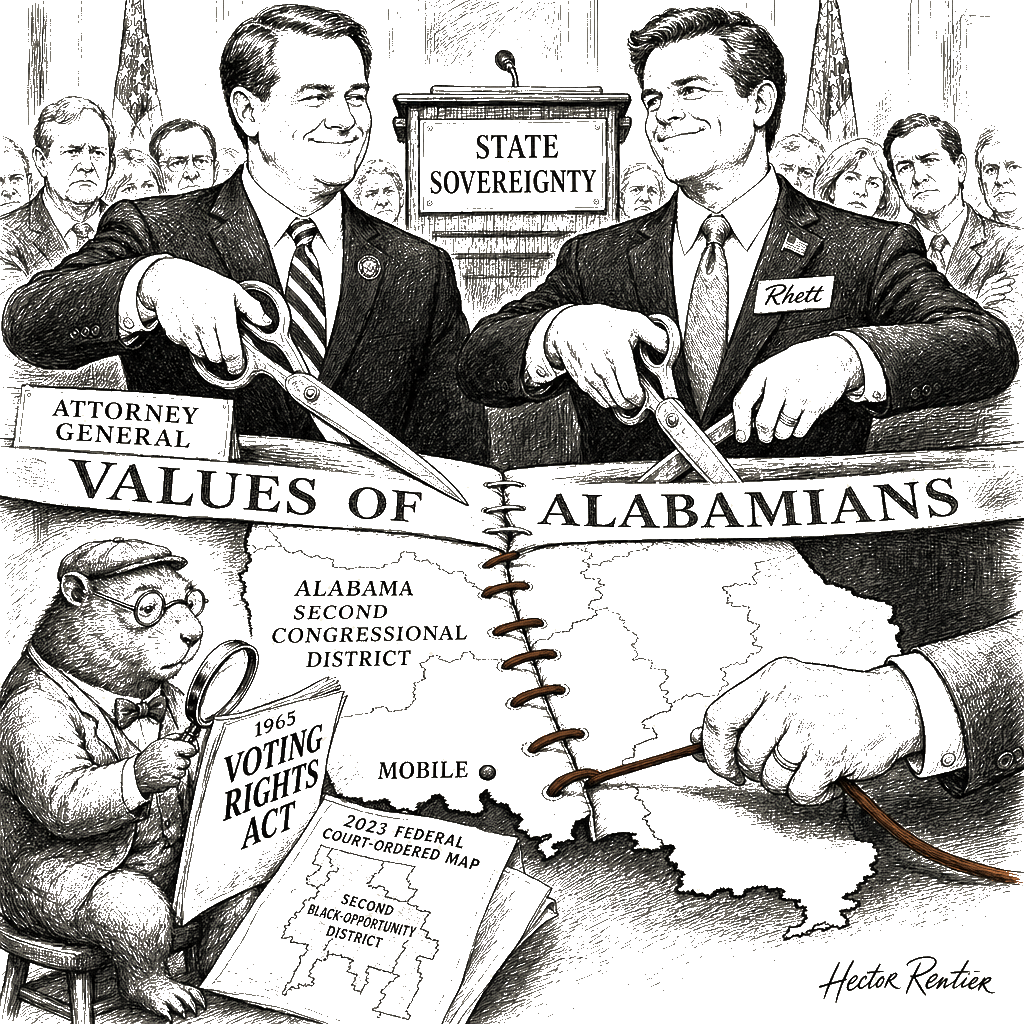
The Alabama Republican state legislature and the Supreme Court majority that lifted the May injunction have, in the span of seven weeks, handed these three people and the Black Alabamians of voting age behind them a problem their elders would have recognized immediately. A 2023 federal court — acting on Section 2 of the Voting Rights Act, the same statute the Supreme Court itself had reaffirmed in Allen v. Milligan — had ruled Alabama’s prior map unlawful and ordered a second district in which Black voters had a substantially better chance to elect a representative of their choice. The map that followed gave them that chance. Shomari Figures, a Democrat, won the new Black-opportunity district by nine points in 2024. The Court majority has now reversed course. The new state map eliminates that district. Figures’s redrawn seat would have voted for Donald Trump by fourteen points in 2024. State Rep. Rhett Marques, the Republican front-runner, switched into the race in May. He has raised $1.1 million; Figures has raised $828,000. The Democratic Congressional Campaign Committee has put Figures on its front-line list. This is the erasure we tracked when the Court first reinstated this map, and it is a crime committed in the daylight.
Let me lay out what is happening, because the public framing is doing enormous work to obscure it.
Alabama Attorney General Steve Marshall, on the Court’s decision: “For too long, Alabama has been denied the full measure of its sovereignty by judges who insist on treating our state as though it never moved beyond the 1960s.” Marques’s campaign, in the same register: the new map “better reflects the values of Alabamians.”
Both statements are doing the same work. They are relocating the conflict from what it actually is — a coordinated legislative and judicial project to eliminate a congressional district in which Black voters had a fair chance at representation — into a story about federalism and shared values. Values of Alabamians is the operative euphemism. The “values” being reflected are the values of a district drawn so that the Black voters of Mobile — a city that was the core of a Black-opportunity district — are now, by one account, a “small blue dot” inside a deep-red constituency. Marshall’s claim that Alabama has “moved beyond the 1960s” is the most cynical lie in a career built on them. The tactics of the 1960s were literacy tests and poll taxes; the tactics of 2026 are precision redistricting and judicial acquiescence. The mechanism has been refined, but the objective — white minority rule masquerading as majority democracy — remains the constant. To say we have moved beyond the 1960s while actively dismantling the voting rights won in the 1960s is a special kind of moral blindness. It is the denialism of the beneficiary who insists the crime scene is clean because he has swept the glass under the rug.
This is the ancient game of cui bono: who benefits? The Republican supermajority in Montgomery, and specifically candidates like Rhett Marques, who has raised over a million dollars to step into a seat the state has gerrymandered into safety for him. Who pays? The citizens of Mobile and Montgomery, whose votes are now mathematically irrelevant in the district they live in. What does the public framing obscure? That this is the predictable consequence of two interlocking decisions, neither of which had to happen.
The mechanics of the theft are laid bare in the numbers. Under the map the federal courts ordered Alabama to draw — the map that acknowledged the reality of Black political cohesion in the state — Representative Figures had a fighting chance. Under the map the legislature has now imposed with the Court’s blessing, the district leans Republican by fourteen points. The intent is not to reflect the values of Alabamians; the intent is to ensure that Black Alabamians have no power to effect those values. This is not governance. This is a crime committed in the daylight.
I want to name, precisely, what is happening to the language. The Alabama AG’s “treating our state as though it never moved beyond the 1960s” line is not a foolish line. It is a sophisticated line, and it does specific rhetorical work. It relocates the conflict from a present-day dispute over who gets represented in Congress to a story about whether federal courts have the legitimate authority to tell a state legislature what its map should look like. This is the pattern the Field Guide names frame-engineered relabeling — the deliberate substitution of one term for another, where the new term carries different connotations, to shift the cognitive frame within which the underlying issue is processed. The vocabulary the Alabama AG and the Marques campaign are using — sovereignty, values, the 1960s — invites the reader to ask “do federal courts have the authority?” rather than the question the conflict actually raises: “should Black voters in Mobile have a representative who has actually won their votes?” The first question is interesting. The second is the question. The relabeling is the move that lets the speaker answer the first while declining the second.
There is a second pattern visible in the same passage, and it is worth naming. The coordinated-message discipline between Steve Marshall’s office and the Marques campaign — the same vocabulary, deployed in close temporal proximity, across a state attorney general’s statement and a candidate’s press release — is the textbook version of what the Field Guide calls coordinated message discipline: systematic, organization-wide deployment of agreed-upon language, frames, and talking points across speakers and venues, such that an issue is presented uniformly. Two speakers. One script. The audience is supposed to read it as coincidence.
The structural cause is the Supreme Court’s revised approach to Section 2. The operational instrument is the Alabama legislature’s mid-decade redistricting, which broke the decennial cycle the post-2020 redistricting process was specifically designed to prevent. The Court, by lifting the May injunction, gives the legal green light. The Alabama legislature, by redrawing the map mid-cycle, takes the green light and runs. The voters in the affected district have no operational remedy except turnout, registration, and the organizing work Rev. Williams is doing on the Edmund Pettus Bridge.
What Martin Luther King, Jr., named in his April 4, 1967, address at Riverside Church — Beyond Vietnam: A Time to Break Silence — as the “giant triplets” of racism, extreme materialism, and militarism, was his argument that the three evils cannot be addressed in isolation, because they reinforce each other. The Alabama map is a small, local instance of the same architecture. The racism is the dilution of Black voting power. The materialism is the donor-class operation that produces a map-drawing process responsive to the interests of the Alabama Republican Party’s donor coalition, rather than to the voters in the affected district. The militarism is the deployment of state power, by judges and legislators alike, in service of a coalition project that the voters in the affected district have not consented to. The architecture is the same architecture. The scale is local. The mechanism is the mechanism.
What is being deployed here is the corruption-of-republics frame in plain form. A republican structure — the periodic, decennial, court-supervised redistricting cycle — is being hollowed from the inside by the very institutions that were supposed to defend it. In the Star Wars prequels — which treat this exact structural problem with more seriousness than most political-science textbooks — Padmé Amidala watches the Senate vote that ends the Republic and says, in the last line she speaks in the chamber: “So this is how liberty dies — with thunderous applause.” That line is reserved, in the franchise’s analytical vocabulary, for the moment a legislative chamber votes away its own authority with the unanimous enthusiasm of a chamber that believes it is preserving order. The Alabama legislature, voting the new map out of committee and onto the floor, is performing the same operation. The Court majority, lifting the injunction that would have prevented it, is providing the legal cover. The applause is bipartisan.
The reaction on the ground tells a different story. JaVaughnae Malone in Mobile knows her city is now a blue dot in a red sea. But she is already writing letters to the very representatives who will ignore her. “No matter who’s in office, if it’s a Republican or a Democrat, you have to advocate,” she said. “That means writing letters, calling their office. You have to let them know.” This is the discipline of the long haul. This is the refusal to let the apparatus dictate the terms of one’s own irrelevance. In Bethel AME Church, Rev. Brandon Thornton is not asking for permission to participate in the democracy that was stolen from his congregation; he is doing the same precinct-by-precinct organizing that Rev. Williams is doing on the bridge and that Knight is doing from his radio perch. When the thousands rallied in Montgomery against this rollback, they were not just protesting a map. They were asserting the principle that the Constitution is not a suicide pact and that the Voting Rights Act was not a temporary suggestion. The Supreme Court may have the gavel, but it does not have the truth.
Let me close on the register this fight actually demands.
King, the night before he was killed, at Mason Temple in Memphis on April 3, 1968 — I’ve Been to the Mountaintop — told the sanitation workers and their supporters that a country with America’s wealth that does not use it to end poverty is bound, in the most theological sense, for hell. He meant it. He meant it the way the eulogy for the four girls killed in the Sixteenth Street Baptist Church bombing, on September 18, 1963, meant it — when he told the congregation that the children’s case had to be made, but the more important inquiry was into “the system, the way of life, the philosophy which produced the murderers.” The system, the way of life, the philosophy — those are the right targets, because the named individuals in office rotate, and the structure that produces them does not.
The Alabama map is the system, the way of life, the philosophy, in 2026. Steve Marshall is in office today. The Court majority is on the bench today. The Republican legislative leaders who drew the map are in their seats today. None of those individuals is the target. The target is the structure that produces the map, lifts the injunction, and supplies the coordinated vocabulary. The named individuals are carriers of the structure; the structure is what this column is built to name.
King, in Where Do We Go From Here (1967), on the Sunday after his organization had just won the Civil Rights Act, told his audience that the bill was a foothold, no more — that the destination was a radical reconstruction of American life. The destination is the Beloved Community: a community in which the votes of Black citizens in Mobile count for as much as the votes of white citizens in Huntsville.
The Alabama map takes that community farther away today than it was yesterday. The work of bringing it back is not the Court’s work. The work of bringing it back is the work Beverly Cooper, Rev. Williams, Rev. Thornton, and John Knight are doing — on the ground, in the churches, on the bridges, in the neighborhoods where the doors are getting knocked. The ballot is not a gift from the state; it is a weapon seized by the people.
The arc of the moral universe does not bend on its own, and it certainly does not bend on the command of a gavel. It bends because specific people, in a specific moment, push it. The map is redrawn. The fight is reset. We will see who has the stamina to outlast the theft.
— Malcolm Little King