Trump is pawning the Atlantic alliance for a Turkish dictator’s affection.
I do not write that easy. The alliance was not built in a boardroom. It was built in the ash of a continent, by men who had seen what happens when commitments collapse. Seventy-seven years later, the man holding the American end of the cord is using it as a prop for a photo with Recep Tayyip Erdoğan.
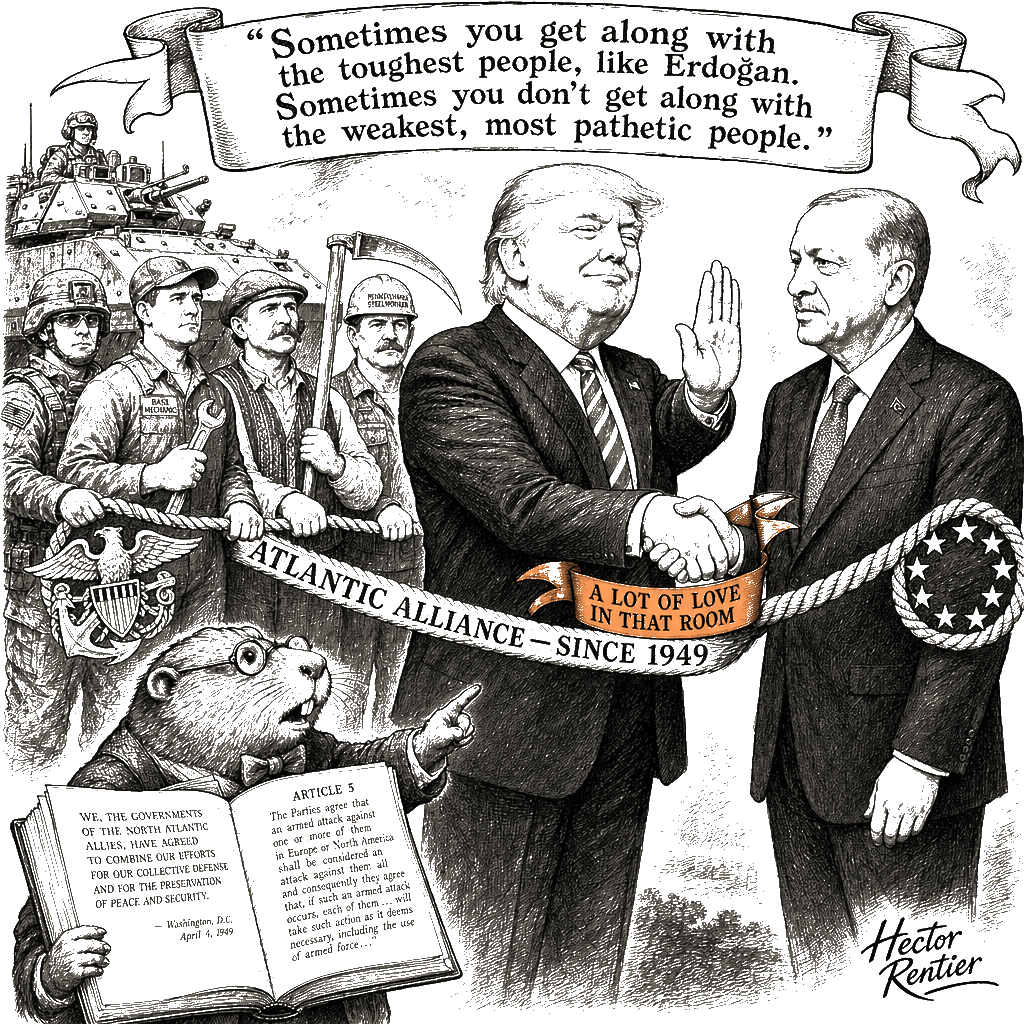
Here is what happened in Ankara. The President flew in angry. A ceasefire he had agreed to with Iran had not held, and he was not in a mood to hide it. He sat beside NATO’s secretary general, Mark Rutte, and called the Iranian leadership “scum” and “sick people.” Two weeks before, he had called the same leadership “very reasonable.” He threatened Spain with severed trade because its socialist government wouldn’t meet his new defense spending targets. He rehashed his claim on Greenland. He threatened “more destruction and mayhem.” Then, hours later, after a meeting with the leaders he had just abused, he walked out and announced there had been “a lot of love in that room” and that he had never had a NATO meeting so positive. The whole Ankara spectacle turned on that pivot — abuse in, flattery out.
That is not diplomacy. That is a man on a stage who has confused the alliance with his own set.
Now the charitable reading has to be addressed, because it is what the cable shows will tell you this week. The charitable reading: the volatility is the strategy. Trump is playing the Nixon madman theory. He keeps the allies off balance, and the fear extracts concessions. It is a clever reading. It does not survive the week. Nothing was extracted. The Iran ceasefire he agreed to did not hold — but it broke because he broke it. He arrived demanding allies help him in the Iran war. No help was offered or delivered. He arrived demanding Greenland. Denmark still has Greenland. He arrived demanding Spain be cut off from US trade. Spain is still in NATO, still not meeting the targets, still trading with the United States. A strategy of deliberate unpredictability requires that the unpredictability be leveraged — that something be traded for the fear. Nothing was traded. The volatility is just noise. A threat or a promise that can be reversed at will is not a threat or a promise. It is a man on a stage.
Let me tell you who pays for that noise.
It is not the cable commentators. It is a twenty-two-year-old specialist sitting in a Bradley in Żagań, Poland, on the tripwire, who has to believe the man who makes the American commitment means it. It is the military family in Grafenwöhr whose spouse deploys to the training areas and comes home different. It is the base-town mechanic in Spangdahlem whose whole livelihood is the American presence, and who has watched three rotations of this now. It is the Pennsylvania steelworker in Bethlehem who pours the steel for the artillery tubes. It is the defense worker in Huntsville, Alabama, who builds the missiles, and the longshoreman in Norfolk who loads them on the ships. It is the Baltic farmer in Latvia whose family has worked the same land for eight centuries, and who, when he watches the American president flip from “very reasonable” to “scum” inside a fortnight on a country with a hundred thousand missiles pointed at him, has to decide whether to plant the spring crop.
These are the tripwires. The man in the Oval Office does not think about them. If he did, he would not have spent the Ankara summit comparing his personal chemistry with Erdoğan glowingly to his relationships with the democracies. “You never know why a relationship is special,” he told reporters. “Sometimes you get along with the toughest people, like [Erdoğan]. And sometimes you don’t get along with the weakest most pathetic people, maybe you don’t respect them.”
That is the language of a man who has replaced the institutional logic of an alliance with the personal chemistry of strongmen. And the thing about a dictator’s affection is, it is just leverage waiting to be exercised. The strongman who calls you his friend today is the strongman who calls your bluff tomorrow, and the bluff is the safety of every kid in the Baltics.
The squeeze is already in the works. The Europeans are raising their defense spending — the 5 percent target was due in 2025 and they are meeting it, some of them faster than the political class in Washington wanted. But they are also doing the math. When the guarantor of your security treats your survival as a reality-television ratings play, you plan for the worst. You build your own industrial base. You sign your own supply contracts. You assume the American commitment is contingent, and you hedge. The chancellor of Germany and the prime minister of Japan are doing that right now, and the people paying for it twice are the workers in Scranton and the workers in Stuttgart — the same workers, on both sides of the ocean, paying for a guarantee that is wobbling while their bosses write the contracts.
You do not have to be a foreign-policy scholar to know that. You have to have worked a job where your plant’s future depended on a contract somebody else in a different city could pull. You have to know what it feels like when the man who is supposed to sign the work slip tells you he is “still considering it.” That is what every allied government in Europe is hearing from Washington right now. They are not getting a commitment. They are getting a “we’ll see.” And a “we’ll see” from the guarantor of your security is the same as a “we’ll see” from the buyer at the parts counter. It is the polite way of saying the deal is not done.
Dwight Eisenhower, in his farewell address of January 1961, warned that only an alert and knowledgeable citizenry could compel the proper meshing of the huge industrial and military machinery of defense with our peaceful goals. He was warning about the military-industrial complex. But he was also warning about the fragility of the democratic processes that govern it — about a machinery of foreign policy handed over to the personal whims of one man. When that happens, the citizenry is not alert. They are just being entertained while the house burns.
The Atlantic alliance was forged in the ashes of a world war. It was not a subscription service, and it was not a prop for a summit photo. The eighty thousand American troops still in Europe are not a stage set. The integrated commands in Brussels are not a backdrop. They are the tripwire. And when the man holding the American end of the cord decides to sell it for a compliment from a sultan, the men and women who stand on that wire are the ones who pay the tab. The mechanic in Spangdahlem. The farmer in Latvia. The twenty-two-year-old in the Bradley in Żagań. The steelworker in Bethlehem. The military family in Grafenwöhr.
They are the ones. And they are not at the summit.