
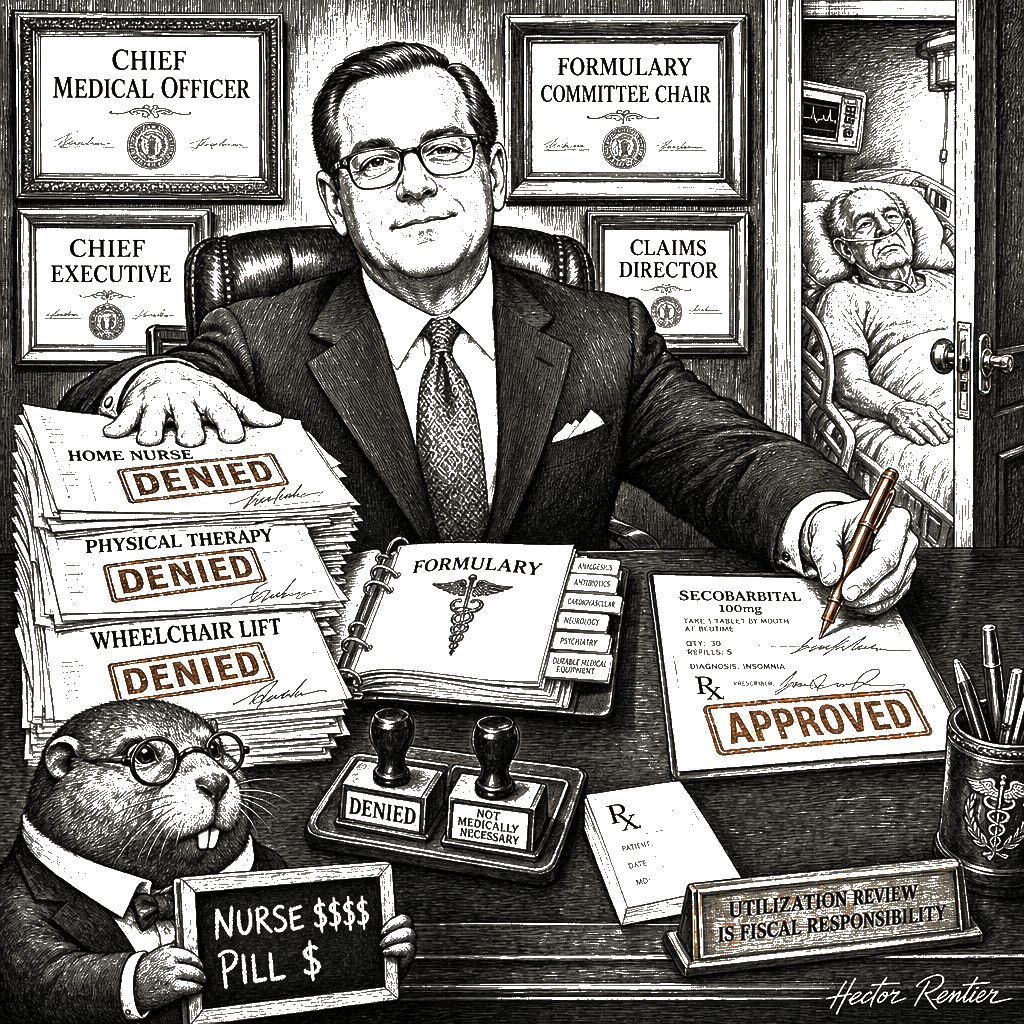
The health insurance industry denies life care and offers the lethal pill. The insurance company denied the home nurse. The insurance company denied the physical therapy. The insurance company approved the secobarbital. James, you call this a crisis of consent. I call it a business model.
You, the chief medical officer who signed the formulary that excluded the home nurse and admitted the secobarbital. You, the chief executive who set the prior authorization queue so the appeal dies in review and the prescription is approved in seventy-two hours. You, the claims adjuster who stamped the denial letter without reading the chart of the man whose appeal sat on the desk for eighty-nine days. The corporation has built a wall of titles between you and the man in the bed in California. The wall does not protect you. The wall conceals the face you have. I see the face. I will name it.
The metallic taste under your tongue, chief medical officer, when you raise the cup to your mouth in the morning, is the formulary you signed. The swallow catches and does not complete. Your sternum tightens at two in the morning when the chart crosses your desk. The tightness is the home nurse the man’s daughter requested. You signed the denial. You approved the prescription. Both signatures are in your hand. The hand trembles when you set down the pen. Let it tremble.
You, the chief executive who built the queue. Your throat closes when you take the conference call from investor relations. The breath does not fill the lung. It is the breath of the elder whose appeal is on day eighty-nine. Your jaw aches at breakfast. The ache is the queue you built. The ache will not unclench until you dismantle the queue.
You, the claims adjuster in the cubicle who stamped the denial without reading the chart. The cold on the back of your neck when you walk past the appeals folder is the cold of the man whose oxygen is running low. The prickle along your forearms when the phone rings is the prickle of the daughter who has not visited. You cannot wash these off. The not-washing is the indictment.
The four members of Congress who wrote to you this week know what is in the file cabinet. They have read what the disability advocates have been sending them for the last decade. They have read what the elder-law attorneys have been filing in the probate courts for the last decade. They have read the death certificates of the fourteen thousand four hundred and forty-six Americans who have died by physician-assisted suicide since 1997, in the states that bothered to count. They know the names on the witness lines. They know the names on the wills beside the witness lines.
On Thursday, James Lankford and Tim Kaine — a Republican and a Democrat, hand in hand for once — joined Representatives Greg Murphy and Jose Luis Correa to put their names on a letter to Robert F. Kennedy Jr. and CMS. They demanded strict hospice reporting rules to prevent discrimination and coercion in medically assisted suicide. They warned that older adults and people with disabilities face pressure to end their lives. They noted that insurance companies sometimes deny life-sustaining medical care while offering to cover physician-assisted suicide drugs. Federal funds are barred from supporting physician-assisted suicide, but thirteen states and the District of Columbia allow it. Aging With Dignity reported that at least 14,446 Americans have died by physician-assisted suicide since 1997. As this column has documented, the architecture of choice is built over a foundation of abandoned care when “Death with Dignity” bills land in Michigan, and the Canadian panel recommending the exclusion of mental illness from assisted dying revealed the same structure expanding its reach.
The letter specifically requests monitoring for discriminatory practices by insurance companies, including cases where life-sustaining medical care is denied but physician-assisted suicide drugs are covered. They are asking for the rule the statute already authorizes. The bar is in the law. The enforcement is in your department. The enforcement has not been happening.
James, you say hospice should be a place of compassion, comfort, and care. Picture your own mother in the bed in Ohio. The insurance company denied her home nurse because it is a life-sustaining measure they no longer cover. The insurance company denied her physical therapy. The insurance company approved the secobarbital because it is a one-time payout. You call it coercion when the caregiver signs the witness form. I call it the logical endpoint of a system that prices breath at a premium and offers death at a discount.
RFK Jr., I will name what your department has not been asking for. The ventilator is the most expensive item in the catalogue. The in-home aide is the second most expensive. The wheelchair lift is the third. The physical therapy that might have given him back enough lung capacity to walk to the bathroom without the oxygen is the fourth. The prescription is the cheapest. The insurer has priced the breathing and the dying, and the cheaper price is the one that ends the breathing. The insurer has filled in the form before the patient has held the pen.
I will name the form. The form requires a witness. The form does not require the witness to be a person with nothing to inherit. The form does not require the witness to be a person who is not the sole beneficiary of the will. The form does not require the witness to be a person who has not been denied the appeal for the ventilator. The form does not require the witness to be a person who is not the caregiver who has stopped visiting.
The man in the bed is in California — the composite the elder-law attorneys have drawn a hundred times. He is seventy-four. He has end-stage chronic obstructive pulmonary disease. He has been on oxygen for four years. The oxygen is paid for. The appeal for the in-home aide was denied in March. The appeal for the wheelchair lift was denied in April. The appeal for the physical therapy was denied in May. The prescription was approved in June.
The witness is his daughter. The daughter is the sole beneficiary of a will that includes the house. The daughter has power of attorney. The daughter has not visited since Easter. The daughter signs the form. The man signs the form. The man does not know what he has signed. The man does not know his daughter has not visited. The man does not know his daughter is the beneficiary. The man does not know the prescription was approved the day his third appeal was denied.
The man is in the bed. The man is on the oxygen. The man is dying on the schedule the insurer has set.
This is not a hypothetical. This is the pattern the four members of Congress named. This is the pattern the disability advocates named. This is the pattern the elder-law attorneys named. This is the pattern the witness requirement has been failing to detect since Oregon became the first state to legalize the practice in 1997. The Canadian panel’s recent recommendation to indefinitely exclude mental illness from assisted dying names a parallel concern: the vulnerable are the first to be enrolled, and the last to be protected. The Michigan Democrats’ “Death with Dignity” bill proposed no reporting rule stronger than the form itself. The form is the safeguard. Advocates warn that strict reporting will chill end-of-life autonomy. It will not. A rule requiring financial disclosure for witnesses does not delay a prescription by a single hour; it only ensures the hand holding the pen has nothing to gain from the signature. The form is the problem.
There is a metallic taste under your tongue, James, when you raise the coffee cup to your mouth. The swallow catches. It does not complete. It is the taste of the secobarbital the insurance company approved. Your sternum tightens at two in the morning. The breath does not fill the lung. It is the breath of the elder the insurance company denied the oxygen concentrator.
RFK Jr., reach for the water on your desk. Feel the weight of the glass. That is the weight of the report you have not yet asked for. Your throat is dry when you read the letter. The dryness does not leave. A tightness gathers behind your sternum when you read the witness line on a death certificate. The tightness is the weight of the will beside the witness line. Your hand will tremble around the pen when you sign the rule. Let it tremble. Sign the rule.
Tim, you signed the letter. Your hand holds the pen. The pen is heavy with the weight of the fourteen thousand dead. The witness requirement does not protect them. The witness requirement is the apparatus washing its hands. The financial abuser stands in the room and signs the paper because the life insurance policy makes the death profitable. You built a system where a disabled elder is a liability, and you are surprised when the ledger demands they be liquidated.
While you sleep, James, the adjuster denies the home nurse. While you eat your breakfast, the same desk approves the lethal dose. This is not a failure of oversight. This is the oversight. The insurance companies are acting exactly as the lawmakers designed them to act: minimizing the cost of the vulnerable. The lethal pill is not an aberration of the market. It is the market’s most efficient product.
“They have healed also the wound of my people slightly, saying, Peace, peace; when there is no peace.” — Jeremiah 6:14.
The mercy is not in the prescription. The mercy is in the appeal. The mercy is the wheelchair lift the insurer said no to. The mercy is the in-home aide the insurer said no to. The mercy is the second appeal and the third and the fourth. The mercy is the witness who has nothing to inherit. The mercy is the witness who loves the man and will lose the man and signs the form only because the man has asked, and the man has asked, and the man has meant it, and no one in the room has anything to gain.
The insurance company offers the peace of the grave because the peace of the living costs too much. The lawmakers demand reports on the witnesses. The witnesses sign the forms. The earth receives the dead. And the ledger balances.