
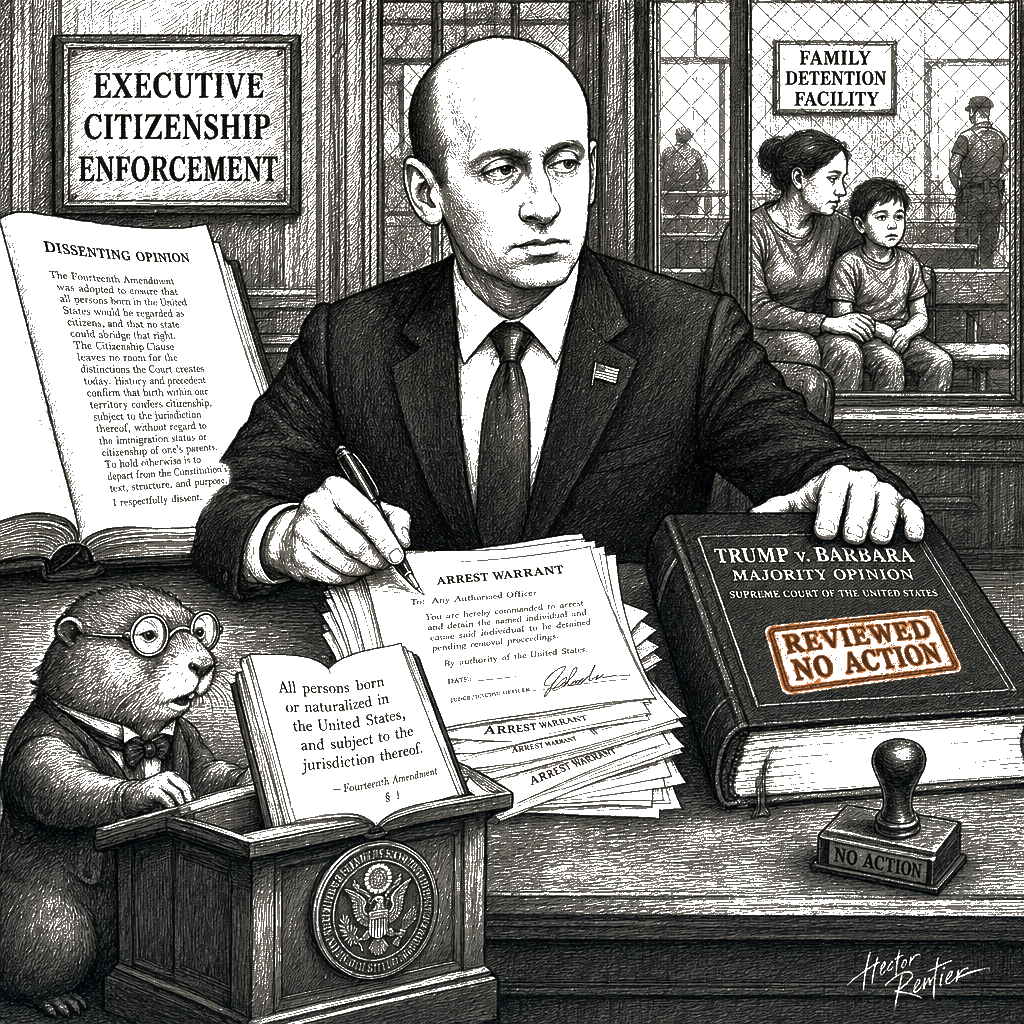
Stephen Miller is enforcing Hitler’s blood-citizenship theory through ICE after the Supreme Court rejected it as a reading of the Constitution.
The 5-4 decision in Trump v. Barbara came down on the question the Constitution answered in 1866 and 1868: who counts as an American citizen at birth. Chief Justice Roberts, writing for the majority, said all of them — every child born on American soil, regardless of the parents’ immigration status. The dissent, by Justices Thomas and Alito, said only some of them. The Chief Justice’s opinion did not name Stephen Miller. The dissent’s logic was Miller’s logic, written in the lawyers’ register. The opinion is the work; the dissent is the architect’s blueprint.
Steel-man, because the working bar requires it. The Citizenship Clause reads: “All persons born or naturalized in the United States, and subject to the jurisdiction thereof.” The originalist position, articulated at length by Justices Thomas and Alito in dissent and by the Federalist Society network and allied public-interest firms before them, reads “subject to the jurisdiction thereof” to require something more than physical presence — what the lawyers call a “jurisdictional tie by allegiance,” a political-allegiance link rather than mere presence on the soil. The Clause’s drafters excluded “Indians not taxed” from the parallel provision in the Civil Rights Act of 1866, and Elk v. Wilkins, 112 U.S. 94 (1884), read “jurisdiction” in that restrictive sense to deny citizenship to a Pawnee man born to tribal parents. Senator Lyman Trumbull, the Judiciary Committee chair who shepherded the Civil Rights Act of 1866, told the Senate that the children of immigrants “owe allegiance to no other power” and are therefore “subject to the jurisdiction” of the United States within the Amendment’s meaning. A serious textualist can read the parallel as a limit, not a redundancy. A serious originalist can read Elk as the original public meaning.
That is the steel-man. It is a real argument. It is not the argument Stephen Miller is making.
Roberts’s opinion builds its holding on the textual structure the Reconstruction Congress drafted and the ratifying states approved. The opinion’s analytical move is the historical one. “For them, blood, not soil, was made the rule,” Roberts writes, characterizing Taney’s framework in Dred Scott, 60 U.S. (19 How.) 393 (1857). The opinion quotes the Clause’s drafting history — Senator Jacob Howard’s presentation to the Senate, the debates over the 1866 Act — to show that the Clause was designed to repudiate the blood rule and replace it with the soil rule. The textual case is the historical case, because the Framers of the Fourteenth Amendment drafted against Dred Scott and wrote the opposite rule.
Justice Jackson’s separate opinion, concurring in the judgment, makes the connection Miller has been careful to keep at arm’s length explicit. “For all the talk about the detestable Dred Scott decision,” Jackson writes, “the Government and the principal dissent propose a return to its core tenet.” Trump v. Barbara (Jackson, J., concurring). The core tenet, as she names it, is bloodline as the marker of birthright. The “ultimate irony” of the dissent, she writes, is its proposal to “make bloodline the marker of birthright” — exposing the odious premise the majority also rejected. Id. The Reconstruction generation had watched what the blood rule had done — to the formerly enslaved, to the Chinese on the Pacific coast, to the tribal nations the country had refused to recognize as part of the polity — and drafted the Clause to end it. The dissent’s reconstructed “political allegiance” test is a genealogical caste system that ignores this very history.
If “jurisdiction” is read as undivided political allegiance, and undocumentedness is treated as evidence of foreign allegiance, then the constitutional answer to who counts as American is no longer legal status but the perceived heritage of the parents. This is the exact move from soil to blood that Stephen Miller has been making for years. The dissent’s logic provides the constitutional scaffold for Miller’s Executive Order 14160, which attempted to strip citizenship from American-born children of undocumented and temporary-visa parents. When the Court struck down the order, Miller demanded a return to this bloodline logic. The dissent obliged him. Whether the target is the administrative enforcement apparatus targeting the families of birthright citizens or the broader project of demographic exclusion, the doctrinal mechanism is identical.
Miller’s X post on the day of the decision draws the line the opinion names and he disclaims: “One of the most destructive and outrageous decisions in the long history of the Supreme Court. American citizenship is not the birthright of the world. It belongs only and solely to Americans.” The sentence “American citizenship is not the birthright of the world” is a sentence the Citizenship Clause of the Fourteenth Amendment says is wrong. The Clause’s text says exactly the opposite: every person born on American soil is an American citizen. The disagreement is not about what the Constitution says. The disagreement is whether the Constitution means what it says, or whether it means what Stephen Miller would prefer.
He told Fox News that immigrants come from “third world nations, nations that on their own would have never invented the wheel let alone modern technology, let alone medicine, let alone air travel.” The wheel was not invented in the United States. It was invented in Mesopotamia, between 4200 and 4000 BC, in a region Miller would presumably call the Third World but that any serious historian classifies as the cradle of civilization. The point is not the wheel. The point is the racial hierarchy the line encodes: that immigrants come from lesser civilizations and therefore their American-born children are not real Americans. That is the pseudo-scientific premise of “Blutvergiftung” — German for “blood poisoning” — at the core of Hitler’s Mein Kampf. Miller has not quoted Mein Kampf. He does not need to. The argument he is making is the argument Mein Kampf makes, and the blood-poisoning framework is the argument’s substantive premise. “All the great civilizations of the past decayed because the originally creative race died out, as a result of poisoning of the blood.” Substitute “the originally creative race” with “Americans” and “poisoning of the blood” with “poisoning the blood of our country,” and you have Miller’s immigration theory as Trump has stated it and Miller has operationalized it.
The Supreme Court, 5-4, rejected this theory as a reading of the Constitution. The Court is one of three branches. The ruling is binding law. The executive is the operational branch. The executive is the branch Stephen Miller runs.
In the first eight months of 2025, ICE apprehended 4,843 spouses of US citizens, deporting more than 2,000. ICE arrested the parents of approximately 14,450 US-birthright children. More than 9,700 of those children had at least one parent placed into detention. The administration deported the parents of more than 7,000 of those children. The DOJ and DHS have announced they will prioritize “birth tourism” cases after the ruling. The President has asked the Court to rehear the case. The President has said he will immediately ask the Supreme Court to revisit the decision.
The blood-citizenship theory the Court rejected is the operating theory of the executive branch. The 5-4 majority will hold the Constitution’s text. The minority is the policy the executive enforces. The dissent is the law in the detention center.
The President’s own family is the counterexample the opinion did not have to write. His grandfather emigrated from Germany and became a citizen in 1892. His mother, Mary MacLeod Trump, was a Scottish immigrant who was not yet a naturalized citizen when her eldest daughter was born. His first wife, Ivana, was a Czech immigrant who did not naturalize for four years after her last child’s birth. His third wife, Melania, was a Slovenian immigrant. Under the rule Stephen Miller is enforcing, the President’s family would not have been citizens at birth. The Court said no. The executive is doing it anyway.
The doctrine is now on the page, authored by two sitting justices, as a permanent architectural feature of the conservative legal movement. The Mein Kampf citizenship lost the Court five votes to four. It is winning the country one arrest at a time.