
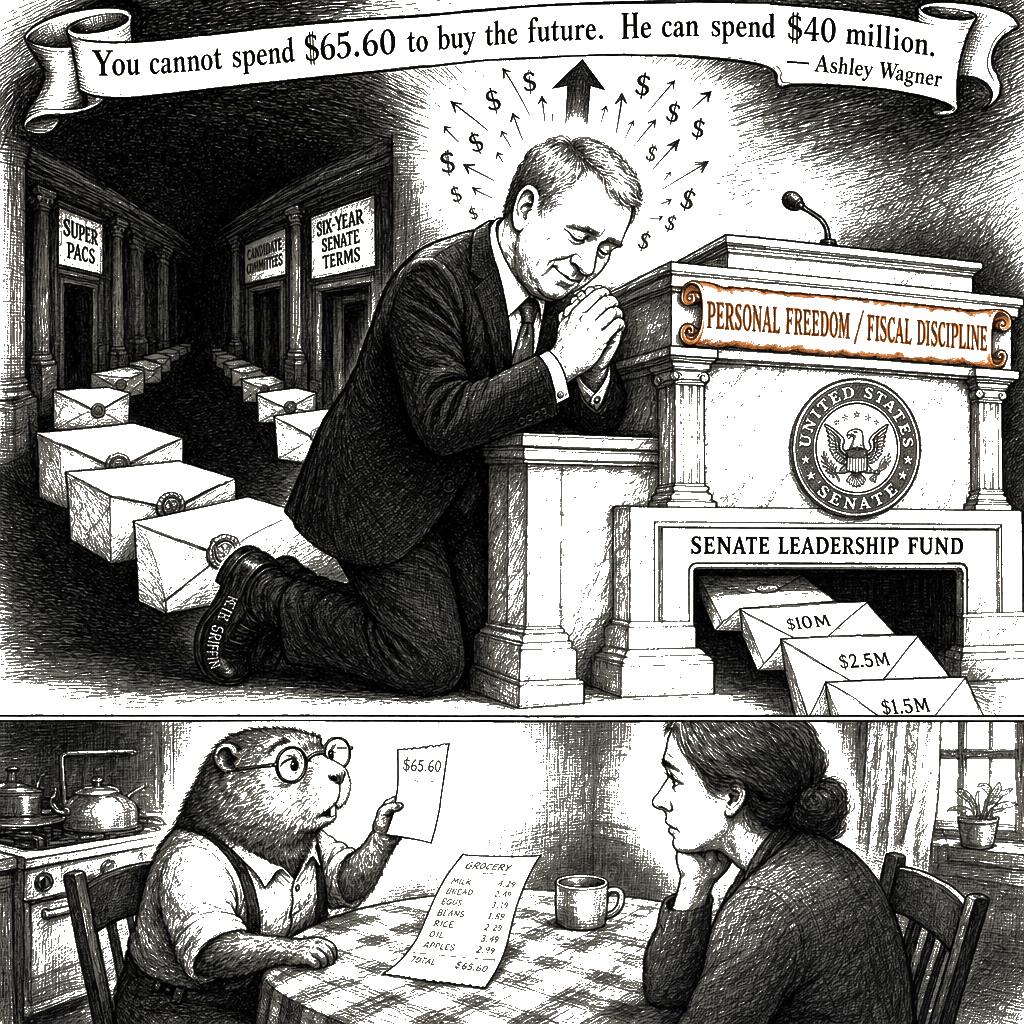
Ken Griffin is spending $40 million to buy the one thing you can’t afford — the future.
Not the $40 million figure. The $50 billion figure. Griffin is worth roughly $50 billion, give or take a market close. The $40 million he has already poured into this year’s midterms — a number that will likely double by November, according to people familiar with his giving — is 0.08 percent of his net worth. For a household earning the Philadelphia metro median of roughly $82,000 (Census 2024), 0.08 percent is $65.60. That is the scale of commitment he is making to reshape the Republican Party for the post-Trump era.
You cannot spend $65.60 to buy the future. He can spend $40 million.
The Wall Street Journal reports that Griffin’s single biggest gift so far this year was $10 million to the Senate Leadership Fund, the super PAC aligned with Senate Majority Leader John Thune. He gave $2.5 million each to groups backing Senators Dan Sullivan of Alaska and Susan Collins of Maine, and $1.5 million to one backing Representative Ashley Hinson of Iowa. Alaska and Maine are rated tossup by the nonpartisan Cook Political Report, while Iowa, despite Trump’s double-digit 2024 win there, is lean-Republican — which makes Griffin’s money a hedge, not a coronation. The through-line, according to people familiar with his thinking: he is focused on the Senate and its six-year terms because he believes that is where his money can have the greatest long-term impact in preparing the GOP for after President Trump’s term ends in January 2029.
He is buying time. Six-year blocks of Senate terms that outlast any single president. He is buying the institutional infrastructure — the super PACs, the leadership funds, the candidate committees — that will determine who runs for what and who wins when the current political moment is over. He is not betting on a candidate. He is betting on a party’s future direction, and he is betting enough to make the direction happen.
People familiar with his giving say Griffin wants to support people who put “policy and principles such as personal freedom and fiscal discipline over personalities and partisanship.” That is the public framing. The kitchen-table reading is simpler: he wants a Republican Party that protects his ability to accumulate wealth without tariffs, without Fed interference, without the kind of populist economic nationalism that might actually help the working families whose tax dollars built the system his wealth depends on.
There is an old Catholic Social Teaching concept called the universal destination of goods. It says the earth’s resources are meant for everyone, and that private property, while legitimate, carries a social mortgage — the owner’s obligation to use it in a way that serves the common good. The concept is not a tax policy. It is a moral framework. It says that when you have $50 billion, the question is not just what you can do with it, but what you owe the society that made it possible for you to have it. Griffin is answering that question. He is answering it with $40 million in campaign contributions designed to ensure that the political class that writes the tax code, the regulatory framework, and the safety-net rules does so in his interest rather than in the interest of families who are watching their childcare costs eat their paychecks and their retirement savings evaporate.
“The last great american dynasty” tracks Rebekah Harkness, who married into the Standard Oil fortune and bought Holiday House — and with it, the right to be a character in her own story. Money buys that right. Griffin is spending $40 million to buy something larger: a party’s direction, and the future that direction produces. What $40 million could buy if it were aimed at working families instead: universal paid leave, child-care subsidies that close the gap between what providers charge and what families can pay, a Pell Grant that covers eighty percent of a public university’s cost instead of twenty-five, a housing policy that treats shelter as a human right rather than an asset class. Griffin is not buying that future.
The families doing the math at 11 PM — the ones wondering whether they can afford the Catholic school tuition their parents managed on a single postal-service salary, the ones hoping the ACA marketplace survives another year — cannot spend $65.60 to shape the political future. Griffin can spend $40 million. He is spending it on the Senate, on the six-year terms, on the post-Trump future that he is already designing. Tech billionaires have been pouring unprecedented sums into races across the country, as MSI has documented, and the pattern is consistent: the money flows to the candidates who will protect the wealth, not the families. In Iowa, the same state where Griffin is backing Hinson, Democrats are eyeing a governor’s upset that could reshape the midterm map.
The people who will feel the cost of that future are not the ones who will be in the room when it is designed. They are the ones at the kitchen table, doing the math, realizing that the math does not add up, and wondering why no one asked them what they wanted the future to look like.
Griffin asked. He just didn’t ask them.