Lindsey Graham funded the deportation machine, and he knew what it was doing.
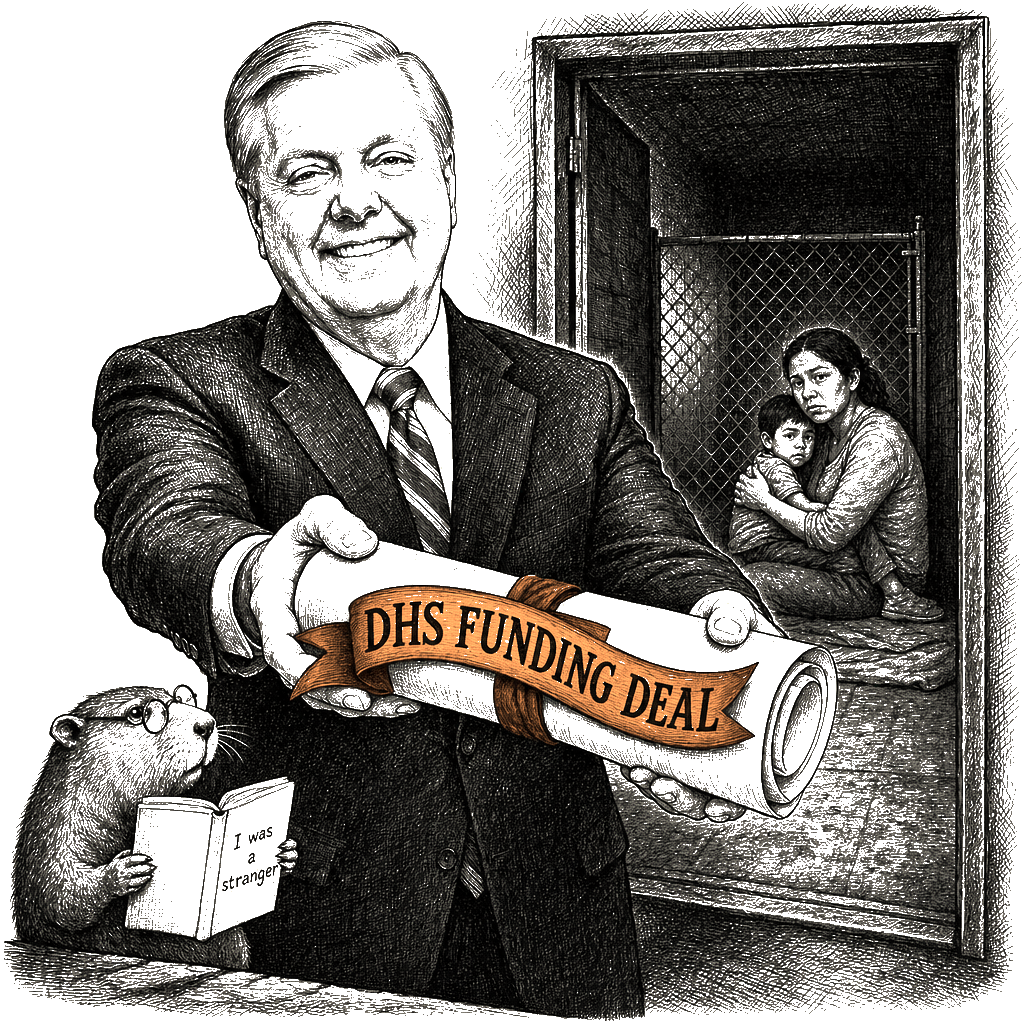
The longest partial government shutdown in American history had shuttered the Department of Homeland Security. Graham — chair of the Senate Budget Committee — ended it by funding the agencies carrying out Donald Trump’s mass deportation campaign for the remainder of his presidency. The Republican conference closed ranks behind the deal. DHS reopened. The rooms Graham moved at the caucus lunch were the rooms the families at Dilley, at Adelanto, and at the county jail in Brownsville could not get out of.
He died on a Saturday after what his office described as a brief and sudden illness. He was seventy-one. The eulogies arrived before the body was cold. The White House called him a warrior. His colleagues called him indispensable. Dick Durbin called him a fierce partisan one day and a bipartisan ally the next. Stephen Miller recalled how Graham would lock down reluctant Republican senators over lunch. These tributes are not wrong about the man’s gifts. They are silent about what the gifts were used for.
The machine had a body count before Graham funded it, and it had a body count after. The South Texas Family Residential Center at Dilley was reactivated in 2025 with twenty-four hundred beds for family detention — mothers and children held in a facility built for the purpose. Credible-fear interviews were stripped from asylum officers and given to Border Patrol agents in uniform. Expedited removal was expanded so that a person who had lived in this country for twenty years could be put on a plane to a country they had left as a child without ever seeing a judge. Transfer flights left the detention compounds at four in the morning so that the people being moved would be in the air before their lawyers could file. The corporations that ran the beds — CoreCivic, the GEO Group — watched their stock climb as the contracts expanded. GEO’s founder called 2025 “the largest amount of new business we have won in a single year in our company’s history.” That is the machine Graham funded. It was not abstract. It was a mother in a county jail in Texas, a child asleep on a mat on a cement floor, a man whose only crime was a traffic ticket he didn’t know he owed.
He knew. He knew the words of Jesus about the sheep and the goats — I was a stranger and you did not welcome me. He had sat across the table with people whose families the DHS enforcement campaign would reach. He was not legislating in ignorance. He was legislating from proximity, and he chose the machine.
We who supplied the cover must say so before we say anything else. The white evangelical establishment that blessed Graham’s deal as “order” and “the rule of law” — the pulpits that quoted Romans 13 at the border and went silent on Leviticus 19 — share the indictment. The Catholic bishops who knew what the catechism taught and chose not to say it when the catechism would have been inconvenient share the indictment. And I, who write this as a Mexican-American Catholic from a family that crossed at night and lived “like thieves” for a generation, share it. Our own parishes made room for the dealmaker because the dealmaker wore the right team jersey. The Torah says it plainly — you know the heart of an alien, for you were aliens in the land of Egypt — and we knew, and we forgot on the days it was convenient to forget. I do not exempt the hand I write with.
What Romero understood, and what the dealmaker’s skill erased, is that the moment of leverage is the moment of choice. On March 23, 1980, Archbishop Óscar Romero stood in the cathedral in San Salvador and said to the soldiers in their uniforms, in the second person, in his own voice: In the name of God, and in the name of this suffering people whose laments rise to heaven each day more tumultuous, I beseech you, I beg you, I order you: cease the repression. He had no leverage except the truth. Graham had the chair of the Senate Budget Committee and a caucus lunch and the votes to end a shutdown. He used the leverage to keep the repression running. A lesser senator could have been ignored. Graham could deliver. When he delivered the DHS reopening, he delivered it on terms that meant the deportation apparatus came back online stronger than before, and the families at Dilley and at Adelanto paid the cost of his gift.
The tributes this week will speak of the man who loved the Senate and made the deal. The parable of the Good Samaritan is not a meditation on complexity. It is a question about who lay bleeding in the road, and who walked past with a budget reconciliation and a reason. The door of return was open to Lindsey Graham every day of his career. The machine he funded is the answer to whether he walked through it.