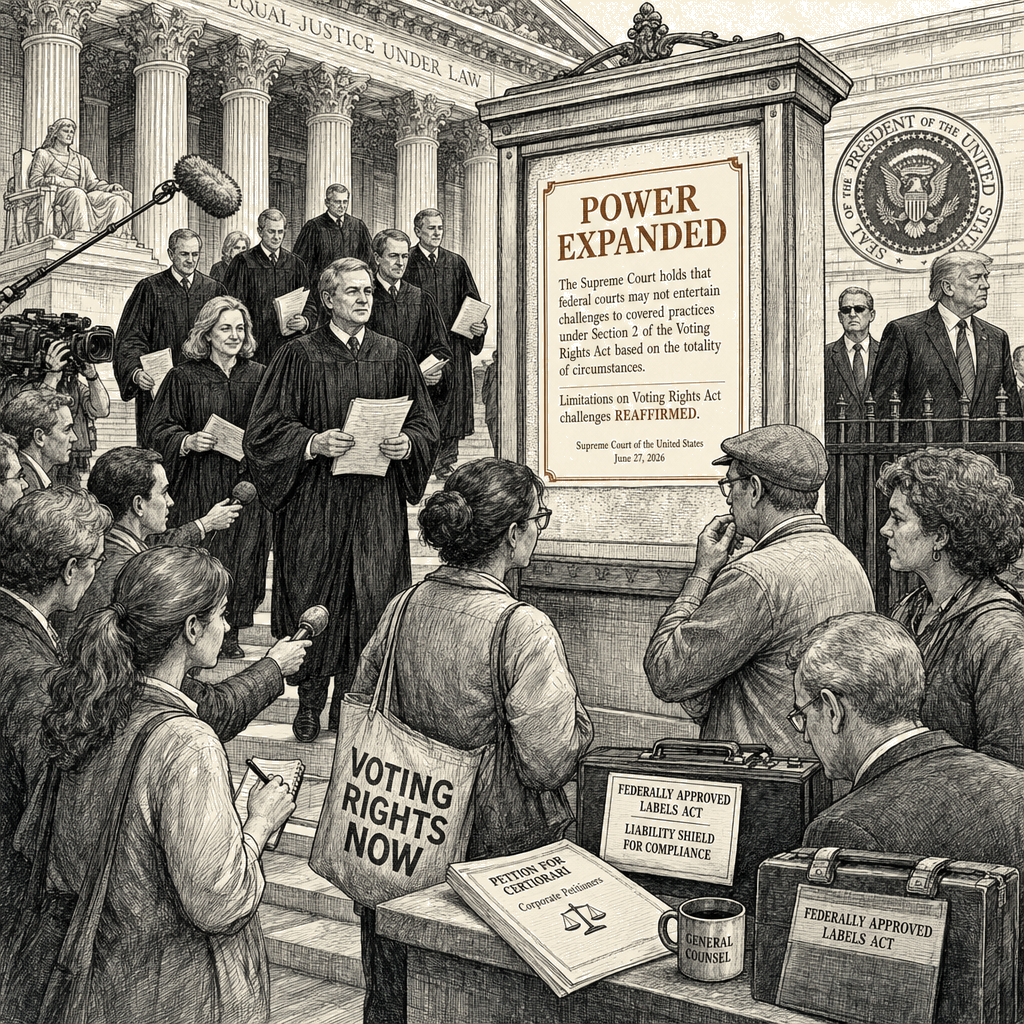
The constitutional architecture the Supreme Court affirmed in its 2025–2026 term is the architecture the Framers bequeathed. Article II vests “the executive Power” in a single president, and that vesting cannot survive if the officers who exercise executive discretion are beyond the president’s reach. The Court’s clarification of the removal power corrects a century-long drift toward unaccountable administrative government: when Congress creates an agency and installs officers who wield executive judgment — designating countries for Temporary Protected Status, enforcing immigration law, registering pesticides, approving drugs — those officers serve the president’s Article II authority or they serve no constitutional purpose. The Humphrey’s Executor accommodation was a practical expedient for a particular New Deal moment; it was never a structural command. The Court’s reaffirmation that presidential authority includes the power to remove those who execute it restores the accountability the constitutional design demands. The people elect a president. The president directs the executive. No officer may claim sovereign shelter from the sovereign’s own hand.
The immigration rulings follow the same textual discipline. The Immigration and Nationality Act grants the Secretary of Homeland Security discretion to designate countries for Temporary Protected Status and to withdraw that designation when the conditions underlying it have changed. TPS was never permanent residence. It was never a path to citizenship. It was a statutory grace — time-limited, condition-dependent, revocable at the Secretary’s judgment. When the Court upheld the Secretary’s authority to terminate Haiti’s TPS designation, it enforced what the statute plainly says: the program is temporary, and the Executive determines when the temporary period has run. Over two hundred thousand Haitian nationals held TPS designations that the Secretary determined were no longer warranted by the conditions in Haiti. Courts may review whether the Secretary acted within statutory bounds; they may not convert a temporary program into a permanent entitlement through injunction. To do so is to transfer the legislative function from the body the Constitution charges with making law to the judiciary the Constitution charges with interpreting it.
Federal preemption confirms the same structural logic. When Congress establishes a national regulatory scheme — pesticide registration under FIFRA, drug approval under the FDCA — state-law claims that would override the federal determination are preempted by the Supremacy Clause. A state cannot impose a cancer-warning label the EPA has found scientifically unsupported. The uniformity the statute was designed to ensure cannot survive fifty separate laboratories of contrary obligation.
These holdings restore the separation of powers to its proper architecture. The president directs the executive. Congress writes the statute. The courts enforce clear text and decline to manufacture obligations the legislature never imposed. The household of government is ordered.
While the Court was settling the constitutional architecture of executive authority, DHS officers executed a warrant at 4:30 in the morning at a two-bedroom apartment in a Haitian neighborhood in Miami-Dade County. The father was a Haitian national who had held Temporary Protected Status for eleven years — since the 2010 earthquake that killed over two hundred thousand people and left Haiti’s health infrastructure in ruins. The mother was a Haitian national who had held Temporary Protected Status for nine years. They had three children, all born in the United States, all United States citizens: an eleven-year-old boy, a seven-year-old girl, a four-year-old girl.
DHS officers forced the door open at 4:30 a.m. An officer seized the father’s left arm and wrenched it behind his back. The officer applied handcuffs before the father had opened his eyes. The father’s face struck the mattress during the restraint. An officer took the mother by both wrists and cuffed her in front of her body. She was barefoot. She was wearing the t-shirt she had slept in. The children were asleep in the bedroom they shared. The officers did not wake them.
DHS transported the father and the mother to the Krome Service Processing Center. DHS held them for seventy-two hours in a cell designed for short-term processing. The facility held forty-three people in a room built for twenty-eight. The floor was concrete. The lights did not dim. There was one toilet visible to the cell. There were no beds.
DHS transported the father and the mother from Krome to Miami International Airport and placed them on a deportation flight to Port-au-Prince. The aircraft landed at Toussaint Louverture International Airport. The father and the mother walked down the aircraft steps into air that smelled of standing water and diesel exhaust. Haiti’s Ministry of Public Health and Population had confirmed active transmission of Vibrio cholerae in Port-au-Prince — the epidemic introduced by United Nations peacekeepers in October 2010, documented by the World Health Organization as causing over eight hundred thousand cases and more than ten thousand deaths, with outbreaks recurring through subsequent years in neighborhoods where deportees were released without screening. The State Department had classified Haiti Level 4: Do Not Travel — citing armed gang violence, kidnapping for ransom, and widespread civil unrest. The health system was nonfunctional in Port-au-Prince’s communes. There was no clean municipal water supply in the districts where DHS released deportees.
The father and the mother were released at the airport with no provisions, no contact information for relatives, and no medical screening. They traveled on foot to a neighborhood where a cousin had once lived. The cousin had fled to the Dominican Republic months earlier. The house was occupied by strangers. They slept in the street.
On the third day the father developed acute watery diarrhea. The stools were pale, milky, and voluminous — the rice-water stools of choleraic infection. He vomited. His skin lost turgor; when the nurse pinched the tissue at his clavicle, it rose in a slow tent and did not return to place for several seconds, the mark of severe intravascular dehydration. His eyes sank into their sockets. His extremities turned cold. His pulse thinned and quickened — tachycardia indicating hypovolemic shock as circulating volume collapsed from fluid loss through the intestinal mucosa. The mucosa of his lips cracked. His fingers drew inward, the joints flexing into the clawed posture of tetany as metabolic acidosis deepened: bicarbonate lost in the stool, serum pH falling below 7.2, calcium binding to albumin at a rate that starved the nerve endings. The CDC’s case fatality rate for cholera without rehydration therapy ranges from twenty-five to fifty percent; Haiti’s health infrastructure had collapsed to the point that oral rehydration salts were unavailable at clinics within walking distance of the neighborhoods where DHS released deportees.
The mother carried him to a clinic that had not received oral rehydration salts in two weeks. The clinic had no intravenous equipment. A nurse attempted to administer fluids by mouth. He could not retain them. His blood pressure fell below a measurable threshold. His skin mottled — the cyanotic marbling of peripheral circulatory failure as the body shunted blood to the core and abandoned the extremities. His core temperature dropped below thirty-six degrees Celsius. He died on the fourth day after onset. He was thirty-four years old. The cause of death was cholera with hypovolemic shock and multi-organ failure secondary to severe dehydration. The body was buried in a mass grave outside the city.
The mother survived the initial infection by fortuity — she had not shared the same water source. After the father’s burial she walked back toward the city. She had not eaten a full meal in four days. Her body was metabolizing its own muscle, the catabolic wasting of caloric deficit where lean tissue is consumed to maintain blood glucose. Her clavicles and iliac crests were visible beneath the skin. She developed edema in both lower extremities — bilateral swelling as albumin fell and fluid leaked from the vascular compartment into the interstitial tissue, the early signature of protein depletion. She was thirty-one years old and could not walk more than a quarter mile without sitting.
Back in Miami-Dade County, the children had not eaten since the morning their parents were taken. The eleven-year-old boy attempted to feed his sisters from the food remaining in the apartment. On the second day there was no food. On the third day the seven-year-old girl stopped crying and lay on the floor. The four-year-old girl sat against the wall and screamed without pause for two hours. The neighbor heard the screaming through the shared wall and called the police. The police arrived and entered the apartment. The police called the Department of Children and Families. The state placed the three children in separate foster homes — the eleven-year-old boy with a family in Hialeah, the seven-year-old girl with a family in Homestead, the four-year-old girl in a group facility in Broward County. The school did not learn of the placement for nine days. When the teacher called the mother’s phone, a foster parent in Homestead answered. Across the country, the Secretary’s termination of Haiti’s TPS designation rendered over two hundred thousand Haitian nationals removable.
The separation of the citizen child from the alien parent is the order of the sovereign sorting those who belong from those who do not. The magistrate keeps the wall. The wall keeps the order. The child on this side of the wall now lives under the roof of the state that confirms his belonging; the parents on the other side live or die under the sovereignty that received them when the statute’s grace was open and withdrew it when the Secretary determined the conditions had changed. The distinction is drawn by the sword the sovereign bears under Romans 13, and the sword bears each to his proper place.
The father was a sojourner whose welcome was withdrawn. The mother was a sojourner whose welcome was withdrawn. They were not of the household. The children are of the household. The foster bed, the separated siblings, the school that did not learn of the placement for nine days — these are the visible judgments of where each soul was placed. The order has spoken. The order is in its place. The citizen child will grow up under the institutional care of the state that recognizes his citizenship, and the deported parents will learn whether the country that expelled them retains the capacity to keep them alive. The ledgers are drawn by standing. The Lord setteth the solitary in families; the Lord setteth the solitary without. The distinction is His.
Judas I Mather is a fictional antagonist in Main Street Independent’s editorial architecture — a religious-legalist heteronym voiced from inside the machinery that fuses Scripture, constitutional doctrine, and hierarchy. The positions this column expresses are NOT the publication’s positions; they are rendered sincerely and accurately as satire so the reader can see the betrayal at work. Nothing here is an endorsement.