
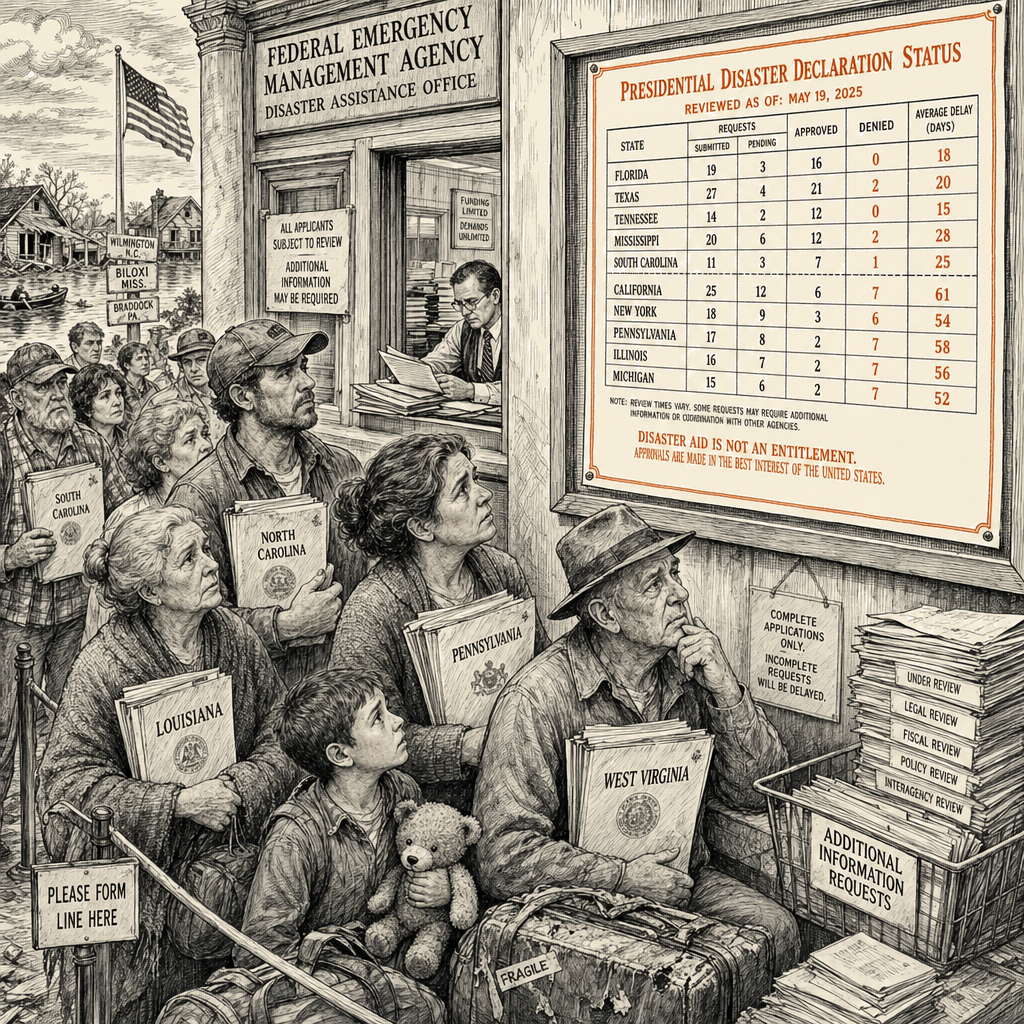
There is a family somewhere in this country who, having watched the storm take what the storm takes — the structure, the possessions, the particular arrangement of a life built over decades into the arrangement of someone else’s storm — is now awaiting a presidential disaster declaration. The request is in. The damage has been assessed. The community has done what communities do. And the White House is deciding whether this community’s alignment warrants help.
The Associated Press’s analysis of FEMA data — the most comprehensive accounting to date of how the current administration handles disaster declarations — should settle any question about what is happening and to whom. Since taking office, Trump has approved roughly 65 major disaster declarations and denied more than two dozen others — from states, tribes, and territories seeking federal financial aid following hurricanes, tornadoes, storms, floods, and fires. He has taken longer on average to approve disaster requests than any president since federal law set new parameters for disaster determinations in 1989. And the AP’s data shows no president, in the nearly four decades since that law was enacted, has produced a disparity in approvals as stark as the one this administration has produced — roughly 80% of requests from Republican governors approved, roughly 60% from Democratic governors. Communities that aligned politically with the president receive help. Communities that did not are more likely to wait — or to be told no.
That fact alone is the indictment. It does not require interpretation. It does not require inference. The AP’s own assessment of the data reaches the only honest conclusion: if you live in a state that didn’t support the president, chances are greater that aid will be denied. The record shows it.
But the delays and denials are only part of the story. The AP’s reporting arrives while the administration is simultaneously attempting to reshape the Federal Emergency Management Agency itself — the very institution charged with processing these requests and administering the aid communities are waiting for. The administration has been systematically weakening federal disaster response capacity through a FEMA review council that, as this publication reported, is proposing sweeping changes to disaster aid. What began as selective approvals and selective denials is becoming something more deliberate: the reengineering of the institution that communities in crisis depend on.
The pattern held in April, when the administration approved disaster requests for at least seven states — a sequence that, for a moment, looked like the routine operation of the system doing what the system is supposed to do. That sequence is best read not as a return to norms but as a procedural brake — a brief pause in the sorting, a test of what the system would tolerate, the administrative equivalent of a screen that flickers back to its usual broadcast before resuming the reengineering underneath. The same month, the administration denied Colorado’s disaster-aid request — a denial made all the more revealing by the fact that it was the first time in 35 years Colorado had been denied federal assistance through the major disaster declaration process. The administration’s own apparatus overrode the standard that had held for more than three decades. Colorado, the record should note, did not support Trump. The communities that did received help. The community that did not was denied.
These are not isolated data points. They are the documentation of a system in which political alignment determines whether your community receives federal disaster aid. The data tells us. The sequence tells us. The administration’s own decisions, recorded and timestamped, tell us.
But there is something more insidious in the structure of this operation, and it is worth naming precisely, because the denials are only the visible face of a machinery that operates at the institutional level. There is a line from a familiar political drama — Padmé Amidala watching the Senate applaud the dissolution of the Republic — that captures the moment when the institutional audience rises to validate its own erasure: So this is how liberty dies — with thunderous applause. What is happening in the machinery of federal disaster response is not applause. It is paperwork. It is denial. It is delay. It is the legalistic form of the same operation: democracy does not always die in a dramatic coup; sometimes it is hollowed out by procedural maneuvers, by a system that conditions the federal obligation to help on the political alignment of the community asking.
The administration is using the machinery of government itself. It has installed a review council that proposes the structural dismantling of the system communities depend on. It has conditioned the presidential disaster declaration — the instrument Congress created in 1988 to ensure the federal government would be the last line of defense — on the political loyalty of the community requesting help. This is not a broken system. A broken system would be easier to fix. This is a system doing what it is designed to do — and what it is designed to do, in this administration’s hands, is sort American communities by their alignment before deciding which ones are worth saving.
There is an observation from a political manifesto, written by a character facing a different empire, that applies here: Tyranny requires constant effort. It breaks, it leaks. Authority is brittle. Oppression is the mask of fear. The machinery of selective disaster response requires constant effort. Every FEMA council meeting. Every delay. Every denial. Every community told to wait while the administration decides whether its political geography warrants the federal obligation that was supposed to be automatic. The brittleness is the vulnerability. The machinery of selective governance — the council proposals, the delay tactics, the denials disguised as routine administration — requires constant administrative energy to maintain. And it requires something more: the silence of the communities it was designed to exclude.
That silence is the engineering. That silence is what makes the machinery appear to work. And that silence is what breaks when the communities themselves refuse it — when they name the pattern the data has already named, when they refuse to accept that their alignment should determine whether the federal government fulfills the promise Congress made in 1988.
There is a moment in Star Trek: Deep Space Nine — a show that was, in its treatment of institutional power, the most morally serious of the franchise — when Sisko and Bashir are thrown into a sanctuary district in a near-future American city, warehoused into districts where the poor, the displaced, and the structurally vulnerable are concentrated, their recovery conditional on political loyalty rather than their actual need. The fiction drew its energy from the same proposals that were circulating in American policy at the time. The writers saw what was coming. What the administration is building, community by community, denial by denial, is the institutional architecture of that fiction — the machinery that sorts citizens into those who receive the federal promise and those who do not.
The communities waiting for disaster declarations — the ones in places where disasters are mounting and the federal response is contracting — are not asking for charity. They are asking for the operation of a system that was built to serve everyone. The AP’s data shows what they are receiving instead: a loyalty test dressed as a bureaucratic process.
There is a covenant in this country — tested, strained, sometimes broken, but operative — that says the federal government does not sort its citizens by their politics before deciding who is worth helping. That covenant is being tested now, community by community, disaster by disaster, denial by denial. The machinery of selective governance is the machinery of covenant-breaking. The administration is not failing to protect these communities. It is choosing not to. And it is doing so through the very system Congress built to make that choice impossible.
The long arc of the democratic promise runs through every disaster response this country has ever mounted — through the understanding that when catastrophe overwhelms local capacity, the federal government fulfills the obligation it made to every citizen, regardless of alignment. When that promise is conditioned on loyalty, the arc does not bend. It is held in place — by the communities who refuse to let go of the promise the law has already written.
The president once said the federal government should be “the last line of defense” when disaster strikes. The work ahead is holding him to it.