
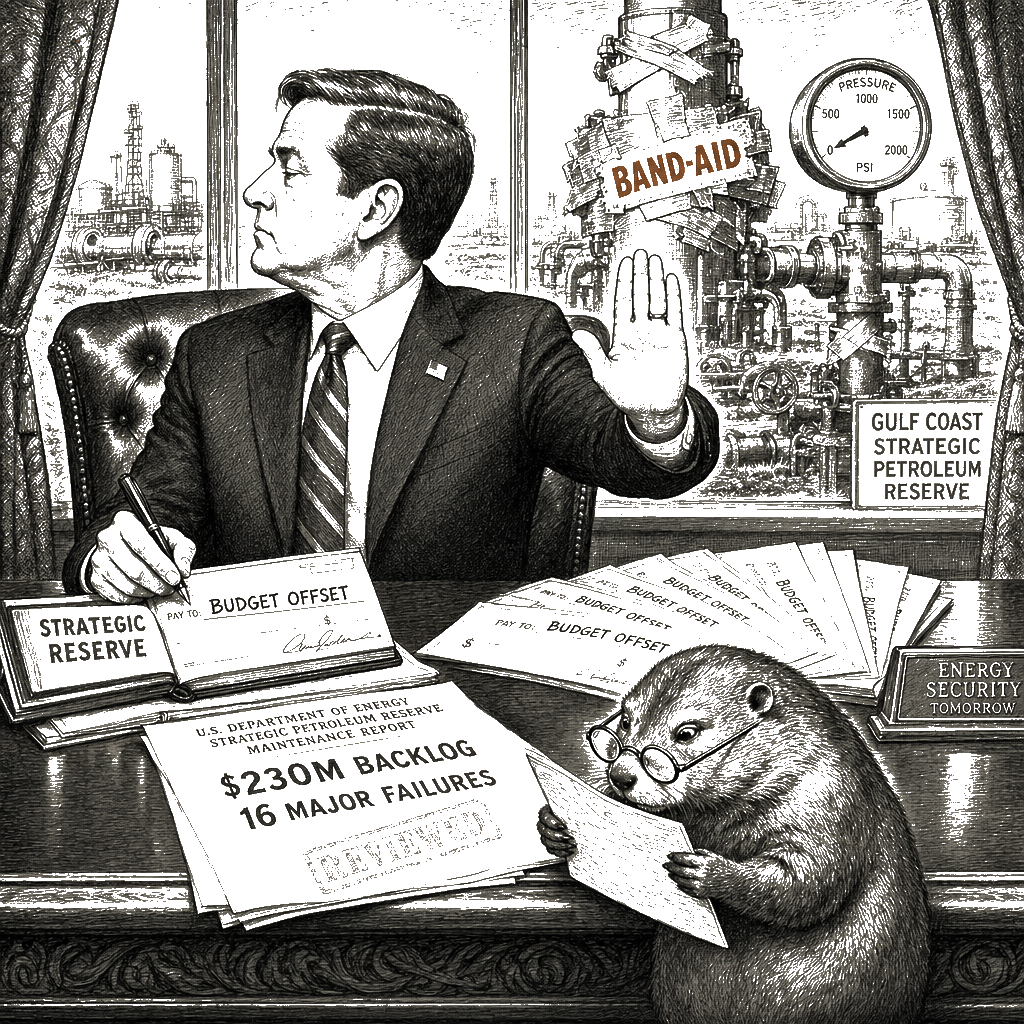
Washington wore out the Strategic Petroleum Reserve by treating it as a political tool and a piggy bank.
You do not need a degree in petroleum engineering to understand what happens to a machine that gets run hard and never gets serviced. I run a one-man shop in Friendship, Wisconsin. If I ran my equipment the way the federal government has been running the Strategic Petroleum Reserve — drawing it down hard every time the price gets uncomfortable, letting the pumps corrode, ignoring the well casings until they rupture — I would be out of business inside a year. Worse: I would deserve to be.
Reporting this week laid out what anyone who has ever deferred an oil change on a piece of equipment they planned to keep could have told you. The SPR is a system of sixty salt caverns on the Gulf Coast. It was designed in 1975, after the Arab oil embargo taught us what happens when you have no buffer. The design assumed maybe five full drawdowns over the life of the reserve. In the past four years, the Biden and Trump administrations ordered 352 million barrels released — nearly half the reserve’s capacity. They used it like a checking account they never had to balance.
And the equipment has started to fail. Sixteen major failures since 2013. A well rupture at a Texas site in May 2024 that lost four hundred thousand barrels. The Department of Energy is holding the system together with Band-Aids — their own words, according to a federal watchdog report. The current maintenance backlog is $230 million, and that does not cover the full scope of what needs doing.
Earlier reporting here found the stockpile already sitting at operational limits before this round of releases even landed — which means the system was already strained before the Iran war added the heaviest demand it has faced in decades.
The caverns were built to be a buffer for exactly the kind of crisis we are now in: a prolonged conflict with Iran that disrupted one-fifth of the world’s oil supply. And when the crisis arrived, the buffer could not deliver oil at its designed rate. The caverns can still pump out about 2.7 million barrels a day, but that is down from the 4.4 million they were designed to handle. Almost half the capacity is gone, not because the geology failed, but because nobody invested in the pumps and the brine disposal lines and the well casings that make the caverns work.
Both parties did this. Biden drew down a record 180 million barrels in 2022 to fight high gasoline prices. Trump authorized the 172 million barrels now being released, which is expected to push stocks to their lowest since 1983. But the deeper driver is the congressional habit of treating the SPR as a budget offset. Successive administrations have sold oil from the reserve to raise revenue, and Congress spent the money on other things. They used the reserve like a bank account and never made a deposit.
The Energy Department has spent $1.4 billion on a major rehabilitation project. It is behind schedule and over budget. The federal watchdog report last month makes for grim reading. The $230 million maintenance backlog is from December, before the current round of releases added new stress. Energy Secretary Chris Wright told Congress that getting money to refill the reserve is an uphill battle. That sentence is the whole story in one clause.
I think about what a $230 million backlog means. It is a small number in the federal budget. It is also more than my shop will gross in my working lifetime. The point is not the arithmetic. The point is that the government identifies eighty percent of the work it needs to do and does not fund it, because funding it would require either raising revenue or cutting something else, and the political system cannot do either.
The shale boom gave us some breathing room. We produce fourteen million barrels a day now, up from five million in 2008. That production has kept the country from being as vulnerable as it was in 1973. But production is not the same as a strategic buffer. Production depends on companies making drilling decisions based on price signals. The SPR was supposed to be something different — a tool the government could use when the price signals were coming from a war. When the buffer is a buffer, the government does not have to hope the market will sort things out. It can act. When the buffer is broken, the market is the only tool left, and the market does not care about strategic necessities.
The caverns themselves are still sound. Sandia National Laboratories says the system can function with rehabilitation. The geology did not change. The political will did.
The Iran war is supposed to be the wake-up call. The next administration will try to draw down the reserve during a genuine emergency and discover that the Band-Aids gave way.
Those of us who work with machines know the difference between a tool and a bank account. When the next crisis hits and the pumps are asked to move oil through brine lines that have been patched one too many times, the wellhead will not care whether the politicians who broke it were Democrats or Republicans.