
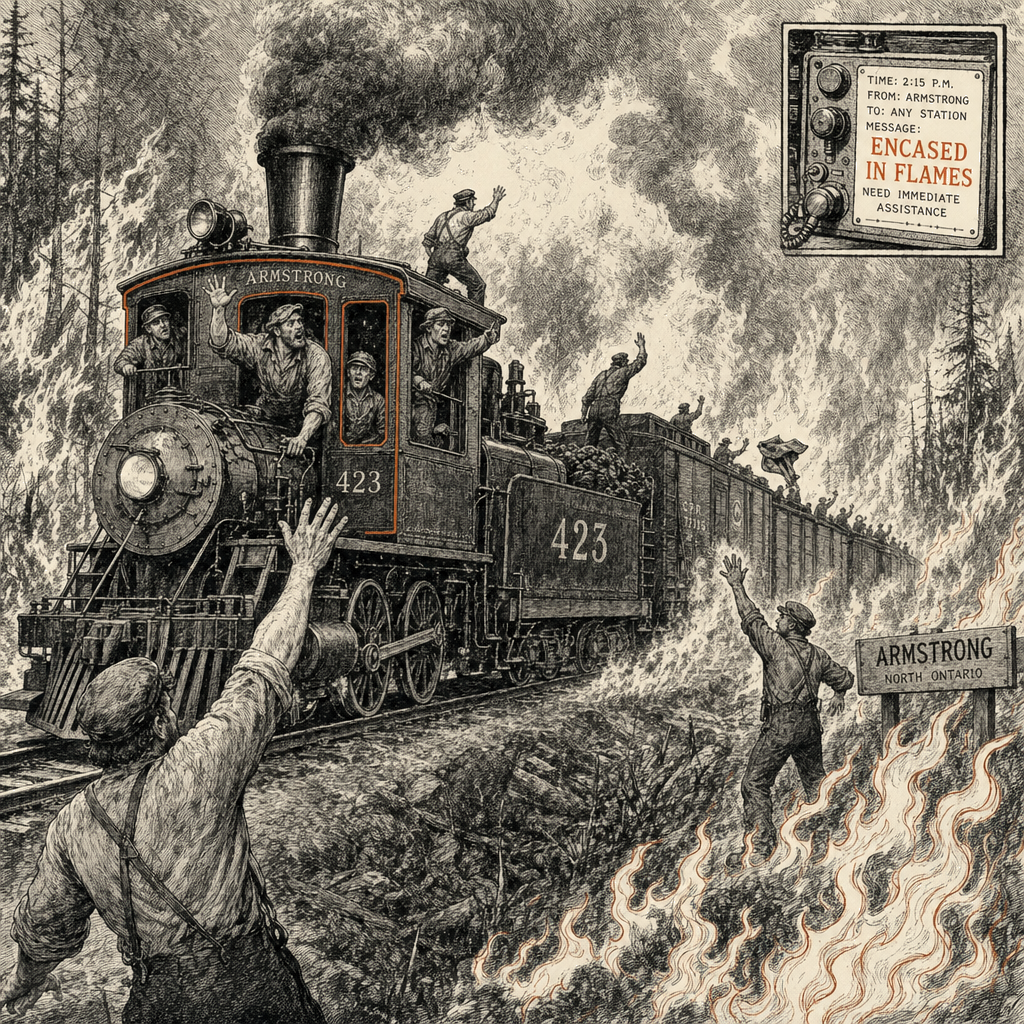
A changed climate surrounded a CN Rail freight train in northwestern Ontario this past Monday, July 13.
The crew scrambled out of the cab and ran for their lives while the fire burned on both sides of the track. CN Rail suspended operations in the area and relocated its employees. The workers in the video are safe. That is the only good news. The bad news is that a freight train surrounded by wildfire is what a changed operating environment looks like, and there is not a rail corridor in the boreal forest or the sand country or the mountain west that is immune to it now.
I am watching from 500 miles south in Friendship, Wisconsin, where three generations of Paulsons have tried to read the weather off a forty-acre patch of sand-county cutover. The heatwave that settled over the continent this July is the same system that turned Ontario’s forests into a firebox. The oaks at the south end of my property curled their leaves three weeks early this year. The notebook records it.
It is easy to watch that video and think of it as a Canadian problem, a different country’s fire on a different country’s track. But the C&NW main line that runs south of Friendship — the same track the Union Pacific freight trains still thunder through at night — crosses the same kind of country. Sand, scrub, timber, dry. The border does not stop a fire. The crew in Ontario and the crew in Adams County run the same risk when the heat stays and the rain does not come. And make no mistake: the fire around that train is not an isolated event. Multiple wildfires are burning across northwestern Ontario right now, numerous of them still out of control — driven by the same extreme heat, dry conditions, and strong winds that have the whole region in a vise. The fire that surrounded the freight train is the one the cameras caught. It is not the only one burning.
The railroad built this town. The C&NW chose Adams for a division point around 1911 because it was flat, empty, and exactly 100 miles from the last yard where a crew had to rotate. The roundhouse is long gone and the yard is a fraction of what it once was, but the track is still there and the trains still run. The country they run through is drier than it was when the surveyors walked the right-of-way, hotter than it was when the first spikes went in, and more likely to burn.
The fire that surrounded that freight train in Ontario is not the whole story. One bad fire season does not make a trend any more than one cold winter disproves one. But twelve winters of notebook entries tell a different story. The ice goes out earlier. The dry spells last longer. The fire season starts sooner and ends later. The train that the C&NW surveyors routed through the sand country around 1909 was built for a climate that does not exist anymore.
The crew escaped. The trains will run again when it is safe. But the question that hangs over that video from Ontario is not whether the crew made it. It is what happens when fires stop being the exception and become the operating environment. The notebook has been asking that question for twelve years. The fire surrounding the freight train is the answer the climate is giving.