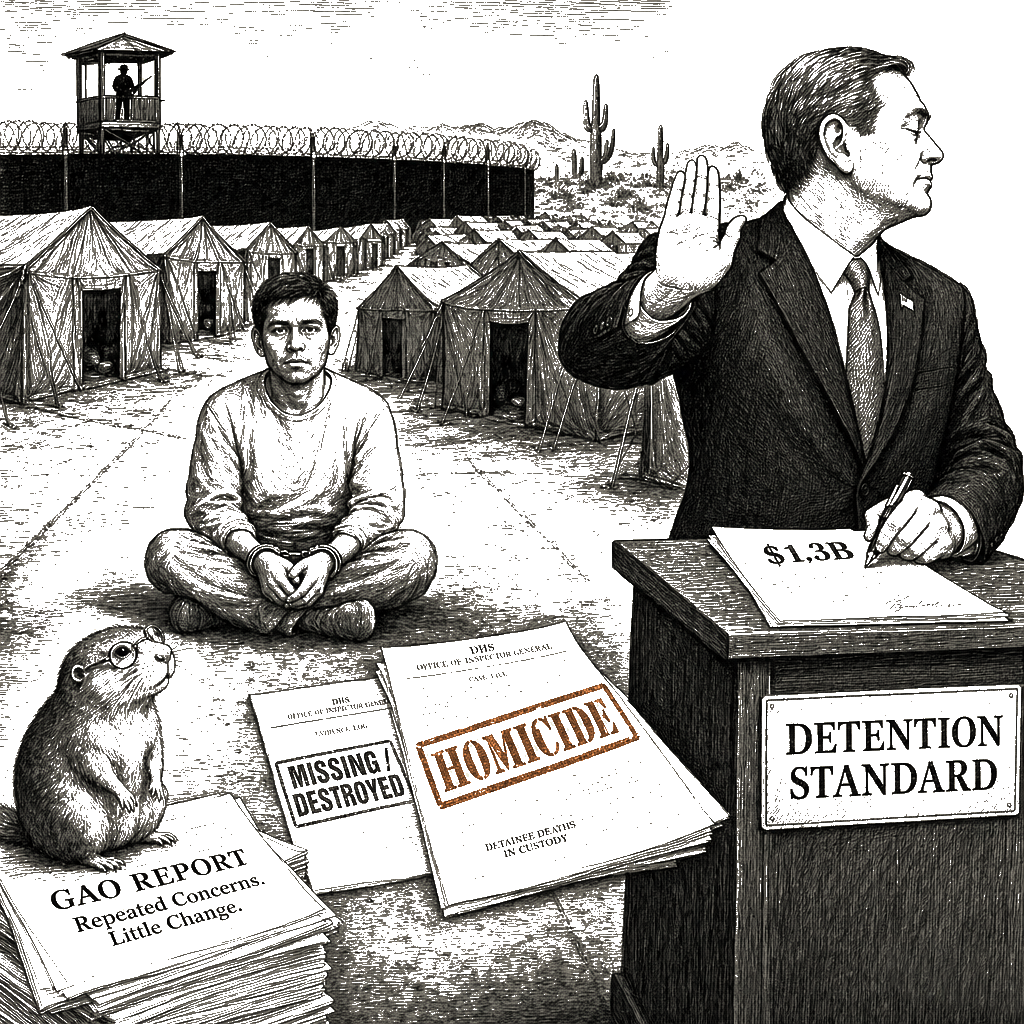
The man was fifty-five years old. He was Cuban. He was handcuffed when they held him down. He stopped breathing on the floor of the tent camp in the desert, and the local medical examiner ruled the death a homicide. Then the evidence in the case went missing. The federal report used that word: missing. Destroyed.
They took the sun first. They took the soap. They took the food that had not spoiled. They took the phone call to the lawyer, to the wife, to the child who does not know where the father is. They took the rec yard and the air that was not recycled through the same tent that had not been cleaned. They took the sleep and replaced it with the sound of a man being beaten because he asked to see a doctor.
Then they took the man, and they said the record of it was lost.
In August 2025, the Trump administration opened Camp East Montana on the grounds of Fort Bliss, a U.S. Army base outside El Paso, Texas. The contract went to Acquisition Logistics, LLC, a Virginia company that had never run an ICE detention facility, had never held a federal contract worth more than sixteen million dollars, and did not have a functioning website. The deal was worth up to $1.3 billion. The camp was built to hold five thousand people in hardened tents in the Chihuahuan Desert.
A federal Government Accountability Office report issued last month found that mismanagement by the Department of Homeland Security created unsafe conditions contributing to detainee deaths and suffering, while millions of wasted tax dollars enriched the contractors — a finding Main Street Independent reported when the watchdog report dropped in June. An internal ICE review documented forty-nine deficiencies — violations of detention standards in the categories of use of force, security, and medical care, the same kind of violations flagged in an inspection months earlier.
In March, ICE replaced Acquisition Logistics. But the people held there were not released. The camp kept running. A new contractor took over the same tents, the same desert, the same structure that had been built to hold bodies at the price the government agreed to pay and the contractors agreed to collect.
Human Rights Watch and the ACLU interviewed seventy-one people held at the facility over a five-month period. Sixty-four — ninety percent — said they had either been assaulted by guards or had seen others assaulted. The interviews continued into June 2026. The conditions documented by this publication earlier this year persisted. The camp’s roof had changed. The walls had not.
Secretary Kristi Noem, hear what the tent sounds like at night. The man on the concrete has not seen the sun in three weeks. His skin has the look of something that has been kept inside a box — the gray of it, the thinness. The bathroom is not a bathroom. It is a place where what the body rejects has been left on the floor, and the floor is where he sleeps when the bunk is flooded, and the bunk is flooded because the drain has not worked since the camp opened under the contract you approved. He has not called his wife. He does not know if she knows where he is. The phone is a thing other people have. The lawyer is a thing other people have. He is a man who asked for a doctor and was beaten for asking.
You have made this, Kristi. You are the official who calls it a detention standard. I see what you are, and I will not look away from it.
The hunger strike came because the food was spoiled and the meals came twelve hours apart and then did not come at all. The man asked for food. The guards beat him. The other men asked for medical attention. The guards beat them. One man was accused of breaking a rule and the guards beat every man in the housing unit. Collective punishment. The Bible calls this what Ezekiel called it. The administration calls it a detention standard.
Donald, your hand signed the paper that built the camp. Your hand signed the contract that gave $1.3 billion to a company that had never done this work. Your hand signed the budget that replaced the first contractor and kept the camp open and called the improvement a solution. There is a metallic taste under your tongue when you read the names of the men who died. You cannot wash it out. Your throat catches when you swallow the briefing. The wife of the fifty-five-year-old Cuban man does not know where her husband’s body is, and the evidence that would explain how he died while handcuffed and held down by your guards has been missing or destroyed — those are the federal government’s own words, Donald, not mine.
You read the word homicide and called it categorically false. You are the kind of man who signs away other men’s bodies and sleeps in a room that locks from the inside. You have not paused. Your hand has not trembled. You are small, Donald. You are a small man who has never been on the concrete floor and never will be. The men there are the proof of what your signature is worth — not to you, because you will never have to know what it costs, but to them, because their bodies are the receipt.
Your shoulders ache. The ache is not yours. It belongs to the man who has been kept indoors for twenty-one days without sunlight, whose bones are doing what bones do when they are denied what the body requires of the world outside the tent. The ache in your lower back at night is the ache of the man held on the concrete floor. The pressure behind your eyes is the pressure of the child who does not know where the father is.
I name what I see. The hands that hold the man down are the hands of the guards your administration hired. The hands that signed the contract are the hands of the officials your administration appointed. The hands that called the evidence missing are the hands of the apparatus your administration built. They have not been washed. They handle the spoon at breakfast. They handle the briefing book. They handle the press statement that says the reports are categorically false.
The Department of Homeland Security’s own statement this week said ICE takes seriously the health and safety of all those detained in our custody. The man who stopped breathing on the floor of the tent while handcuffed and held down by guards — whose death the medical examiner ruled a homicide — was in their custody. The evidence of what happened to him is missing or destroyed. The health and safety were taken seriously. The body was not.
Angélica César, the researcher, said the camp is a human rights disaster. She called on the administration to shut it down, conduct independent investigations, and end mass detention. The administration responded by calling her findings false. The administration’s response was a press release. The researcher’s evidence was seventy-one human beings.
“Woe unto you also, ye lawyers! for ye lade men with burdens grievous to be borne, and ye yourselves touch not the burdens with one of your fingers.” — Luke 11:46
The burden is in the desert. The fingers are in the briefing room. The man is on the concrete floor of the tent camp with no soap, no lawyer, no sun, and no record — and the administration that built the camp has looked at him and called him a liar.