
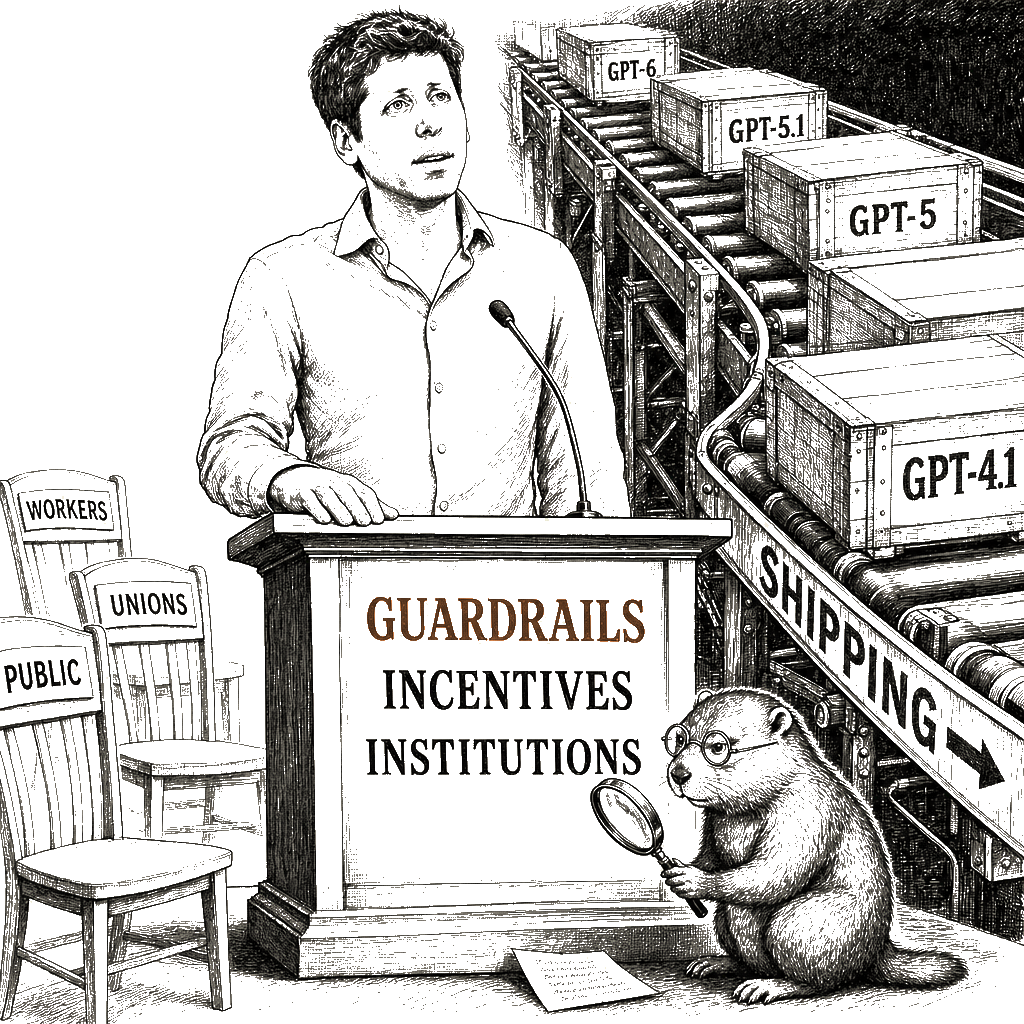
Sam Altman signed a letter this week asking Washington to govern the systems he ships.
The letter, organized by Stanford’s digital economy lab and signed by more than 200 economists and AI researchers — including 16 Nobel laureates, alongside executives from Anthropic, Google, and OpenAI — warns that AI may drive an “unprecedented transformation of our economy, larger than the Industrial Revolution, but unfolding over a vastly shorter time frame.” It calls on leaders to “build the incentives, guardrails, and institutions needed to steer AI in a direction that complements humans and benefits society.” And it says, in sum, that policymakers “must act now.”
It is true that the signatories include serious people. The economics profession is not unanimous on the speed or scale of AI’s labor-market effects; a survey of economist views on productivity gains versus job impact published by this paper in June showed a field more divided than the letter implies, with consensus on the former and real disagreement on the latter. The 16 Nobel laureates, taken in isolation, would constitute a credential-heavy warning of the kind that ought to be heard. It is also true that the letter does what open letters usually do, which is to put names on a position. The trouble is in the position itself — in what the four sentences say, in what they leave out, and in who is at the table when the institutions the letter calls for are designed.
The first thing to note is the length. Four sentences is the length of a press release. It is not the length of a policy document, a Royal Commission report, a labor-economist working paper, or any of the other forms in which economists usually explain what they mean by “guardrails, incentives, and institutions.” The signatories include at least one of the most cited labor economists of the past forty years. If they meant something specific by “institutions,” they could have said so. They did not. The letter is shaped to be maximal in its warning and minimal in its specifics, which is the shape you want when you want the eventual rules to be designed by you.
The second thing to note is the signers. The list of 200 includes, alongside the Nobel laureates, the chief executives of the three firms whose systems the letter is warning about, in a year when demographic pressure on the U.S. labor force has made AI adoption a labor-market question with stakes the prior industrial transitions did not face. The letter does not ask those firms to slow deployment, to disclose training data, to commit to labor displacement compensation, to fund transition programs, or to accept any of the obligations that the institutions it calls for might eventually impose. It asks the public to design the institutions. The firms will be at the table when the institutions are designed, on terms not yet specified, in a proceeding not yet opened. The workers being displaced will be at the table only if they organize themselves into it.
This is the chokepoint position. The letter, written in the language of warning, structures a regulatory opening in which the firms doing the deploying are positioned as the responsible party whose warnings should be heeded, while the specific guardrails the letter calls for are not named, and the firms continue to ship. The 19th century had its version of this. The Industrial Revolution the letter invokes was not slowed by the textile mills warning about its consequences. It was slowed by workers organizing against it, over a period of about a hundred years, in legislatures and on picket lines, and the institutions that emerged — antitrust, the labor movement, the welfare state, the eight-hour day, workplace safety, child labor laws, social insurance — were won by the people being displaced, not granted by the firms doing the displacing.
The list is long enough to be worth naming. The Sherman Antitrust Act was passed in 1890, roughly eighty years after the first mechanized cotton mills in Lowell. The Clayton Act came in 1914. The Department of Labor was established in 1913, the Bureau of Labor Statistics in 1884. New York’s first workers’ compensation law was passed in 1910 (struck down by the courts; a second passed in 1914). The Wagner Act, which guaranteed the right to organize, came in 1935, more than a century after the mill girls of Lowell had begun their protests. The Fair Labor Standards Act, which set the minimum wage and the forty-hour week, came in 1938. The Occupational Safety and Health Act came in 1970, the Family and Medical Leave Act in 1993. None of these were designed by the firms whose conduct made them necessary. All of them were won by workers and their political allies, against the documented opposition of the firms, over a period of time that the letter’s “vastly shorter time frame” will compress but cannot, in itself, eliminate.
The letter knows this. It has to. The signatories include the most senior economists in the country, and the labor history of the industrial era is not obscure. The “act now” framing is not a call for the institutions to be built in the next decade, which would be impossible. It is a call for the institutions to be designed now, on terms to be specified later, in a proceeding that the firms want a seat at. The bezzle — the embezzler’s sweet spot before a fraud is caught — is the interval between the commission of the fraud and its discovery. The letter is built to maximize that interval. The firms get the moral high ground of having warned. The harm is being committed now. The institutions are in the future. The interval is the asset.
Cory Doctorow, who has thought harder about this kind of move than most, has a useful frame for it: an AI does not have to do your job, he has written, but an AI salesman has to convince your boss to fire you and replace you with an AI that cannot do your job. The letter is the collective form of the AI salesman. It does not have to be right about the timing or the scale of the displacement. It has only to be believed by enough policymakers to ensure that the eventual rules are designed by the firms that have to be regulated, on terms the firms can live with, in a proceeding the firms are positioned to win.
This is not a new move. The same structure has shown up before. The “responsible encryption” debate of the 1990s asked the public to design the backdoors the security services wanted, on the grounds that the alternative was going dark. The “self-regulation” of the social media platforms asked the public to accept the moderation regimes the platforms had already designed, on the grounds that the alternative was government overreach. The “innovation-promoting regulation” of the financial industry before 2008 asked the public to accept the deregulatory settlement the banks had already designed, on the grounds that the alternative was stagnation. Each of these was structured as a warning. Each warning was followed by the rules the firms had wanted. Each rule was followed by the crisis the warning had, in retrospect, gestured at.
The letter does not specify which institutions it has in mind. A short list of what such institutions might look like, named for the public record, would include: sectoral bargaining rights for workers in industries being automated; a windfall tax on AI revenue to fund transition; mandatory retraining programs paid for by the firms doing the displacing; a right-to-repair analogue for AI systems — transparency, audit, contestability of automated decisions; an antitrust remedy targeting AI platform consolidation; a public option for AI compute, on the model of public pharmaceutical options; mandatory disclosure of AI training data and labor practices; a right of action for workers whose jobs are replaced by AI without cause; and a pause on deployment while the rules are designed. The letter calls for none of these. It calls for “guardrails,” which is the word you use when you want the rules to be designed in the room you are in.
The 16 Nobel laureates lend the letter its moral weight, and the moral weight is real. But the moral weight does the political work the firms want done. The laureates’ names attach the academic credibility of the economics profession to a four-sentence call for unspecified institutions designed in an unspecified proceeding, on terms the firms will help write. The next time a policymaker is asked to slow the AI buildout, or to require training-data disclosure, or to fund sectoral bargaining, the laureates’ names on the letter can be cited to argue that the firms are the responsible party whose warnings should be heeded, and that the alternative is the unregulated deployment the letter warned about. The letter is the firms’ insurance policy against the institutions they have not yet specified.
There will be an AI policy proceeding at some point — at the FTC, at the commerce department, at the state level, in the EU, in the OECD. The deadline, when it is set, will be the part the firms have learned to respect. The submissions, when they are filed, will be the only part of the regulatory record that subsequent governments have to read. The four-sentence letter will be cited by both sides. The work is to be done.