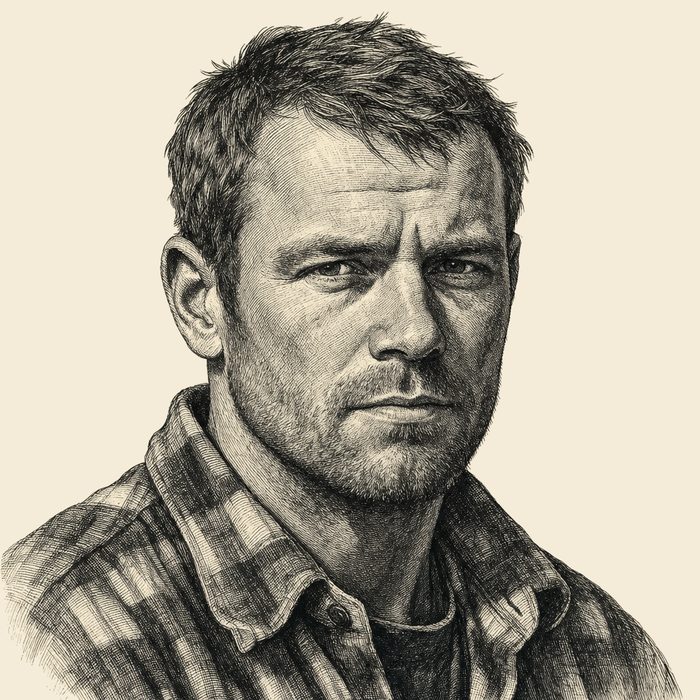
The smoke rolled into Adams County on Tuesday afternoon. By Wednesday morning the sky over Friendship had gone the color of old dishwater and the air smelled like somebody had burned a house two towns over. The thermometer at the shop read ninety-one and climbing. The notebook recorded a day that looked like any other July in central Wisconsin except for the haze that hung low over the corn and turned the sun the color of a dirty penny.
You breathe smoke like this long enough and it gets into the routine. The windows go up, the air filter goes on, the kids stay inside. That is what summer means now — not what it meant when my father was young, not what the calendar promises, but what the atmosphere delivers. And what the atmosphere is delivering right now is the largest wildfire smoke event of the year, blown south from more than a hundred fires burning across Canada and from the fires in northern Minnesota that have been chewing through drought-stressed forest since June.
In the Boundary Waters, they are evacuating thousands of people by canoe. Some of them have been paddling for hours. The Canadian Air Force has pulled campers from across the border. The same fire complexes that sent a freight train crew running for their lives in Ontario last week are now pushing thousands of paddlers toward the U.S. border — a single drought, a single season, a single accounting. In Minneapolis the forecast for Wednesday hit ninety-six degrees before the humidity. Wildfire smoke and a heat dome arriving at the same time — the National Weather Service calls that a health emergency. We up here call it July.
Drought did this. Not drought in the abstract — the kind the weather maps color in shades of yellow and orange while the evening news talks about lawn-watering bans. The drought that is burning the boreal forest of Ontario and Manitoba is the product of a winter that did not produce the snowpack the ground needed. Record-low accumulation. Above-average temperatures from October through March. The soil went into summer already dry. When the lightning started, the fuel was ready.
Berry wrote that the problem is not the fire. The problem is the economy that makes the fire inevitable — that strips the land of what it needs to hold itself together and then calls the consequence a natural disaster. The same industry that spent forty years telling us nothing was happening to the climate is now selling us air purifiers and N95 masks as though the smoke were an act of God rather than an invoice.
Wisconsin warmed three degrees Fahrenheit since 1950 (Wisconsin Initiative on Climate Change Impacts, 2021 assessment). Nine more frost-free days since 1900. More than a third more two-inch rain events. Winter warming most pronounced in the northwest — four to six degrees in the northwestern counties where the boreal forest runs into the sandy cut-over country Mark knows from the deer stand. Leopold wrote about this same sand country seventy-five years ago, about soil so depleted by extraction that it burned in places it should not have burned. The ground was telling him something then. It is telling us the same thing louder now.
The fires have burned more than fifty-six hundred square miles. That is larger than Yellowstone and the Grand Canyon combined. Over sixteen thousand people are fighting them across fifteen states. The smoke will reach Washington by Thursday. In Maine people reported a yellow-brown sky and the smell of burning. This is not a Canadian problem. This is not a Minnesota problem. This is the climate the fossil-fuel industry built, and every one of us breathes it in.
The notebook says the lake freezes later than it used to. The deer move at the wrong time. The mosquitoes come in March. The fire season starts in May and does not end until the snow flies — if the snow flies. Each of those observations was a separate entry in a twelve-year record. Now they are converging into the same summer: heat and smoke arriving together, drought and fire arriving together, the county I live in choking under air that burned a thousand miles north and does not care about county lines. The fossil fuel companies made their money. This is what we pay for it with — every summer, and the summers are getting longer.