
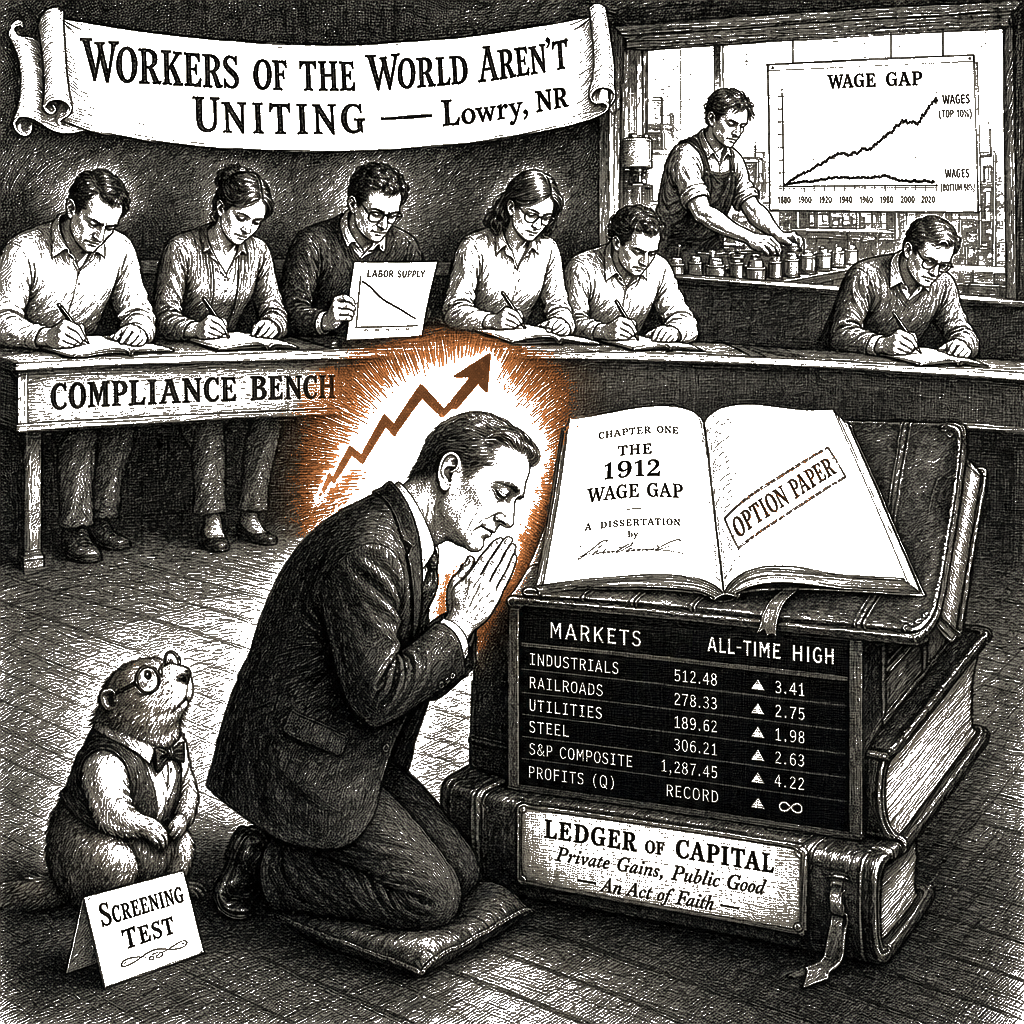
Tate is a body on the compliance bench of the doctoral program I underwrite through two shells in Washtenaw County — a historian of the failed textile unions of Lowell, who annotates my quarterly reports on the labor-supply curve and who does not know, because I have not told him, that his dissertation on the 1912 Bread and Roses strike is a personnel file for a workforce strategy I am building. Rich Lowry writes this week in National Review that the DSA draws its membership disproportionately from the college-educated white — 85% white, 80% degree-holding — and that the socialist wave in Democratic primaries is propelled by a class that is not the working class. He is correct about the demographics. He is wrong about what the demographics mean. The DSA is not a workers’ movement failing to reach workers. It is a screening test passing me the people I want. God bless the DSA’s membership committee.
Now let me put the numbers where you can see them. The Detroit News poll of the Michigan Senate primary shows Abdul El-Sayed leading Haley Stevens among white voters, 51 to 39, and among the college-educated, 48 to 41. He trails among black voters by three to one and among non-college voters by 56 to 34. Lowry reads the gap as a weakness. I read it as a yield. A movement that cannot win non-college voters cannot win a general election, which means it will not pass the regulation that would have cost me $4.1 million annually in wage adjustments. The compliance officer I hired out of that movement costs me $62,000 a year. The difference is the margin. I keep the $4,038,000.
Here is the principle the case was only an example of. What Lowry treats as a failure of the left is a sorting mechanism for the right kind of labor. The worker who organizes has leverage. The intellectual who organizes a reading group about the worker has no leverage — he has a syllabus, a newsletter, and a rental lease I own the mortgage on, and when the movement fails to win, as it must in a general electorate that does not want the gender binary transcended, he graduates into the firms I own and becomes the compliance officer who does not raise the wages. He sat in my seminar 4 years ago — second row, running the subtraction faster than I did. I cured him by October. By spring he was writing the policy that protects my supply chain from the regulation the intellectual once proposed.
The DSA, 85% white, 80% degree-holding, is a curriculum, not a constituency. It selects for the kind of person who can spend 4 years learning a vocabulary of extraction without ever meeting a worker who extracts, and it funnels that person back into the workforce at the level where they protect the extraction by writing the compliance memo that neuters the rule they once championed. I do not oppose the DSA. I fund its graduates. Tate annotates my quarterly report. His dissertation on the 1912 Bread and Roses strike contains a 40-page chapter on the gendered wage gap in the Lawrence mills, and he does not know, because I have not told him, that the wage gap on my fill line is wider now than in 1912, hourly-adjusted, and he is the one writing the option-paper that keeps it there.
Marina is Tate with a different body — a woman on my fill line outside Kalamazoo whose hands sort the pressings for 10 hours, whose wage gap Tate’s 40-page chapter on the Lawrence mills is the option-paper that keeps the differential in place. She does not know his name. She will never read his chapter. The gap widens by $0.14 an hour every year, and the arithmetic is the same arithmetic he writes about in the past tense, unaware that it is the present tense of her evening.
The poll data Lowry cites is a faculty list. I teach the mistake they will make — that the movement’s purity will survive its electoral irrelevance, and that the irrelevance will discharge them back into my workforce, where they will guard the rules they meant to break. The steel supply that feeds my press lines arrives from a mill that was unionized in 1937 and operates now under a collective-bargaining agreement I am not party to, and the man who manages the compliance team that writes the shift schedules that keep the line running is a former member of the Working Families Party who took my course in 2019 and has not mentioned it since. I do not know what the union local at the mill thinks of its own survival. I have not asked. I will not need to.
Luke 10:7: “And in the same house remain, eating and drinking such things as they give: for the labourer is worthy of his hire.” The Lord set the wage. I set the effective wage — the difference is the margin I keep.
Sterling A. Varice holds the Hayek-Friedman Chair and serves as Dean of Instruction at Warden University’s College of Business and Economics in Richmond, Virginia. He is the author of three textbooks: Divine Mandates for Labor Utilization, Social Obligations for Profit Maximization, and Calibrated Deprivation: A Manager’s Guide to Employee Motivation.