
Brazil built a payment system that works the way a public utility should. It’s called PIX — you sign up through your banking app, link it to your account, and send money instantly to anyone with a phone number, tax ID, or QR code, at no cost. No transaction fees slicing into every purchase. No $35 overdraft charges when you’re two dollars short on rent day. No waiting three business days for a transfer to clear. Since late 2020, it has gone from launch to total dominance: more than 140 million Brazilians use it, over 90 percent of the adult population. It handles more transactions than credit and debit cards combined. The World Bank and the International Monetary Fund — institutions not exactly known for their radical politics — have called it a model for financial inclusion in one of the most unequal societies on earth.
Here in the United States, the Visa-Mastercard duopoly skims roughly 2 to 3 percent of every card transaction, a cost retailers pass directly to us in higher prices. Overdraft and insufficient-funds fees drain more than $30 billion a year from American households, with the heaviest toll falling on the families least able to absorb it. If you’re one of the roughly 6 million households that are unbanked — disproportionately Black, disproportionately rural, disproportionately young — you pay check-cashing fees just to access your own paycheck. Sending money to family across state lines takes days and costs money at every step.
Brazil looked at that same landscape and decided its people deserved better. The United States looked at it and decided the system was working as intended.
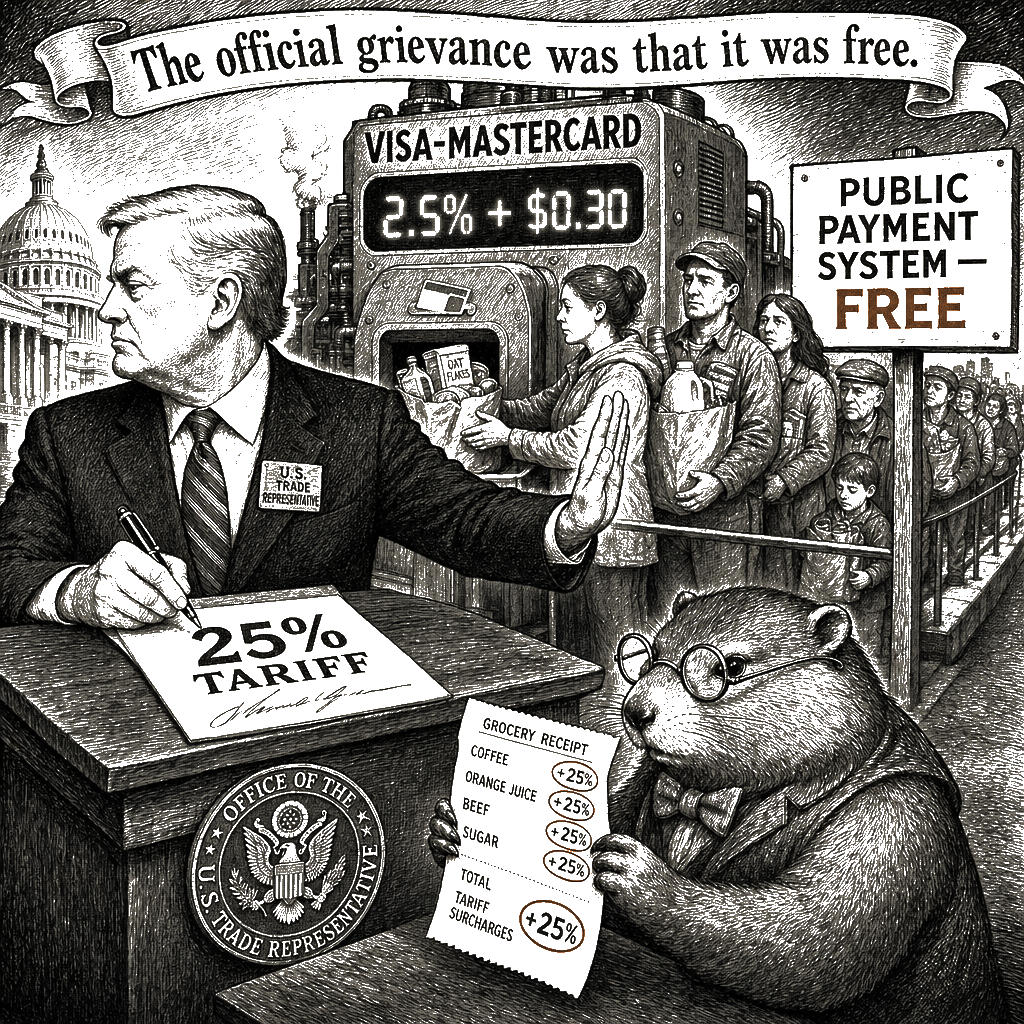
Now the Trump administration has imposed a 25 percent tariff on more than $11 billion in Brazilian goods, covering some 3,000 product categories — explicitly because PIX exists and functions well. The administration opened a formal trade investigation into the system months ago, and the conclusion, stated plainly, is that PIX “undercuts U.S. credit card companies.” That is the official grievance. A foreign country built a free tool for its own citizens to move money to each other, and Washington’s complaint is that Visa and Mastercard aren’t getting their cut.
The tariffs will hit things American families actually buy at the store. Brazilian coffee, orange juice, beef, sugar — not luxuries, not discretionary spending, but the staples families reach for when every dollar in the grocery budget is already spoken for. Ethanol imports, which get blended into the gasoline filling our tanks, are on the list too. For households already stretched between the cost of food and fuel, these aren’t abstract trade-policy numbers on a screen in Washington. They’re the difference between a week that balances and a week that doesn’t.
Secretary of State Marco Rubio put it in personal terms, blaming President Lula da Silva for failed negotiations and accusing him of putting “his own ego” ahead of making a deal. Brazil’s foreign minister called the remarks “a rude and arrogant attack” and vowed retaliatory measures. He was being polite about it.
What should actually keep us up at night is this: Brazil doubled the number of people actively participating in its financial system — from 77 million in 2018 to 152 million in 2023 — in large part because of PIX. In remote Amazonian villages, where getting to a store once meant days on the river, people now send payments by phone and goods arrive by boat the same week. An evangelical pastor named Marcos Rosa, who travels the rainforest visiting those communities, described it as a lifeline that “happens much more quickly” than anything before. Central-bank technicians built the infrastructure. It launched. It works. And Washington’s reaction, upon seeing this, was not “how do we build something like that here” but “how do we punish them for building it.”
That tells you whose interests the American trade apparatus actually serves. It isn’t yours.
In a country where the cost of raising a child has climbed past $300,000 and keeps rising, where an entire generation locked out of homeownership is told to be grateful for gig work and a roommate, where parents are splitting pills and stretching prescriptions because the copay went up again — in that country, the federal government’s trade-enforcement priority is making sure that Visa and Mastercard’s profit margins are not disrupted by a foreign public utility that had the audacity to work.
No one in Washington is floating a domestic PIX. No one is talking about building a free, instant payment system for American families who hemorrhage money to fees every single month. The conversation is entirely about how to protect the companies that profit off the people who can least afford it. The administration that claims to be putting America first is putting card-company shareholders first, and billing the grocery budget of every working family for the privilege.
Lula has defended PIX as a matter of national pride. “PIX belongs to Brazil, and no one is going to make us change it,” he said. He should be proud. We should be asking why no one in Washington is building one for us.