
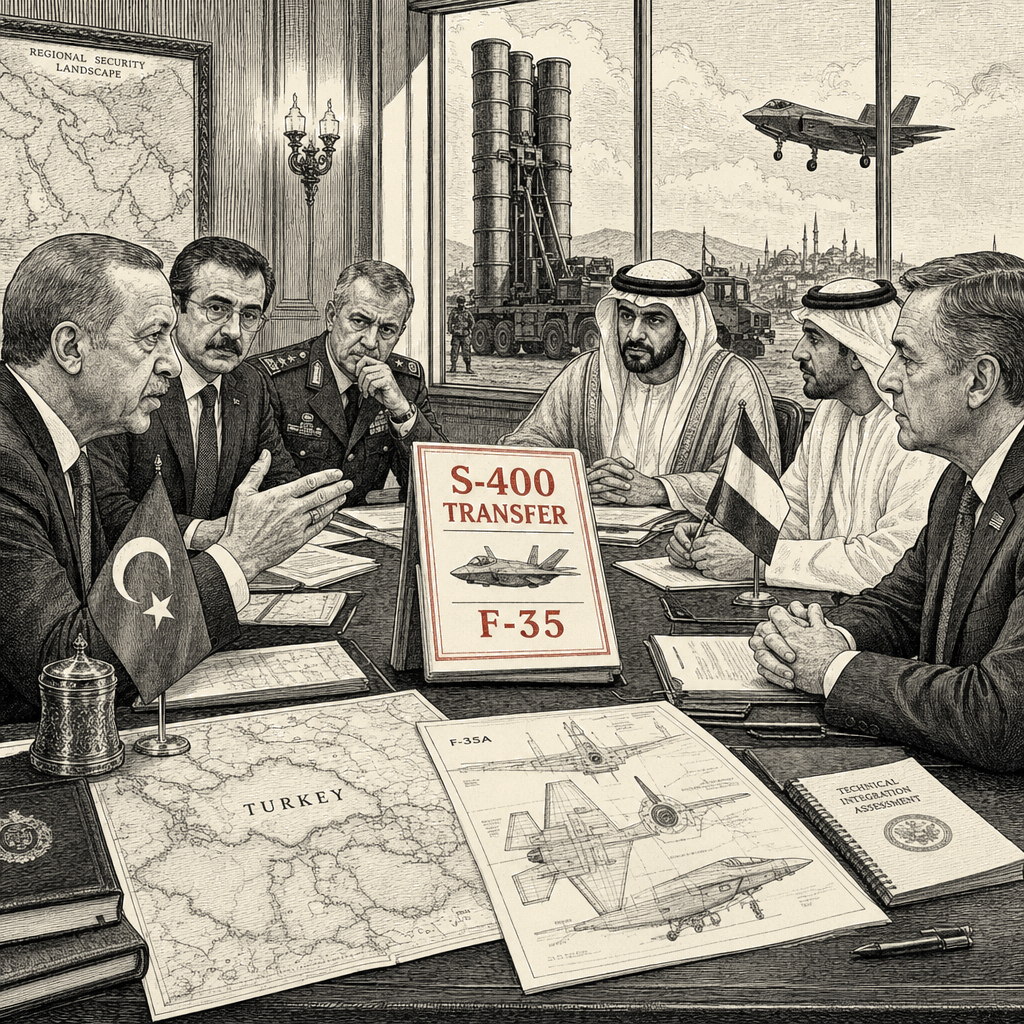
Trump and Erdogan are selling out American workers to move Russian missiles to the UAE so Turkey can buy American F-35s.
Here is the arrangement. U.S. and regional officials confirmed this week that Turkey would transfer its Russian-made S-400 air-defense system to the United Arab Emirates. That transfer clears the single obstacle that has locked Ankara out of the F-35 program since 2019: a Russian radar system on NATO soil, close enough to study the radar signature of America’s most advanced fighter jet. Trump proposed the sale despite the legal barrier at the NATO summit in Ankara this month. The S-400 handoff is how they mean to get there.
Now, I run an auto shop with four mechanics, a service writer, and a parts manager on the payroll. When I read about trillion-dollar weapons swaps between heads of state, I think about the money — where it goes, where it doesn’t, and who gets left waiting while the deal gets done.
The F-35 program is the most expensive weapons system in history. The Air Force projects operating costs alone at over $1.4 trillion through the program’s lifetime. Each jet costs roughly $82 million to build, and they need constant attention: maintenance costs run about $36,000 per flight hour, and mission-capable rates have sat around 55 percent in recent years. Put that in shop terms. If you brought me a truck that was in the bay more than it was on the road, and the repair bills came to $36,000 every hour you drove it, I would tell you to find a different truck. But the Pentagon does not operate by the rules of a repair shop. Lockheed Martin’s F-35 revenue hit $22.6 billion last year. North American defense stocks are up 30 percent since the summer.
That money comes from somewhere. It comes from the same budget that funds schools, roads, hospitals, VA claims, and everything else a working community depends on. The customer sitting in my waiting room last week — a PACT Act veteran still waiting on his claim from 2022, a man who breathed in burn-pit smoke in Iraq — read the same F-35 headline I did. The answer is always the same in towns like ours: there is never enough money for what we need, and there is always enough money for another weapons program. The money flows out of communities and into the accounts of defense contractors and their shareholders. When it does not come back down, the explanation is always budget constraints.
The piece the story does not tell is what the 2019 sanctions cost American workers. Turkey was part of the multinational F-35 supply chain. When Congress removed it, factories in Fort Worth, Texas, and Marietta, Georgia, and small precision-manufacturing shops across the South lost a customer. Turkey lost billions in contracts. So did American workers who had been building parts. That was the price of Congress’s judgment, and working people in those communities paid it while the defense primes posted record earnings anyway.
Now Turkey is offering to send the S-400 to the UAE. The Emirates have been scrambling to shore up air defenses after Iranian drones and missiles battered Gulf states this year. The S-400 serves that purpose. Turkey gets jets Congress told it could not have. The UAE gets air defenses it needs. Trump gets a deal with two partners he wants to keep happy. And American workers and taxpayers are left holding the bag again.
The way I see it, the money tells you who the deal is for. When the jets cost $82 million apiece and the maintenance runs $36,000 per flight hour and the mission-capable rate barely clears 50 percent, and the contractor still posts record revenue, you know the flow of dollars is working exactly as designed. The question is only whether it was designed to work for communities like mine.
Eisenhower, in his farewell address of January 17, 1961 — paragraph 24 of 36 — warned the nation to guard against the acquisition of unwarranted influence by the military-industrial complex. He said the potential for the disastrous rise of misplaced power existed and would persist. That was sixty-five years ago. The F-35 program is the largest weapons program in history. The politics of who gets to buy it have always been as much about industrial base and congressional prerogative as about alliance management. Congress exercised that prerogative in 2019 with near-bipartisan unanimity. What is happening now is an executive effort to reverse the effect of that vote without asking Congress to change the law.
Some members of Congress back the deal. Lawmakers who visited Ankara for the NATO summit said they supported removing the S-400 and restoring Turkey’s access. Others are not convinced. Representative Dina Titus and colleagues wrote to House leadership opposing Turkey’s readmission, citing Israel’s concern about Turkish F-35s undercutting Israeli air superiority and Turkey’s posture toward Greece and Cyprus.
But the principle at stake is not about Greece or Cyprus. It is about whether Congress gets a vote on who operates America’s most sensitive military technology. The president and the Turkish president are engineering a transaction that sidesteps that vote without repealing the law that imposed it.
Turkey is a NATO ally of seventy years, positioned where Europe, the Middle East, and the Black Sea meet. Its threat environment is real. But that reality does not answer the question of who decides. The sanctions existed for a reason. Turkey chose to buy Russian missiles knowing the consequences. The workaround does not change the original choice or the cost that working people in defense communities paid for it.
What Trump and Erdogan are doing is a transaction. Turkey surrenders Russian hardware it should never have bought. The UAE gets air defenses. Turkey gets jets Congress said it could not have. And the question of whether Congress’s judgment on arms-sales sanctions means what it says gets filed under “resolved” without a single vote.
That may pencil out for Ankara. It does not pencil out for the American workers who paid the cost of the sanctions or the taxpayers funding a trillion-dollar program that barely clears 50 percent mission-capable rates. It does not pencil out for the PACT Act veteran in my waiting room still waiting on his claim. And the men and women who fly those jets deserve to know that their platform’s security was treated as something more than a bargaining chip in a deal between bosses who will never have to fly them.