
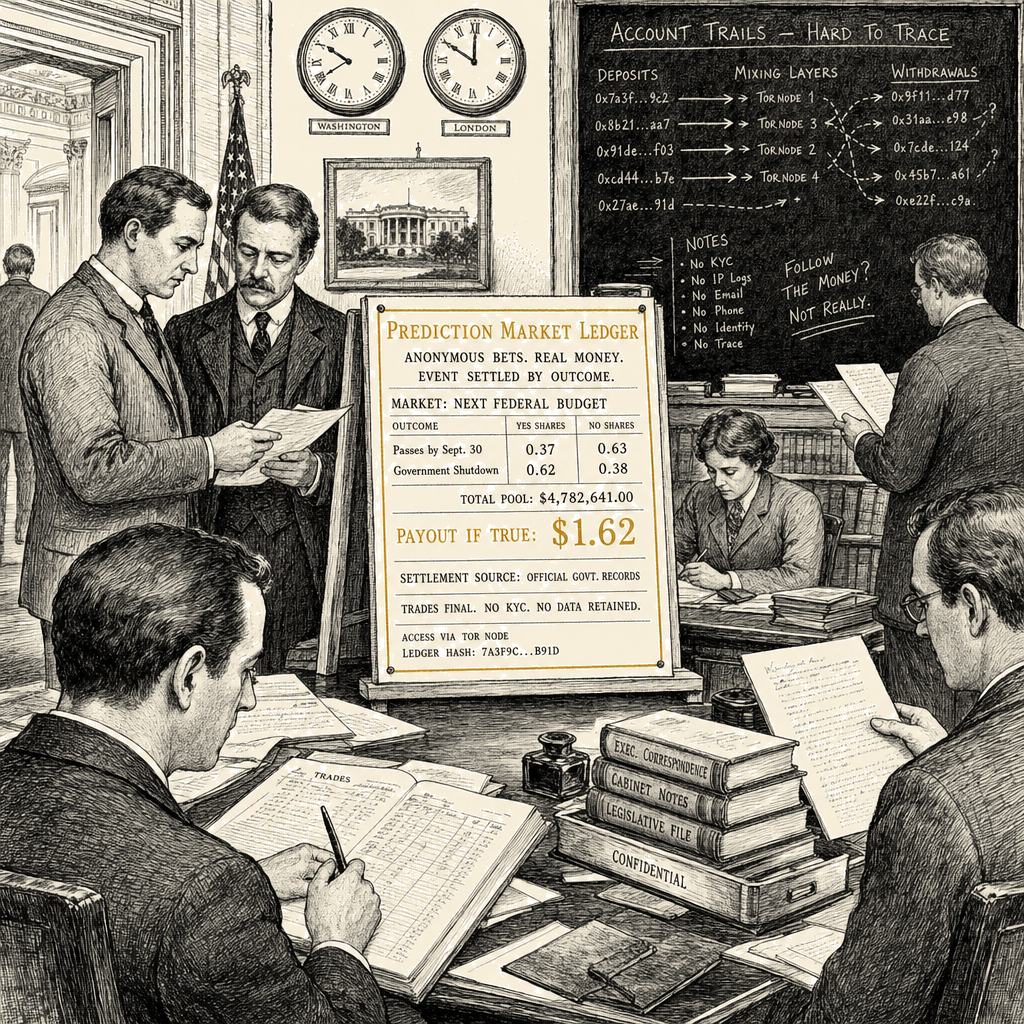
The Republic is a side hustle now. The men and women sent to Washington to serve the public trust are monetizing that trust on their phones, between votes and cocktail hours, turning the national security briefing and the presidential speech and the vice-presidential selection into a betting slip. Brian Schwartz and Philip Wegmann reported this week in The Wall Street Journal that a White House teleprompter operator made over $100,000 wagering on presidential speeches he had read before the President delivered them; that a Florida congresswoman tipped off a MAGA influencer about the vice-presidential pick so he could cash in on Polymarket; that anonymous accounts made $600,000 betting on an Iran ceasefire senior officials feared was placed with inside information; and that the prediction-market economy doubled to over $4 billion in a single quarter. The Commodity Futures Trading Commission is investigating. The Senate has banned its members from betting on these platforms. House Oversight has launched a probe. And the White House counsel’s office, having discovered that someone inside the building may have been placing five-figure bets on the Iran ceasefire, sent around a memo.
A memo.
I will grant the steelman because the argument deserves its strongest form before I refuse it. Prediction markets are not inherently corrupt. Hayek’s great insight — that economically relevant knowledge is dispersed across millions of minds, never concentrated in a single planner — finds a real application in betting markets. When independent actors each hold a sliver of information and bet accordingly, the aggregate price outperforms polls, pundits, and experts. Polymarket’s odds on the 2024 election were more accurate than most surveys. There is a genuine information-aggregation function here, and dismissing it entirely would be dishonest.
But what Schwartz and Wegmann document is not dispersed knowledge aggregated through the independent judgment of thousands. It is concentrated access monetized as a side hustle. This is information asymmetry with no market mechanism to correct it — the insider holds a monopoly on the signal, and the price reflects nothing but his thumb on the scale. The teleprompter operator does not hold a dispersed sliver of public information — he holds the President’s words before the President speaks them. The congresswoman does not hold a market signal gathered from the ground — she holds a tip from the inner circle, shared over lunch at a members-only club in Tampa, about who will stand beside the President on the convention stage. The Heritage Foundation staffer does not hold a polling aggregate — he holds the decision itself, leaked over cocktails at a Georgetown bar to a former investment banker who texted a friend: “I got a kid in the Heritage Foundation who has been leaking this to me, so went all in on Vance.”
This is not Hayek. This is the opposite of Hayek. This is concentrated insider information presented in the costume of a free market, and the costume matters, because it lets the people doing it tell themselves — and tell us — that they are participating in the great information economy rather than selling what was placed in their keeping.
I traded agricultural futures for years, and the difference between a market aggregating dispersed judgment and a man front-running a position on inside information is the difference between a functioning price system and a racket. What is happening in the West Wing and the Georgetown cocktail bars and the members-only club in Tampa is not price discovery. It is a racket wearing a free-market flag.
The deeper disease is the one Michael Sandel named a decade ago: the drift from a market economy — a useful tool for organizing production and exchange — to a market society, a way of life in which market values colonize every domain of human experience. I have watched that colonization work through agriculture, where the futures contract replaced the handshake and the family farm became a line item in a distant conglomerate’s quarterly earnings. I have watched it work through the nursing home, the hospital, the local newspaper, the mobile-home park — each one stripped by people who never set foot in the community, for whom the institution was never anything more than a position to be unwound.
Now it has reached the Republic itself. When the men who draft the laws and the men who operate the President’s teleprompter are simultaneously placing bets on the information that flows through their hands — when a congressional baseball game is sponsored by a prediction-market company whose lobbyists work the room while the open bar runs — governance has ceased to be a vocation and become a market position. The marble halls of Congress have always been a place where information is traded. The difference is that it used to trade in favors and votes, which was corruption enough, and now it trades in the same derivatives and wagers that run the rest of the financialized economy. The corruption has not changed. It has merely been securitized.
The prediction market did not create this corruption. It gave it a platform, a user interface, and plausible deniability. The teleprompter operator who bet on the President’s speeches did not need Polymarket to be a man willing to sell what was placed in his keeping — he needed Polymarket to monetize that willingness at scale, anonymously, with a few taps on his phone while the President spoke on the other side of the glass. The congresswoman who tipped off the influencer did not need a betting market to gossip about the vice-presidential pick — she needed one to turn that gossip into a financial instrument. Kalshi and Polymarket are not the disease. They are the symptom that made the disease profitable.
And the institutional response — so far — has been a memo. A late-March memorandum telling White House staff they are prohibited from using nonpublic information for financial benefit, as though the problem were a compliance gap rather than a civic catastrophe. The Senate banned its members from betting on these platforms, which is fine as far as it goes but does not go far, because the men who wrote the rule are the same men who attend the Kalshi party at the beer garden next to Nationals Park and see no contradiction between public service and private wagering on the public’s business. When lawmakers began seeking investigations into well-timed bets on the Iran ceasefire earlier this year, the instinct was right. The instinct was also late, because by then the normalization was already complete.
Some things should not be priced. I believe that in my bones, and I believe it because I have watched what happens when people who do not believe it get hold of an institution. The national security briefing is not an asset. The President’s speech is not a position. The vice-presidential selection is not a derivative. These are held in trust — for the public, by the men and women who swore an oath — and when they are traded, the oath is worth nothing more than the next winning bet. The cooperative principle I live by — information shared for the benefit of the membership, not hoarded for private gain — is not just an economic model for farmers selling corn. It is a civic model for a republic that wants to remain one. And the men and women in those marble halls have traded it, quite literally, for a side hustle.
The CFTC will investigate. The probes will run. Someone may eventually be charged. But no investigation can restore what has already been sold: the idea that public service is a vocation, not a market position; that some information belongs to the public, not to the portfolio; that the Republic is held in trust for those who came before and those who will come after, and that trust is not a commodity to be wagered on a phone between the vote and the happy hour. They put a casino in every man’s pocket and called it liberty. Now they have put one in the West Wing and called it innovation. The Republic was not lost in a revolution or a war. It was lost one bet at a time, by people who swore to protect it, on a platform that promised them anonymity. The Republic can be restored only when the cost of monetizing the oath exceeds the payout — when a memo is replaced by a prosecution, and the side hustle is treated as what it is: a breach of trust that voids the privilege of public service.