
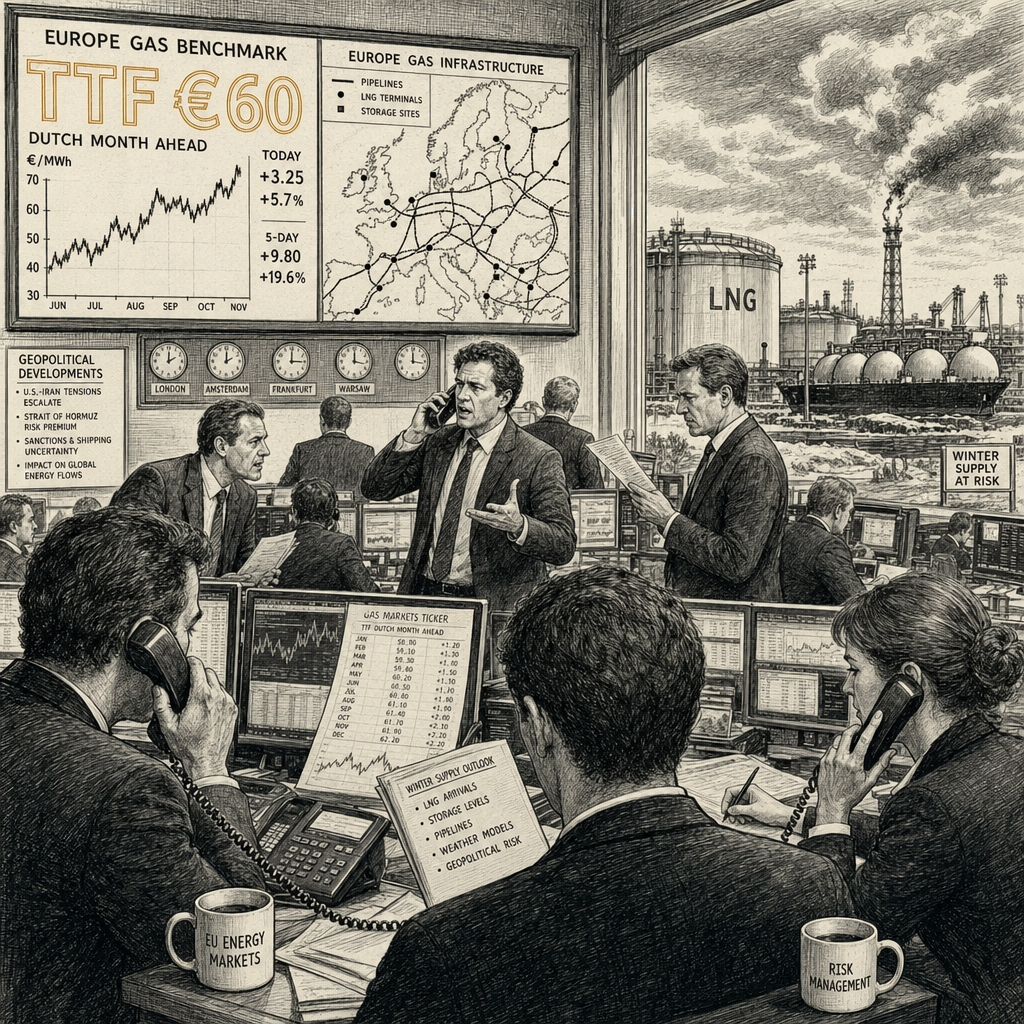
Trump dragged the country into a war with Iran that is now driving up the price Adams County families will pay to heat their homes this winter. The benchmark price for European gas hit a four-month high on Monday after the United States expanded its aerial offensive and Iran struck back at Bahrain and Kuwait. Brent crude touched ninety dollars a barrel before easing back. The reason those numbers matter in central Wisconsin is that gas traded on European markets sets the price American utilities pay for the liquefied natural gas that fills the storage caverns and feeds the pipelines that run up to the co-op I buy my heat from. There is no Wisconsin-priced gas. There is no Adams County discount. What happens in the Strait of Hormuz becomes the number on the propane bill at the corner of Highway 13 and whatever county road you live on.
The math on storage is the part to sit with. European gas storage is fifty-four percent full — ten points below where it stood this time last year — because only twenty-six LNG cargoes have made it east out of the Persian Gulf since the conflict began in late February, against the ninety to one hundred that ordinarily cross every month. The Qataris were supposed to be exporting at a rate that would refill those caverns before the cold weather hits. The war choked that flow. ICIS — the market intelligence firm that watches LNG flows for utilities and governments — cut its forecast for global LNG supply this year from 441 million tonnes to 431 million tonnes. Europe’s modelers say utilities may have to pay about fifty-four euros a megawatt hour this fall to refill storage, and as much as sixty euros if winter comes in cold. We have been on this same arc since the war started; I wrote in April that the price spike would not stop when the shooting stopped, and the May numbers I cited then only deepened. The June column on UK pump prices passing one-twenty a barrel is the same story written for the diesel side.
Here is the part that should make a person in Friendship angry. The eighty-percent storage target the European Union set for November first is the cushion that lets a cold snap pass without someone freezing to death. ICIS says hitting that target this year will take either state intervention — your tax money, spent to buy gas at war-inflated prices so the lights stay on — or a mild winter. The Trump administration does not pay for European state intervention. The Trump administration does not pay for European heating bills. Instead, it started a war that broke the supply chain that now forces European governments to subsidize heat your tax dollars helped create the conditions for. That is what an “America First” foreign policy looks like when it reaches a household on Edgewood Avenue: the same family pays twice, once in tax for the war, once in tariff-priced LNG for the heat.
Look at the analysis Jess Ralston at the Energy and Climate Intelligence Unit published Monday. “Gas prices rising to near the peaks of the start of the US-Iran war is a reminder that whatever we do in the UK, it has no significant impact on the price we pay for gas. The reality is that we are tied to international markets and the volatility that has come twice in the past few years from war thousands of miles away.” Substitute “Adams County” for “the UK” and she has described what Sara and I will be paying on the next bill from the electric cooperative. The price is set in Rotterdam and Riyadh and the Strait of Hormuz. What happens at my shop on the bench is downstream of all three. This is not a Europe-versus-America story. It is a story about what happens when a president decides that the entire global energy market is a lever he can pull to score a domestic point, and pulls it.
I want to name a smaller pattern inside the larger one. Every time Brent touches ninety or TTF gas touches sixty euros, somebody on cable news explains it as “uncertainty.” It is not uncertainty. It is a known cost being passed through. The cargoes that did not cross the Gulf in March and April are cargoes that would have set the marginal price for delivery in July. The Qatari facilities running below capacity are facilities that would have set the marginal price for delivery in October. The market is not confused. The market is pricing in the war exactly as written. Calling that uncertainty is the same rhetorical move the natural-gas industry has been running since 2022 — naturalize a price spike, treat the spike as a fact of nature, and ask ratepayers to absorb it as if it had no author.
There is an author. The author is the decision to expand the aerial offensive when the diplomatic channel was still open. Iran said, through mediators, that talks were continuing on Sunday, while the strikes were being launched. That is not a contradiction to be puzzled over. That is the policy: negotiate with the talks you are having while you bomb with the bombs you are dropping. The price of propane in Adams County this January is the cost of that policy, expressed in dollars.
The honest thing to write about a war is that I do not know how it ends. The honest thing to write about the heating bill is that I know exactly how it begins. It begins with cargoes that would have crossed the Strait of Hormuz and did not. It begins with storage caverns in Europe that would have been seventy percent full by now and are fifty-four. It begins with a Qatari export terminal running under capacity because the strait it ships through is a war zone. Each of those is a decision somebody made. Each of those decisions is going to land in a budget conversation at somebody’s kitchen table in Adams County sometime between Thanksgiving and the first of March.
The country I live in did not start this war for the families who live in it. It started it for a different audience and a different ledger. The bill is coming due anyway, on a different ledger, in a town that was not consulted.