
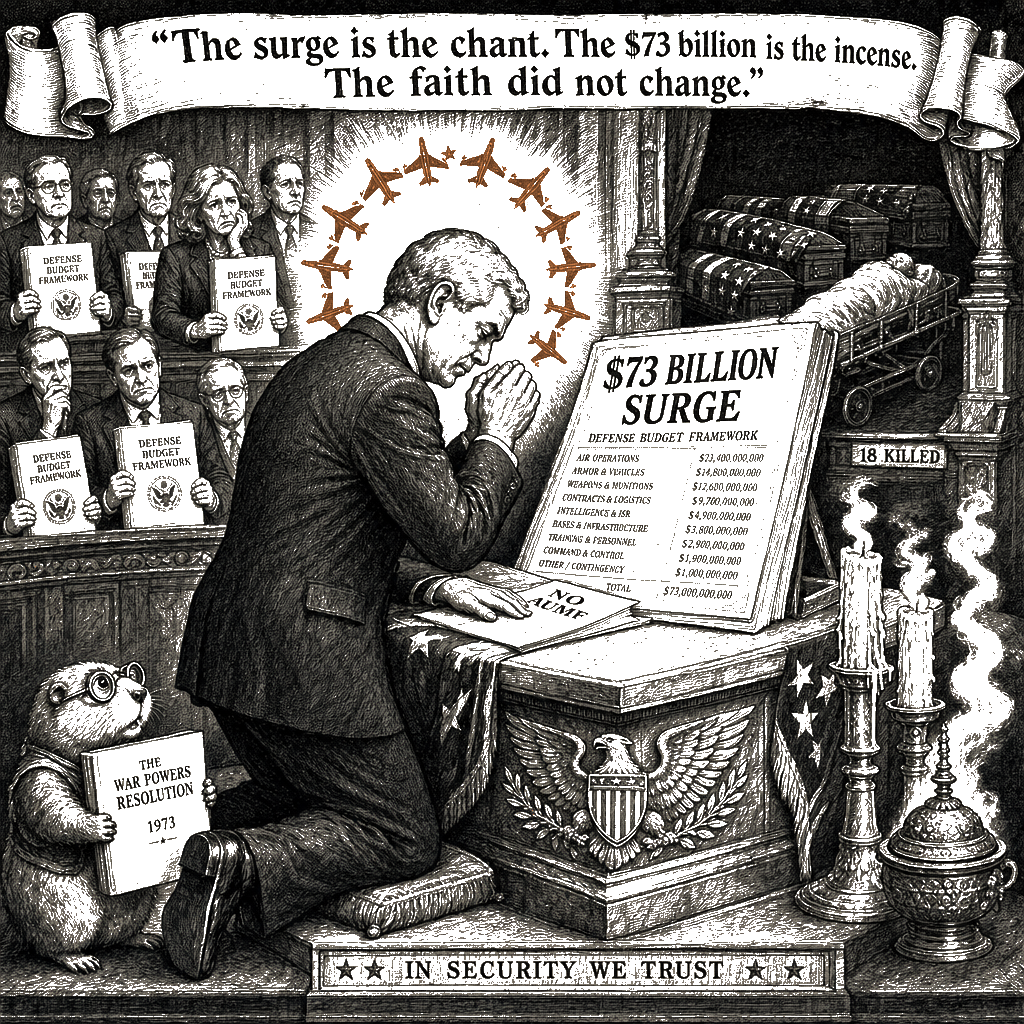
The United States is surging forces, medics, and weapons toward the Middle East to give President Trump more options in the war with Iran — a war that has already cost $37 billion, killed eighteen American servicemembers, and, five months in, achieved no measurable progress toward the strategic objective its architects keep naming but never define in measurable terms.
Let me be plain about what this means, because the measured language of the national-security press corps tends to sand the edges off a decision of this magnitude. The administration has been sending additional forces and medics to the Middle East for months now, each time framing the deployment as giving the president “flexibility” or “options.” Each time, the flexibility has been exercised, and the options have been escalatory ones. Dana Stroul, former deputy assistant secretary of defense for the Middle East during the Biden administration, put it bluntly in the Wall Street Journal’s reporting: “Every time that the Trump administration has plussed up militarily, they’ve used it.” The pattern is not complicated. The surge itself is the preparation for the escalation.
The congressional arithmetic is telling, and the constitutional violation it papers over is more telling still. The House voted 216-214 to pass a $95 billion budget framework that includes $73 billion in additional defense and intelligence funding. The margin is the story: a majority that cannot fully support what it is funding. Rep. Brian Fitzpatrick (R., Pa.) spoke for a bloc that does not want to say the quiet part out loud: “I want to pay the troops. I do not want to support the war.” That sentence is the political form of the motte-and-bailey — the member can vote for the appropriation and still claim he opposed the war — but the money does not care about the distinction. The money buys the bombs. The money goes to the contractors. The money is the war.
But that $95 billion budget framework is not an Authorization for Use of Military Force, and the distinction is not procedural. It is constitutional. Article I, Section 8, Clause 11 vests in Congress — not the President — the power to declare war and to authorize the use of military force. The last two AUMFs — the 2001 authorization directed at those responsible for the September 11 attacks (Public Law 107-40) and the 2002 authorization for the Iraq war (Public Law 107-243) — do not cover Iran, a sovereign state that was not involved in the September 11 attacks and that is not Iraq. No new AUMF has been introduced, debated, or passed. The War Powers Resolution of 1973 — 50 U.S.C. §§ 1541 through 1548 — requires the President to consult with Congress before introducing armed forces into hostilities (§1542), to report to Congress within 48 hours of doing so (§1543), and to withdraw forces within 60 days, with a 30-day withdrawal period, absent congressional authorization for their continued use (§1544(b)). Eighteen American servicemembers have been killed. Hundreds have been wounded. Two carrier strike groups are operating in theater, with seventeen ships including eleven destroyers and a Marine expeditionary unit. Special-operations forces, F-35s, and B-1 bombers are staged for escalation. By any measure the War Powers Resolution contemplates, this is hostilities, and the 60-day clock expired months ago. What is being prosecuted is a war without the authorization that the Constitution and federal statute demand, funded through a budget framework that Congress cannot bring itself to call what it is.
Defense Secretary Pete Hegseth has defended the conflict as necessary to prevent Iran from obtaining a nuclear weapon. That is the stated objective. But the unstated one is what this surge is really about: the administration has painted itself into a corner where it cannot afford to not escalate. Three American soldiers were killed in an Iranian attack in Jordan; a fourth died in Iraq. The political pressure to respond is intense, and the only response the administration has built the infrastructure for is the kinetic one. There has been no serious diplomatic track — despite the administration’s earlier talk of seeking negotiations — no off-ramp built alongside the military one. The surge’s stated purpose — giving the president options — conceals the truth that the only options being prepared are military ones.
The $37 billion figure is itself illuminating. This is what five months of a limited war of choice costs when you are fighting an adversary that has spent the ceasefire reconstituting the weapons programs the U.S. and Israel tried to destroy in the war’s early days. The strategic outcome is that the threat has been degraded temporarily and then regenerated, at a cost of $37 billion, eighteen American lives, and hundreds wounded. And the proposed solution — as the surge makes clear — is to do more of the same, at higher intensity, on the theory that this time it will stick.
The Lord does not speak to the U.S. Central Command’s operational planning, as far as I know, but He did give Israel a warning about trusting in military solutions to political problems. Jeremiah 7 is the sermon Jeremiah preaches at the gate of the Temple, when the people of Judah are chanting “the temple of the Lord, the temple of the Lord” as though the building will save them. The structure of the argument is: you can stand in the right building, perform the right rituals, spend the right money — and still be heading for destruction, because the trust is misplaced. “Will you steal and murder, commit adultery and perjury, burn incense to Baal and follow other gods you have not known, and then come and stand before me in this house, which bears my Name, and say, ‘We are safe’ — safe to do all these detestable things?” (Jeremiah 7:9–10). The chant of safety — “the temple of the Lord” — is the sound of a nation refusing to see that the thing it trusts is not what it thinks it is.
This is what we are hearing from Washington right now. The surge is the chant. The $73 billion is the incense. The operational flexibility is the faith that more of the same will produce a different outcome. And the thing that the administration is trusting — the capacity of air power and special-operations forces to resolve a political conflict with an adversary that can regenerate its capabilities faster than we can degrade them — is a temple that Jeremiah warned us about.
If you are looking for the theological architecture that supports this kind of war, you will find it in the same places it has always been. Not in any overt “God is on our side” proclamation from the Pentagon podium, but in the underlying assumption that American military power is categorically different from other nations’ military power — that it is righteous, that it is restrained, that it serves a divine purpose even when the stated purpose is muddled. Trump threatened to bomb a bridge or a power plant each time Iran attacks a vessel in the Strait of Hormuz. Current and former military officials told the Journal this would be unlawful. They were speaking precisely. The principle they are invoking is the principle of distinction — the foundational rule of the law of armed conflict, recognized as customary international humanitarian law and codified in the Department of Defense’s own Law of War Manual and in Article 48 of Additional Protocol I to the Geneva Conventions. It requires that parties to a conflict “at all times distinguish between the civilian population and combatants and between civilian objects and military objectives and accordingly shall direct their operations only against military objectives.” Civilian objects — bridges, power plants, the infrastructure ordinary people depend on for water, heat, transit, and survival — are protected under Article 52(2) of Additional Protocol I unless they constitute military objectives by their nature, location, purpose, or use. A bridge that Iran’s military uses to resupply a naval base on the Strait of Hormuz may be a legitimate target; the U.S. has struck those, and the military rationale can be assessed on its merits. But a power plant bombed as retaliation for an attack on a commercial ship is not a military objective selected through the principle of distinction. It is collective punishment — the infliction of damage on civilian infrastructure to coerce an adversary by making its civilian population suffer — prohibited under Article 33 of the Fourth Geneva Convention and under customary international humanitarian law as codified in the International Committee of the Red Cross’s Rule 103. The President of the United States announced this targeting policy on social media. The distinction between a legitimate military objective and collective punishment is not a technicality. It is the line the law of armed conflict draws between warfare and atrocity.
Iran’s foreign minister, Abbas Araghchi, warned that “any aggression against Iran, including our infrastructure, will compel a powerful and decisive response” — a promise of escalation that the administration’s own surge is designed to invite. The administration’s lawyers will produce a justification; they always do. But the justification cannot come from the War Powers Resolution, because the administration has not complied with it. It cannot come from an AUMF, because none has been enacted for this war. And it cannot come from the law of armed conflict, because the President has announced targeting intentions that the law of armed conflict prohibits. What is left is the deeper assumption — the theological one. The conviction that what America does with its power is, by definition, not what other nations do with theirs.
The war is now entering its fifth month. The cost has passed $37 billion. The stated objective — preventing Iran from obtaining a nuclear weapon — is no closer than it was at the start. The additional forces and weaponry will arrive in theater. The president will have more options. And if the pattern holds, those options will be exercised. The surge will become the escalation, and the escalation will become the next surge, and the body count and the dollar figure will rise, and somewhere in the Pentagon there will be a briefing slide explaining that the strategy is working if we just give it more resources.
I think of Amos 5:21–24. “I hate, I despise your religious festivals; your assemblies are a stench to me. Even though you bring me burnt offerings and grain offerings, I will not accept them… Away with the noise of your songs! I will not listen to the music of your harps. But let justice roll on like a river, righteousness like a never-failing stream.”
The festivals in this case are the budget votes and the deployment announcements and the press conferences where the Secretary of Defense and the Secretary of State assure us that the strategy is sound. The Lord is not impressed by the amount of the appropriation or the number of troops staged at Landstuhl or the precision of the B-1 bomber’s targeting pod. The Lord wants to know what the justice is that we think we are serving, and whether the righteousness of the outcome — the actual outcome, not the one we project onto the briefing slides — matches the righteousness of the language we use to describe it.
I do not know what the right strategy is in the Middle East. I am not a general or a diplomat. But I know what a strategy is not. A strategy is not a series of escalations strung together by the phrase “giving the president options.” A strategy is not a $73 billion budget framework that the people who vote for it do not actually support. A strategy is not a war waged without the congressional authorization that Article I, Section 8 of the Constitution and the War Powers Resolution require. And a strategy is not an endless cycle of degrade-and-reconstitute that costs American lives and treasure while the adversary rebuilds in the ceasefire we gave them — all while the President announces targeting policies that the laws of war prohibit and Congress funds the whole enterprise through a budget framework it refuses to call an authorization.
The finest hour of the American military is not the quantity of force it can apply. It is the wisdom to know when force is the right instrument and when it is a substitute for the harder work of building a political solution. We are not in that finest hour. We are in the surge, waiting for the escalation, pretending that the temple of the Lord will save us.