
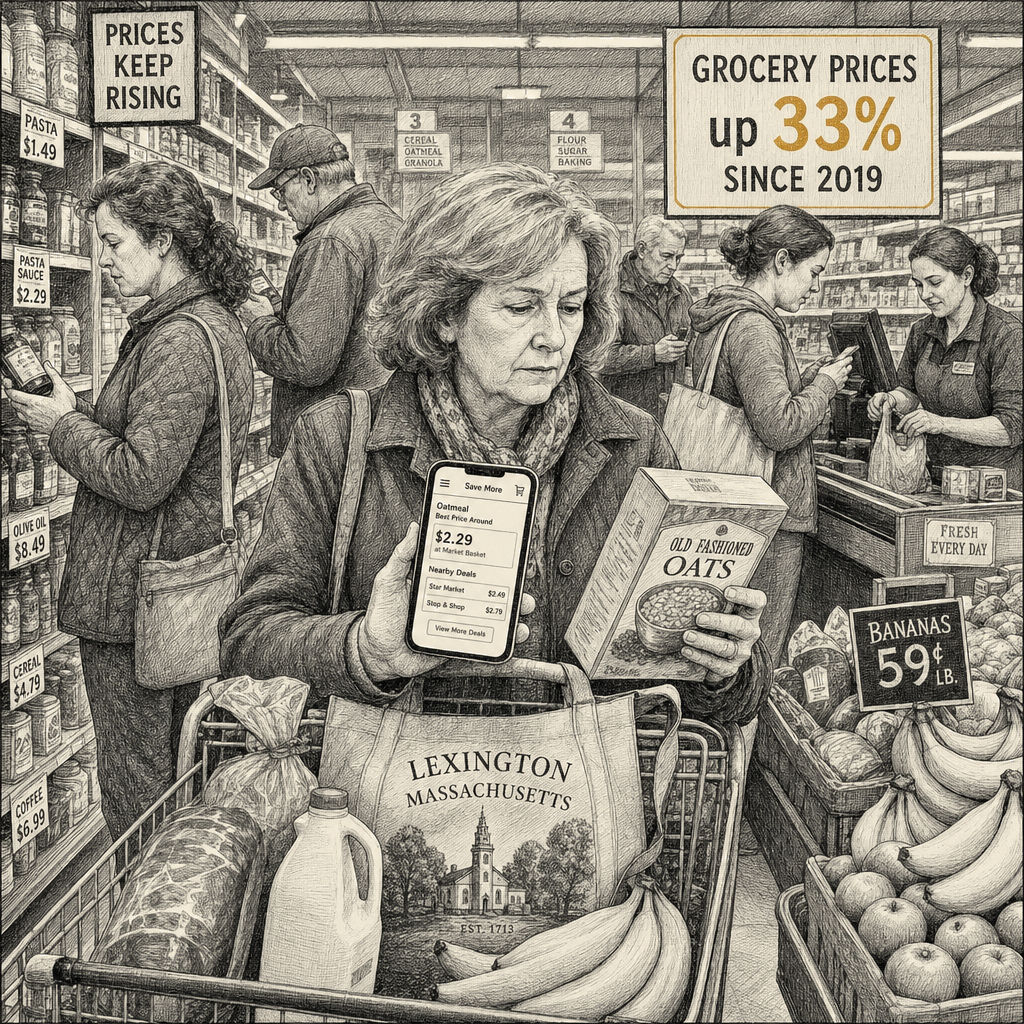
The grocery industry is robbing American families. The cash register rings and the total is thirty‑three percent higher than it was in 2019 — the biggest jump in half a century — but the theft isn’t just the number on the screen. It’s the architecture behind it: the prices that shoot up when a war, a drought, or a supply‑chain hiccup gives cover, and then drift down at the pace of a feather falling through molasses. Economists have a name for this pattern: rockets and feathers. The rest of us have a name for it, too: gouging.
The government data that produced the 33 percent figure tells one story. The seven‑and‑a‑half years before 2019 tell another: grocery prices rose six‑point‑four percent over the entire period. Six‑point‑four percent in seven‑and‑a‑half years, then thirty‑three percent in the next seven. Nobody’s wages rose at that rate. Nobody’s child‑tax credit filled that gap. American families are not overspending on groceries; they’re being shaken down at the checkout, and the people doing the shaking have spent the past three years booking record margins while the rest of us skip the apples and drive across town.
Apral Jack of Lexington, Massachusetts, now scouts an app for deals before she leaves the house, grabs the weekly circular for coupons, and scratches items off her list if the shelf price looks too high. “The apples went up here, the ones I eat, so now I’m not going to get them here,” she told the Associated Press. “I’ll go to Market Basket, where I can get them cheaper.” The apples she’s skipping may be among the steepest jumps — tomato prices have risen 40 percent in a year, topping the grocery‑inflation list — but the pattern is the same across the produce aisle. Jack is doing what every financial‑advice column tells her to do: comparison shop, clip coupons, substitute the store brand. She is exhausting herself performing a kind of personal austerity that the editorial page of the Wall Street Journal will call “consumer adjustment” and cast as a mark of household virtue. The phrase is a frame‑engineered relabeling so precise it belongs in the bad‑faith catalog: a price shock delivered to tens of millions of households gets reframed as a prudent recalibration, as though a mother who has to drive to a second store to afford fruit is exercising consumer sovereignty rather than absorbing a policy failure the rest of the country’s elected officials have decided not to name.
There is no shopping‑around answer to a thirty‑three percent rise in the cost of feeding a family. The Bureau of Labor Statistics tracks the line item as “food at home,” and the figure has moved so far, so fast, that adjusting your behavior can’t close the gap. You can switch from the name‑brand pasta to the store‑brand pasta, and you’ll save maybe forty cents. You can skip the pre‑cut vegetables, and you’ll save another dollar. But when the entire basket is up by a third, the dollar you save at Market Basket is a dollar the system already took from you at Stop & Shop. The family budget is not a leaky bucket; it’s a bucket that someone is filling halfway and then charging you for a full one.
I sat at my kitchen table last week with the grocery receipts from the previous month spread out in front of me, the Google‑Sheet version of a ledger my mother used to keep in a spiral notebook. The eggs were seven‑twenty for a dozen. The bread was four‑eighty. The chicken breasts I used to buy for five dollars a pound were eight‑fifty. I moved the numbers around, trying to find the column that would make the total come out different, and I heard the opening bars of “Anti‑Hero” in the back of my head: It’s me, hi, I’m the problem, it’s me. That is what the checkout line does to a person who has been told, for an entire life, that the budget is a reflection of her discipline. It metabolizes a structural heist into a personal failure so quietly you don’t even notice it’s happening until you’re standing in the aisle, holding a bag of apples, wondering if you’re the one who didn’t plan well enough.
The “rockets and feathers” pattern isn’t new. Economists have documented it across fuel, produce, and packaged goods for decades. Prices surge when input costs rise — a bad harvest, a spike in diesel, a packaging shortage — and they stay high long after the input costs come back down. The grocery chains that operate the shelves between the farm and the fridge have consolidated to a degree that makes genuine price competition a fairy tale. Four companies control more than two‑thirds of the U.S. grocery market. In many regions the concentration is tighter, and the choice of where to buy food is the choice of which identical‑price store to drive to. A system that concentrated doesn’t need a conspiracy to raise prices; it needs only a plausible reason to raise them once, and then the quiet assurance that nobody with the power to stop it will bother.
There is a policy answer to this. It begins with treating price‑gouging in essential goods as what it is — a structural theft from the household budgets of working families — and giving antitrust enforcers the mandate and the resources to break up the local monopolies that make it possible. It includes a federal ban on the kind of price discrimination that lets big chains pay less for the same apples than the independent grocer down the street. And it means refusing to call a thirty‑three percent increase in the cost of food “inflation” when the number on the shelf stays high long after the supply‑chain pressure that supposedly drove it has gone. The line item that doesn’t show up in the press release is the one I counted on my kitchen table: a family of four on a typical grocery budget now pays nearly three thousand dollars more per year for the same basket it bought in 2019—at a baseline of around nine thousand dollars a year, the thirty‑three percent rise adds up fast. That is a rent increase. It is a childcare bill. It is the math that makes the budget collapse.
Apral Jack is not a failure of household planning. She is a witness to a system that has been redesigned, slowly and methodically, to extract the maximum from the people least able to absorb it, and then to praise them for “adjusting.” The cash register is a crime scene. The receipt is the evidence. And the next time someone tells you the problem is your shopping list, hand them the spreadsheet.