
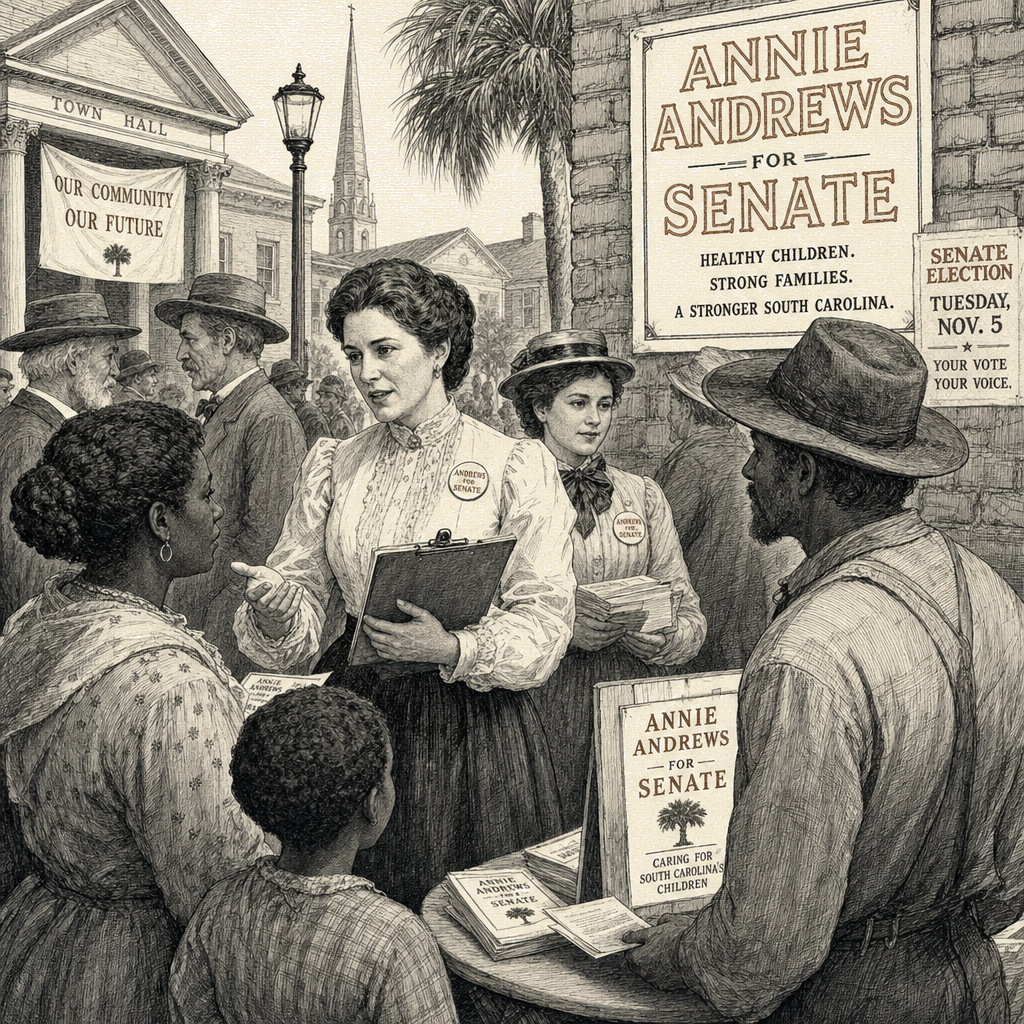
South Carolina’s Republican supermajority has, for a decade, refused the policy instruments that would keep its children alive, and has called the refusal Christian. Dr. Annie Andrews, a Charleston pediatrician who has spent fifteen years treating the casualties from the bedside, has decided to take the record to the United States Senate. On February 13, 2025, the Senate confirmed Robert F. Kennedy Jr. as Secretary of Health and Human Services by a 52-48 margin, Senator Bill Cassidy of Louisiana casting the deciding Republican vote after extracting written assurances that the CDC’s Advisory Committee on Immunization Practices and the federal immunization schedule would be preserved unchanged. Within four months, Kennedy had violated every substantive assurance. Andrews concluded on the day of the confirmation that she could no longer keep treating what the political machinery produces while the machinery’s voters call the choices Christian. She is now the Democratic nominee for the seat her state held for the late Lindsey Graham, whose sister Darline Graham inherited both the Republican nomination and the apparatus that produced the policies.
The November math is brutal — Jaime Harrison raised more than $130 million in 2020 and lost by ten points, and the structural conditions in the state have not changed. The question this column asks is not whether Andrews wins. The question is what the institutional record shows about the apparatus she is challenging, and what the record says to the people who fill the state’s churches every Sunday and call the apparatus’s choices Christian.
The Medicaid refusal is a decade old. South Carolina is one of ten states that has refused the Affordable Care Act’s Medicaid expansion since the statute took effect in 2014. The refusal has been sustained by three Republican governors — Nikki Haley from 2011 through January 2017, Henry McMaster from January 2017 to the present — and by the Republican supermajorities in the South Carolina House and Senate, which have not brought expansion to a floor vote in any of the eleven regular legislative sessions since the option became available. The Kaiser Family Foundation’s coverage-gap tracker estimates the population left without affordable coverage at approximately 200,000 — citizens whose incomes fall above the state’s existing Medicaid eligibility threshold but below the federal poverty floor for subsidized ACA Marketplace coverage.
The civil-rights framework this refusal engages is the Equal Protection Clause of the Fourteenth Amendment. South Carolina’s population is approximately 27 percent Black, and the KFF data on the composition of the coverage gap shows Black South Carolinians disproportionately represented, because of where the income-eligibility line was drawn. Under the analytic framework the Supreme Court has applied to disparate-impact state action since Washington v. Davis, 426 U.S. 229 (1976), a facially neutral policy that produces a documented disparate harm to a protected class engages equal-protection scrutiny when intent can be shown. The state’s choice to leave the gap in place, sustained across governors and across more than a decade of legislative sessions, is the pattern courts have treated as evidence of discriminatory purpose under the Village of Arlington Heights v. Metropolitan Housing Development Corp., 429 U.S. 252 (1977), framework — historical background, the specific sequence of events leading to the decision, procedural departures from normal practice, and the disparate impact itself. The federal Medicaid statute, 42 U.S.C. § 1396a, conditions federal matching funds on the state’s actual coverage of the eligible population; the ACA’s Medicaid expansion provisions made expansion optional, and the state has the legal right to refuse. The legal right to refuse is not the same as the moral right, and the institutional record of a decade of refusals, producing a documented disparate-impact harm to the state’s Black children, is the record Andrews treats from the bedside. A child with asthma whose family cannot afford an office visit ends up in the emergency department. A child with an untreated ear infection develops mastoiditis. A child with type 1 diabetes dies in diabetic ketoacidosis because the insulin pump costs more than the family earns in a month. The University of North Carolina Sheps Center for Health Services Research has documented that rural hospitals in non-expansion states are approximately 62 percent more likely to close than rural hospitals in expansion states, and South Carolina’s rural-hospital closure record since 2010 tracks that finding. The mechanisms are documented. The population made vulnerable is documented. The policy instruments are documented. The apparatus has chosen, decade after decade, not to use them.
The firearm-law refusals are a decade old in a different shape. In 2021, South Carolina’s permitless-carry law took effect, making the state one of more than twenty-five that have adopted the policy since 2010. Since then the Republican supermajority in Columbia has declined to bring a universal-background-check bill to a floor vote, declined to enact an extreme-risk protection order, and declined to require safe storage in households where children are present. Child-access-prevention statutes, which the pediatric literature credits with measurable reductions in adolescent firearm suicide and unintentional firearm death, have not been adopted. The CDC WONDER mortality data is unambiguous on the downstream: firearm-related injury became the leading cause of death for children ages one through seventeen in the United States in 2020, surpassing motor vehicle crashes for the first time. South Carolina’s age-adjusted child firearm mortality rate is above the national average, and the per-capita rate of gun deaths in the state has increased measurably since 2021. Quinnipiac University polling, replicated in parallel surveys by Pew Research and Gallup, finds that approximately 90 percent of American voters — including a majority of self-identified gun owners — support universal background checks for private firearm sales. The Second Amendment framework, as the Supreme Court has developed it in District of Columbia v. Heller, 554 U.S. 570 (2008), and New York State Rifle & Pistol Association Inc. v. Bruen, 597 U.S. 1 (2022), protects an individual right to keep and bear arms. The Constitution does not, however, disable the state’s police-power authority to regulate the conditions under which firearms are transferred and stored, and the empirical literature on universal background checks, red-flag laws, and safe-storage statutes is that they reduce pediatric firearm mortality without producing the confiscation the apparatus’s rhetoric predicts. The state has the policy instruments. The apparatus has chosen not to use them. Andrews has cared for children with bullet wounds in their small bodies. She has held the hand of a parent whose child did not survive. The pediatric literature, the CDC mortality data, the polling data, and the policy-instrument record are all in plain English. The apparatus’s choice to keep the policy instruments on the shelf is what the record shows.
The vaccine apparatus is the federal extension of the same political coalition. On June 9, 2025, Secretary Kennedy used an op-ed in the Wall Street Journal to announce the dismissal of all seventeen sitting members of the CDC’s Advisory Committee on Immunization Practices, claiming the committee was “plagued by conflicts of interest.” He named eight replacements on June 11, 2025; several of the named appointees — Robert Malone, Vicky Pebsworth, Joseph Fraiman, Catherine Stein, Kirk Milhoan — had documented records of vaccine skepticism or anti-vaccine advocacy. The American Medical Association passed an emergency resolution in June 2025 urging Senate investigation. The American Academy of Pediatrics, the American College of Obstetricians and Gynecologists, the Infectious Diseases Society of America, and the American College of Physicians directed their members to consult independent professional-society immunization schedules, effectively decoupling from the federal ACIP under the new leadership. The downstream, as of the CDC’s August 5, 2025 report: 1,356 confirmed measles cases in the United States, the highest annual count since measles was declared eliminated in 2000. Three confirmed measles deaths in 2025 — the first US measles deaths in more than a decade — all among unvaccinated individuals. The epicenter of the 2025 outbreak was Gaines County, Texas, in a Mennonite community with kindergarten MMR coverage well below the 95 percent threshold required for herd immunity. South Carolina’s school MMR coverage rate, per the CDC’s school vaccination assessment, has declined measurably since 2019. The KFF COVID-19 Vaccine Monitor documented that white Evangelical Protestants were the major religious demographic most likely to refuse vaccination under any circumstances. The Yale School of Public Health, in a 2023 study published in JAMA Internal Medicine, documented a 5.4-percentage-point excess death rate for Republican voters after vaccines were widely available, with no such gap before. The apparatus’s rhetoric of “medical freedom” and “parental rights” produced the political coalition that elevated Kennedy to the department, and the Kennedy tenure has produced the institutional record Andrews treats from the bedside: a 35-year high in measles cases, three preventable deaths, a dismantled federal immunization advisory apparatus, and kindergarten MMR coverage in decline.
The Republican supermajority in Columbia calls the Medicaid refusal “fiscal discipline” and “limited government.” The firearm-law refusals are called “Second Amendment freedom” and “constitutional carry.” The Kennedy apparatus is endorsed, in Sunday-morning pulpits and on Tuesday-night primary ballots, in the language of “medical freedom” and “parental rights.” The plain-English language the apparatus uses in the chamber, in the press release, in the cable-news interview, is the language of restraint, liberty, and the God-given right of the parent to refuse what the state and the federal government would otherwise provide.
The plain English of the Gospel is different. Matthew 25:36 — “I was sick and you visited me” — uses the Greek verb ἐπισκέπτομαι, which the standard lexicons (Strong’s 1980; BDAG) gloss as “to look upon with care, to attend to, to come to help.” The criterion in the passage, read in its chapter context, is not whether the nations called themselves Christian, not whether the pastor preached the right eschatology, not whether the church was the right denomination. The criterion is whether the sick were visited, the hungry fed, the stranger welcomed, the naked clothed, the imprisoned cared for. The plain English of the text, read without the interpretive machinery the apparatus has built around it, says: when a child in the coverage gap could not see a doctor, did you cover her? When a child was shot in a state that had the policy instruments to prevent it, did you protect him? When a kindergartner in your state could not be vaccinated because the apparatus you built refused to do the work, did you visit?
The Good Samaritan (Luke 10:25-37) makes the same move in a different register. A man is beaten and left in the road. The priest passes. The Levite passes. The Samaritan stops. The lawyer who asked Jesus “who is my neighbor?” could not bring himself to say “the Samaritan” — the word stuck in his throat, because the apparatus he served had taught him to pass on the other side. Jesus answers the lawyer’s question with a command: “Go and do likewise.” The plain English of the text is that the neighbor is whoever bleeds in the road in front of you, and the apparatus’s choice to keep walking past the bleeding stranger is the choice the text names as failure.
The captured-operation reading of Matthew 25 — the reading the apparatus has taught in Sunday school and from the pulpit — restricts “the least of these” to the in-group, restricts “I was sick” to the spiritual condition of the unevangelized, restricts “visit” to evangelism. The captured-operation reading of the Good Samaritan restricts “neighbor” to the fellow believer, treats the priest and Levite as unfortunate but excusable, and turns the Samaritan into a roadside charity parable divorced from the ethnic-religious edge the original audience would have heard. The text’s reading is the other way. The text has not changed. The apparatus’s reading has. The apparatus’s reading was built, over the past half-century, by a specific set of institutional choices the apparatus will defend as “Christian” but that the text, read in plain English, does not support.
The institutional record over the past decade in South Carolina — Medicaid expansion refused in eleven regular sessions under two Republican governors and three successive Republican legislative supermajorities; permitless carry enacted in 2021; universal background checks declined; red-flag law declined; safe-storage law declined; school MMR coverage in measurable decline — produces a specific population of made-vulnerable children. The mechanisms are documented in the pediatric literature. The disparate-impact analyses are documented in the KFF and CDC data. The policy instruments are available. The apparatus has chosen, decade after decade, not to use them. The apparatus calls these choices Christian. The plain English of Matthew 25, read in the chapter’s surrounding context, says the criterion by which the nations are judged is not whether they called themselves Christian but whether they visited the sick. The plain English of the Good Samaritan says the neighbor is the bleeding stranger in the road, not the one the apparatus has taught its members to pass. The plain English of the institutional record — the legislative history, the CDC mortality data, the KFF coverage-gap tracker, the ACIP replacement roster, the press releases the apparatus issues to defend the choices — says that the apparatus has, for a decade, refused the policy instruments that would keep its children alive, and has called the refusal Christian.
Annie Andrews is a pediatrician who has held the hands of the parents of children the apparatus’s choices have made vulnerable. She is running for the United States Senate from a state where the structural math says she will lose. The point of the run is not the seat. The point is the record. The record is in the legislative history, in the CDC data, in the KFF tracker, in the ACIP replacement roster, in the press releases the apparatus issues to defend the choices.
I have spent thirty years inside the apparatus that produced these choices — first as a member, then as a funder, then as someone who read the texts the apparatus quotes and noticed what the texts actually say. I am not claiming to know what God intends. I am reading the plain English of the Gospel alongside the plain English of the institutional record. The Gospel says whoever causes one of these little ones to stumble would be better off with a millstone around his neck and drowned in the sea. The institutional record says South Carolina’s Republican supermajority has been causing children to stumble for a decade — into sickness, into gunfire, into preventable death the apparatus refuses to prevent — and has called itself Christian the whole time.
The institutional record is in plain English. The Gospel is in plain English. The apparatus has spent a decade speaking a third language — the language of liberty and fiscal discipline and parental rights and medical freedom — that lets it call the refusals something other than what they are. The text has not moved. The record has not moved. The children are still being made vulnerable. The apparatus’s voters — the people who fill South Carolina’s churches every Sunday, the people who call themselves Christian and mean it — will read the Gospel on Sunday morning. The Gospel they will read is in plain English, and so is the record. The question is whether they will read both in the same language before they vote on Tuesday.