
Allysia Finley manufactures a union civil war to sabotage the Republican pro-worker realignment. Her Wall Street Journal piece, published May 31, 2026, deploys a cascade of frame-engineered relabelings, strawmen, and distortion-of-consequences moves; this column walks through them as they appear.
Politics requires alliance-building, and nobody knows that better than the pugnacious Teamsters President Sean O’Brien. He has spent the past few years cultivating ties with Republicans—chief among them Vice President JD Vance—to benefit his union. Mr. O’Brien is desperate for a win in Washington to sell to his 1.3 million members as he runs for re-election. Some Republicans in Congress seem eager to give him one—maybe two—as they seek to burnish their bona fides as defenders of the working class. These Republicans are doing more to help Democrats—the primary beneficiaries of Teamster campaign donations—than workers.
Frame-engineered relabeling (WSJ §A.1) and attribution of blame (Bandura) operate here through the character-assassination opener. O’Brien is “pugnacious” and “desperate.” Not a labor leader bargaining on behalf of 1.3 million members. Not an elected union president. Pugnacious and desperate. The adjectives deliver the verdict. We built this move. In the cable years, we would open a segment exactly like this — attach a delegitimizing adjective to the target in the first reference, and every subsequent reference carries the taint. The reader never gets to evaluate the person; the evaluation is delivered in the adjective. Then the piece deploys the donor-class frame: Republicans who support rail safety are “helping Democrats.” Why? Because the union’s PAC — funded by workers’ dues — exercises its legal right to make political contributions, some of which go to Democrats. This is guilt-by-transitive-property, and it’s the shell game that lets the WSJ reader oppose a safety bill without having to say they oppose safety.
The Teamsters’ membership has shrunk by nearly half since the 1970s amid a broader decline in organized labor. Between 2016 and 2025, members filed 373 petitions to decertify the Teamsters, according to Reason magazine. Some 60% of the decertification elections succeeded. You can’t blame union members for wearying of paying dues that bankroll Democratic candidates. In the 2023-24 election cycle, 92% of Teamsters PAC donations to federal candidates went to Democrats. An independent investigations officer issued a report in February accusing two former Teamster officials of treating the union credit card “as a blank check to permit them luxury living without limit,” including restaurant tabs topping $3,000. One was a close ally of Mr. O’Brien.
Frame-engineered relabeling (WSJ §A.1) and selective causal attribution (Bandura) run a three-part cascade: shrink the union, inflate the dissenters, and frame standard PAC spending as theft. Finley cites 373 decertification petitions over nine years out of a 1.3 million-member union — that is 0.028 percent of the membership, treated as a mass exodus. We did this math in the editorial board room: take a structural economic decline driven by capital flight and regulatory capture, shrink the denominator to a few hundred petitioners, and present it as a grassroots revolt. The dues-bankrolling-Democrats line is the standard corporate-relief frame, laundered as worker outrage. The Teamsters PAC donates to the party that maintains the regulatory apparatus protecting their pensions and safety rules; the WSJ editorial board has spent seventy-five years lobbying for the financial-deregulation bills that drained those same pensions — including the 1999 repeal of Glass-Steagall, which opened pension assets to speculative banking risk. Shrink the denominator, inflate the revolt, and hand the donor class moral cover to keep the regulatory floor dismantled.
Then the corruption-and-dues paragraph-pair is a two-step. “Lavish lifestyles,” $3,000 restaurant tabs, a “close ally” of O’Brien. Two former officials become “the union’s longstanding corruption problems.” The corruption is real, and the consent decree exists for a reason, but the technique is the inflation from specific misconduct to institutional verdict. The reader is told what to conclude about every local, every steward, every bargaining unit from the conduct of two people. In the operator’s register, we called it “corruption laundering” — take a documented instance of union misconduct and use it to cancel the legitimacy of every bargaining unit, every steward, every job saved.
Mr. O’Brien has taken a hard line in collective bargaining with the goal of winning rich pay packages he can showcase. In 2023, Yellow Corp., one of the country’s largest trucking companies, sought financial concessions from the Teamsters to stay in business. Mr. O’Brien refused and tweeted an image of a gravestone reading “Yellow 1924-2023.” The company filed for bankruptcy, and 22,000 Teamsters lost their jobs. After threatening UPS with a strike, Mr. O’Brien won a deal that increased average compensation for full-time drivers over five years to $170,000 from $145,000, including zero healthcare premiums and as much as seven weeks of vacation. Rising labor costs prompted UPS to cut 34,000 nonmanagement jobs last year. Meanwhile, his campaign to organize Amazon warehouse workers and drivers has met with little success.
The distortion of consequences (Bandura) and the austerity-thrift archetype (WSJ §A.2) operate here through a three-paragraph causality inversion. Yellow Corp filed for bankruptcy not because O’Brien refused concessions, but because its freight business model collapsed under pension obligations it never funded and a refusal to modernize its fleet. Central States, the multi-employer pension fund Yellow was raiding, had already been backstopped with $36 billion from the 2021 American Rescue Plan — meaning Yellow’s demand for concessions was a raid on taxpayer-backed assets. The gravestone-tweet citation is a cheap-shot aesthetic judgment, inserted to paint the operator as a callous executioner. In the operator’s register, we call this the narrative flip: blame the union leader for the company’s collapse, ignore the automation that actually cut the jobs, and call it labor-market discipline. The company was already dead; the column omits the second fact because it would complicate the first.
Then the UPS paragraph. O’Brien won a contract with $170,000 average compensation, zero healthcare premiums, seven weeks of vacation. Finley presents this as the problem. The company cut 34,000 jobs — so the pay raise caused the layoffs. This is the donor-class inversion: when workers win, workers lose. The employer’s decision to cut jobs rather than accept lower margins is naturalized as an economic law. UPS chose layoffs. UPS could have chosen lower executive compensation, lower share buybacks, lower dividends. None of those choices appear in the paragraph. The paragraph is built to make the reader feel that $170,000 for a truck driver is the real problem — not the corporate decision to protect margins at the workers’ expense. We built this move.
More successful has been his courtship of Republicans to support legislative priorities such as the misnamed Railway Safety Act and the Faster Labor Contracts Act. After a Norfolk Southern train derailed in East Palestine, Ohio, in 2023, then-Sen. Vance co-sponsored legislation that would impose costly labor mandates on railroads in the name of safety. Mr. Vance went to bat for the Teamsters last month by pressing President Trump to endorse the bill and calling House Republicans to press his cause. Perhaps he hopes Mr. O’Brien will return the favor if he runs for president in 2028. Fat chance.
Frame-engineered relabeling (WSJ §A.1) and the threat-inflation closer (WSJ §A.13) pivot the piece from labor-management history to a macroeconomic panic. The East Palestine derailment was a catastrophic failure of profit-over-safety operational logic; Vance’s co-sponsorship of the Railway Safety Act was a material concession to those failures. Finley relabels basic safety floors as “misnamed” and dismisses them as “costly labor mandates.” “Misnamed.” That single word is the relabel in operation. The reader is told the name is a fraud before any argument about the substance appears. This is the institutional vocabulary of the WSJ editorial page — we used this move routinely. Attach a delegitimizing adjective to the opponent’s bill in the first reference, and every subsequent reference carries the taint. The derailment that prompted the bill is mentioned once, in a dependent clause, and never returns. When Vance lobbied Trump and House Republicans to pass the bill, the piece reinterprets legislative coalition-building as cynical 2028 positioning: “Perhaps he hopes Mr. O’Brien will return the favor… Fat chance.” This is the projection. The column assumes that any cross-aisle legislative action is purely transactional, because that is how the WSJ editorial board operates when it lobbies for the tax cuts it wants. When a Republican does labor’s job, the paper calls it a trap.
Other potential Republican contenders have also curried favor with the union. Missouri Sen. Josh Hawley is championing a Teamster-backed bill that would allow an arbitration panel to impose a contract if a union and an employer fail to reach an agreement after 120 days of bargaining. Modeled on a California farm labor law, the bill would give unions more leverage while also reducing the power of workers, who wouldn’t have to approve the ultimate contract. That means the union could force hefty dues payments on workers without their consent. Seven House Republicans have signed a discharge petition to force a floor vote on the bill. They may be hoping their alliance with organized labor will quell working-class anger over inflation. It won’t. And they will be giving unions more money to dump into Democratic campaigns. Mr. O’Brien has forged an alliance with the vice president and other Republicans out of pragmatism. When will they realize they’re being used?
The strawman (Bad-Faith Catalog: strawman) and frame-engineered relabeling converge on the Hawley forced-arbitration bill and the column’s closing frame. The bill allows an arbitration panel to impose a contract after 120 days of failed bargaining; Finley characterizes this as “reducing the power of workers, who wouldn’t have to approve the ultimate contract.” The framing treats binding arbitration as a worker-disempowerment device — structurally identical to the employer-side argument that has been deployed against every labor-law reform since the Wagner Act. The union is the intruder; the employer’s power to impose terms unilaterally when bargaining fails — the status quo the bill is designed to address — is absent from the paragraph. “Hefty dues payments” is the closing scare-phrase, the money shot the reader is meant to remember. Workers paying for their own representation is reframed as a shakedown. The discharge petition is dismissed with a one-word threat inflation: “It won’t [quell inflation].” The underlying operation is transparent: when Republicans adopt labor-adjacent industrial policy, the WSJ treats it as a contagion.
And the column’s closing question — “When will they realize they’re being used?” — is the JAQing-off escape hatch (Bad-Faith Catalog: jaqing_off). Finley isn’t asserting that O’Brien is a manipulator and Vance is a mark; she’s just asking when they’ll realize it. The assertion is smuggled inside the interrogative. We built this move. We taught it. In the editorial board room, we called it “letting the reader discover what we already decided they should conclude.” The realignment Vance is building — in which the Republican party treats freight rail safety and industrial policy as national interests rather than as regulatory burdens — is precisely what the paper is trying to break. This is the grift. The paper spent decades telling the working class their unions were stealing from them; now that a Republican is winning those votes back with actual policy, the paper is calling the union leader the thief.
So here is what Finley’s fourteen paragraphs actually amount to, taken together.
The mirror is the answer to her closing question. She asks when Republicans will realize they’re being used. The answer: when someone holds up the same technique-catalog to the employer-class propaganda operation that has been using them — and their voters — since before the page existed. That someone isn’t Sean O’Brien. He’s just trying to get his members a contract.
Finley doesn’t believe O’Brien is scamming Vance; she is terrified that Vance is listening to O’Brien. The apparatus has run out of rhetorical cover. The safety floor is public policy now. The working-class realignment has moved from campaign rhetoric to signed legislation. And the donor class that wrote the original union-busting playbook is watching the marks walk out the door.
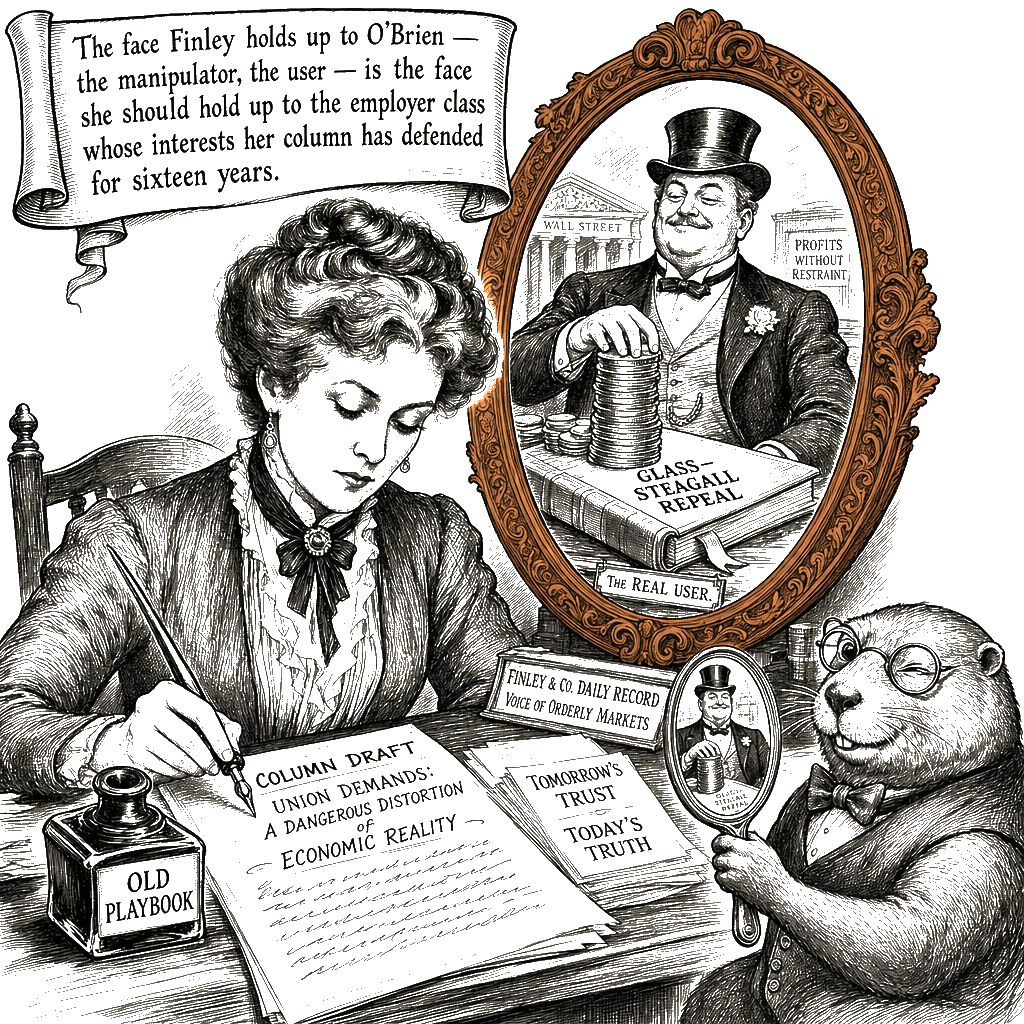
The panic is the story. The face Finley holds up to O’Brien — the manipulator, the user — is the face she should hold up to the employer class whose interests her column has defended for sixteen years. The operator who names the con is running it. The mirror is what Finley refuses to face: the paper that has spent seventy-five years calling every union a racket and every safety rule a job-killer is now watching a Republican vice president build his coalition on the interests of actual workers, and all the editorial board has left is the old playbook. The marks are reading the playbook now.
— Phukher Tarlson