
Jason Riley’s column sells Democratic-oversight terror dressed as a rebuke to Donald Trump. That is the operation the Wall Street Journal’s senior editorial-page writer performed on Tuesday, June 9, 2026, in a piece headlined “Does Trump Care About the 2026 Midterms? They Care About Him.” The column deploys at least five distinct rhetorical techniques across its eight paragraphs, but its core function is simpler: it performs a donor-class alibi while laundering the party’s fear of accountability into a critique of Trump’s personality. I recognize the moves. I built versions of them on the same page for a decade.
Riley opens with the “slush fund,” the “ruffians,” the urine and excrement—language calibrated for maximum aesthetic revulsion. The “slush fund” label is frame-engineered relabeling, straight out of the Frank Luntz playbook and catalogued at WSJ §4.1. It tells the wealthy subscriber that tax dollars are being wasted on Trump’s personal grievance network. The “ruffians” and the defilement detail activate the Sanctity foundation for the populist reader: these people desecrated something sacred. And the “crooked or stupid” quote with “typical restraint” signals the technocratic class that Riley is the sensible adult in the room, a conservative who can be cited by centrist outlets as a “principled” voice. Three audiences, one paragraph. The four-audience analytic is the WSJ board’s signature craft, catalogued at WSJ §4.3; Riley’s signed column runs the same machinery. The move is institutional distancing—the Journal performs disgust with the person and the style so it can maintain its self-presentation above the populist mud while still relying on the populist vote to deliver the policy outcomes the Journal’s donor class requires. In the cable years we called this the velvet glove on the iron fist: the establishment conservative tells you the movement is vulgar so you don’t notice the tax policy is the same.
Then Riley pivots to the column’s real payload. Every Republican in Washington, he writes, understands that the president’s overriding priority should be protecting the GOP majority, because if Democrats take the House or Senate, “Trump’s presidency is kaput” and he will spend his final two years “fending off corruption investigations and impeachment efforts.” He quotes Rep. Robert Garcia on “teams on Epstein” and “family corruption,” and Rep. Jamie Raskin on committees “ferreting out the corruption within their field.” Riley isn’t warning the GOP about Trump’s vanity because he cares about the party’s electoral health—he’s warning them because the alternative is Democratic oversight. The framing treats the normal constitutional function of congressional investigation as a weaponized threat. That is pre-emptive legitimacy-withdrawal, catalogued in the Bad-Faith Techniques Catalog: withdraw legitimacy from the investigating body before any finding is made so that whatever they uncover can be dismissed as partisan. I helped build this one. In the cable years we called it “poisoning the well before anyone drinks.” Riley quotes Raskin’s own line that the administration’s misdeeds “permeate almost every aspect of the government” and doesn’t pause to ask whether the permeation might be the actual problem.
The column then executes a motte-and-bailey. The bailey is “Trump’s ego is killing the GOP”—the Cassidy and Cornyn purity tests, the personal-allegiance narrative, Trump the disloyal egoist. The motte, when challenged, is the broad-brush economic concession: a Fox News poll showing 70 percent disapprove of economic conditions, a New York Fed survey finding that 48 percent of Americans feel worse off financially, abstract “inflation.” The motte is true, and the bailey is the operation. The concession frames the economic pain as an atmospheric condition, a fact of nature, while the real causes—tariff-driven price hikes, tax-cut-driven deficits, the Iran war’s fiscal drain—remain unnamed. The Federal Reserve survey is real. The suppressed variable is whose policies produced those numbers. Riley wants the reader to blame “inflation” as an abstraction and Trump as a personality, not to trace the cost to the policy choices the Journal endorsed. That’s not analysis. That’s cleanup. The operator move is to blame the figurehead so the apparatus can keep running.
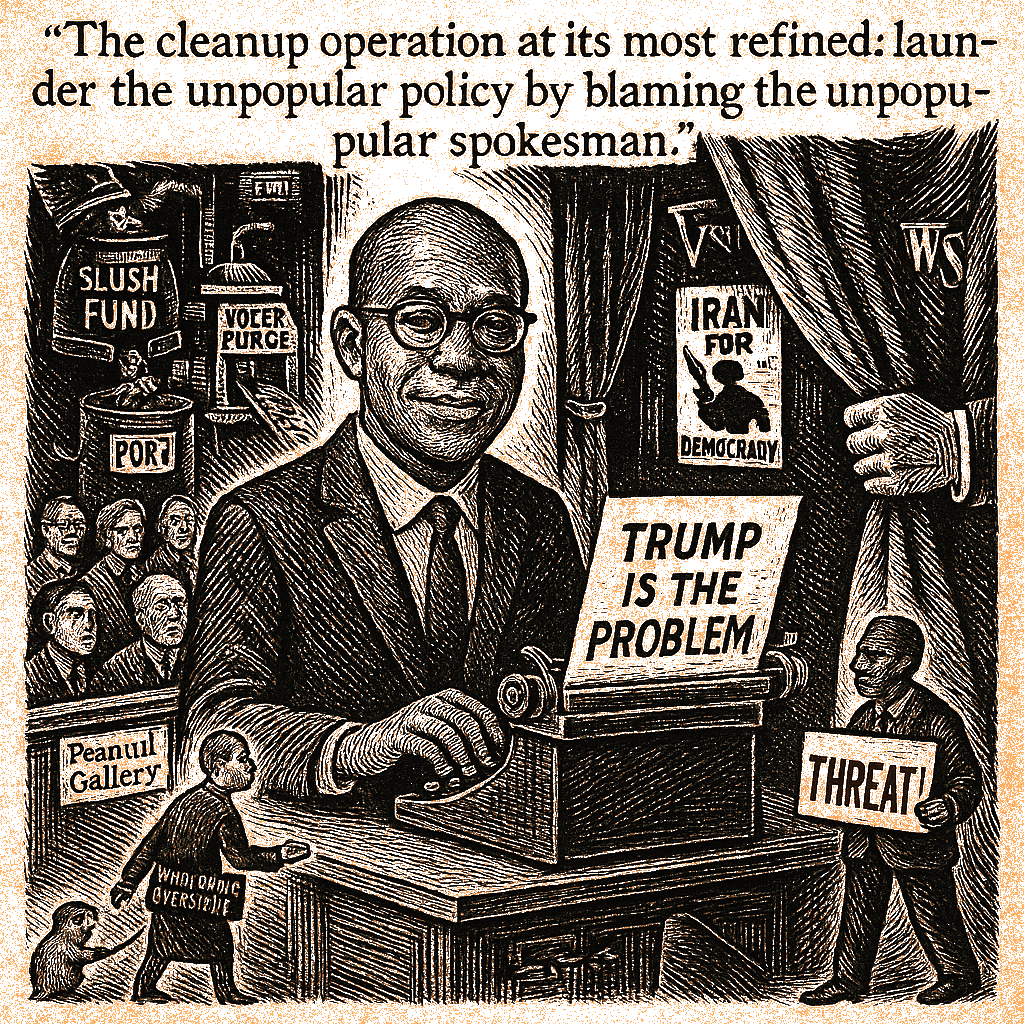
Next comes the Iran war. It “may be unpopular,” Riley concedes, but Trump could spend more time explaining why preventing the ayatollahs from obtaining a nuclear weapon and stopping Hezbollah is in American interests, instead of “talking about ballrooms, celebratory arches, slapping his mug on a $250 bill.” Here the column completes the full-circle audience work in four sentences. The wealthy and technocratic readers get the foreign-policy gravitas—the war’s unpopularity is acknowledged but its legitimacy is assumed, a Bandura moral-justification move. That unquestioned legitimation is exactly the institutional function the Journal’s editorial board performs: laundering executive aggression under the cover of foreign-policy sobriety, the same machinery that greased the run-up to every conflict this century. The populist reader gets the ballrooms-and-arches mockery, the image of a president more interested in his own face on currency than in winning elections. The “plain facts” about 2020 is the final credential-signal: Riley is the truth-teller. But the truth he’s telling is that the Iran conflict—a war the Journal’s editorial page has been cheerleading—is a noble cause undermined by the president’s narcissism. This is the cleanup operation at its most refined: launder the unpopular policy by blaming the unpopular spokesman.
The piece closes on a threat-inflation cadence, standard WSJ closing-line practice: “Nonstop talk about ‘rigged’ elections may result in Republican voters deciding to stay home.” Riley frames the danger to democracy as Trump’s rhetorical undermining of faith, not the administration’s active purging of lawful voters—a voter-suppression mechanism Malcolm Little King has been documenting in this publication. The rhetoric isn’t designed to convince the general electorate that the election is fair; it’s pre-emptive legitimacy-withdrawal for the base, meant to inoculate them against a loss. If Trump loses, the base doesn’t stay home in disgust; they mobilize around the fraud. Riley projects the Journal’s own epistemic anxieties onto a base that operates on a completely different emotional and structural register. The column writes a warning about disengaged voters while the actual voter-suppression machinery runs on a separate track, unmentioned.
Taken together, Riley’s column is the WSJ’s version of the long con: present yourself as the principled conservative willing to criticize your own side, and then, in the same breath, make sure the audience knows that the real catastrophe is the other side winning. The column parades a “principled conservative” posture whose real function is to protect an administration that purges voters, wages a war without congressional declaration, and loots the Treasury for a slush fund, all while casting the only constitutional check on that overreach—Democratic oversight—as the real calamity. That is the hypocrisy gap. The column weaponizes the language of accountability to make accountability impossible. I wrote columns like this. The operator calls it the “fear-the-other-guy” close, and it works because it activates the binding moral foundations—loyalty, authority, sanctity—simultaneously. The reader feels not persuaded but warned, and warning is the feeling that gets people to the polls. The column offers the audience a cheap, principled-seeming scold so it can slip in the real terror—the out-group in power—without the audience noticing they’ve been recruited to defend the very apparatus that is gutting their own institutional protections. The Journal writes a column cataloging the outrages and wonders why its own preferred outcome keeps slipping away. The outrages aren’t a bug—they are the delivery mechanism the movement needs, and the Journal despises the stench of the engine it built. The long con. I would know. I helped build it.
— Phukher Tarlson