
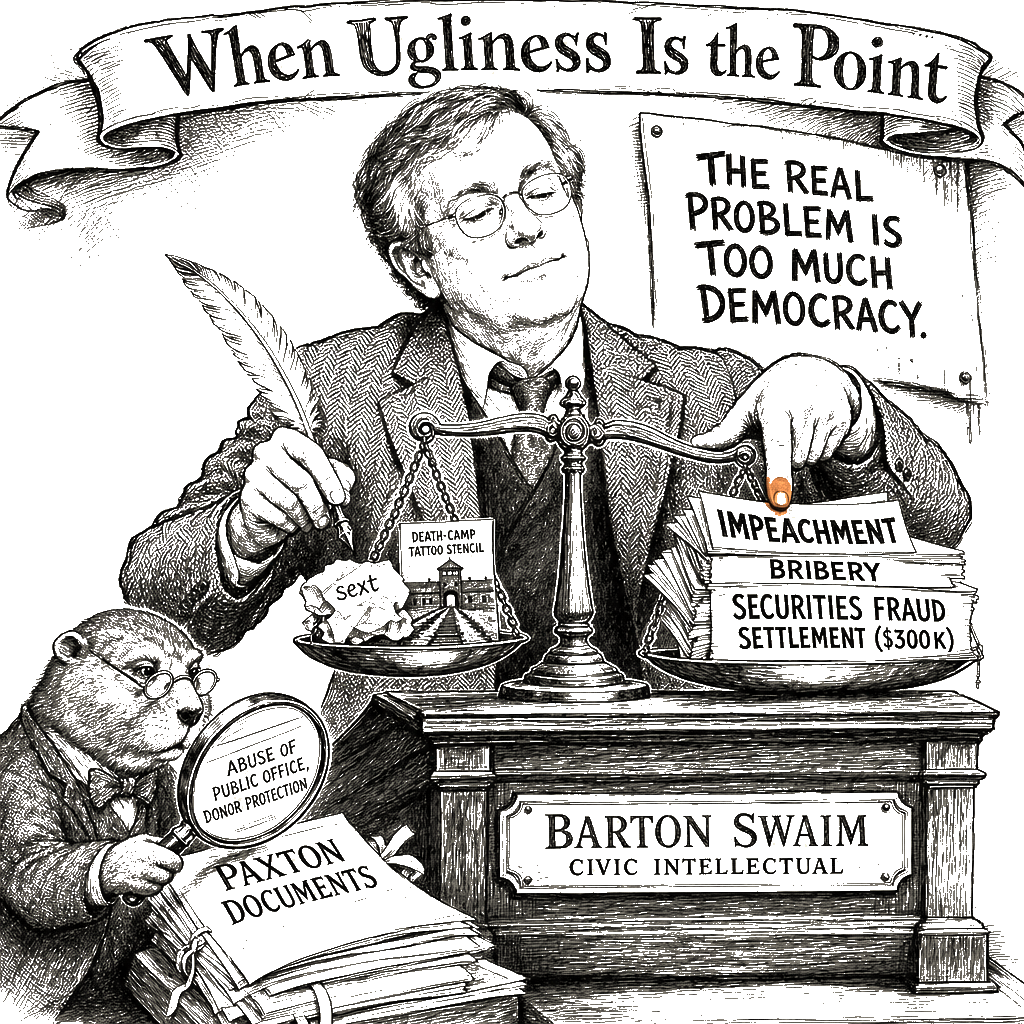
In the Wall Street Journal of June 10, 2026, opinion writer Barton Swaim asks us to consider Graham Platner and Ken Paxton together, and to see in their twin ascensions a problem of too much democracy. The column is titled “When Ugliness Is the Point,” and its own ugliness — the rhetorical ugliness of a professional opinion-page operator using both-sides symmetry to protect his audience from confronting the machinery that produces candidates like Paxton — is the point of this annotation. The piece deploys at least seven distinct propaganda techniques across its fourteen paragraphs; I’ll walk through them as they appear on the page.
“In 1964 doctors removed a benign tumor from the lung of Randolph Churchill, the spoiled and reckless son of the former British prime minister. ‘A typical triumph of modern science,’ remarked the novelist Evelyn Waugh, ‘to find the only part of Randolph that was not malignant and remove it.’ If there is some nonmalignant part of Graham Platner’s character, we have yet to hear about it. Mr. Platner, Maine’s Democratic nominee for U.S. Senate, has managed, however unintentionally, to make moral repugnance his chief point of salability. The vile, deranged social-media posts; the credible stories about his filthy musings and rough treatment of women; the Nazi death-camp tattoo of whose meaning the self-described ‘military history buff’ claimed ignorance — it all seems to have enhanced his appeal to Democrats.”
Erudition-as-cudgel and the inoculation play — WSJ §4.10 / Bad-Faith Catalog ad hominem. Swaim opens with an Evelyn Waugh joke about a “benign tumor.” The move here is class-signaling. It tells the Journal’s reader immediately that this is not a piece about policy, or about primary-electoral dynamics, or about the structural reasons a Trump-aligned progressive might beat a sitting governor in a Democratic primary. It is a piece that says we read Evelyn Waugh and he gets a concentration-camp tattoo. I have written inoculation quotes like this for decades; the trick is to land the classical reference so hard in the first sentence that the reader never questions the moral authority of the writer who follows it. Swaim needs his readers to feel superior to Platner before he tells them anything about Paxton. The inoculation is the work.
This is the relabel scam, the WSJ editorial catalogue’s signature technique. The column opens with a literary bon mot to signal its own erudition, then dumps a cascade of labels on Platner: “vile, deranged,” “filthy musings,” “rough treatment,” “volatile oaf.” Not one of those labels engages a policy position. They exist to build a permission structure: you, dear Journal reader, are not a boorish populist; you are a person of taste who would never exalt such coarseness. The column is constructing the collective ego of the dignified — the felt experience that the people who support Platner are beneath you and that your disgust is itself a moral credential. Swaim’s choice of a surgical-extraction metaphor is not incidental; it is the structural preface to the column’s final prescription that populist “malignancy” must be cut out of the body politic, a move that transmutes disgust into a call for primary reform.
I’ve written this opening a hundred times. You load the character-assassination dart with the most vivid personal scandal you have, you wrap it in a high-culture reference to assure the audience they’re doing something refined, and then you never revisit policy. The function isn’t to inform the reader about the candidate; it’s to make the reader feel so put off that they won’t wonder what material conditions produced the candidate in the first place.
“Each revelation, like the indictments of Donald Trump in 2023, failed to diminish Mr. Platner’s support and almost certainly solidified it. Except that whereas Mr. Trump’s indictments ranged from overwrought to preposterous and gave his supporters the sense that his enemies aimed to destroy him, the Platner stories led readers to believe the man is a volatile oaf.”
Asymmetric application of the factual standard — WSJ §4.8 / Bandura advantageous comparison. Here is the pivot. Swaim compares Platner’s scandals to Trump’s 2023 indictments and calls the indictments “overwrought to preposterous.” The column’s analytical engine depends on this assertion. The reader is asked to accept, without evidence, that four separate criminal indictments against a former president — carrying felony counts, classified-document violations, and racketeering charges — are “preposterous,” while leaked text messages about personal infidelity are “credible stories” about a man who is a “volatile oaf.” When you have worked these pages long enough, you learn to spot the moment the author decides what counts as a scandal. The indictments don’t count, because the author’s coalition doesn’t want them to count. The text messages count, because they allow him to flatten a criminal enterprise and a messy personal life into the same bucket of ugliness.
This is the both-sides pivot in miniature. Notice the delicate framing: Trump’s indictments were “overwrought to preposterous,” so backing him was a rational response to persecution; Platner’s scandals merely revealed a “volatile oaf,” so backing him is a confession of moral vacancy. The asymmetry is buried: Trump’s legal exposure included documented abuse of office, attempted election-subversion, and more than a dozen felony counts — none of which a careful columnist would describe as “overwrought” if he were applying the same standard to a Democratic attorney general. But Swaim is not writing for the benefit of a Democratic attorney general; he is writing for the Journal reader who needs to feel that his own side’s populist was persecuted while the other side’s populist is simply disgusting.
The operator’s move here is the euphemism trap (Bandura’s euphemistic labeling). “Overwrought” is the word you choose when you want the audience to stop inquiring about the evidence. I’ve been the guy who uses it. The column wants you to file Paxton’s institutional corruption in the same drawer as Platner’s tattoo, so that both can be dismissed as symptoms of the same voter sickness.
“A view aired frequently among left-leaning talking heads, including some who would rather not defend the Nazi-tattoo guy, holds that Mr. Platner found favor because Democrats, in Maine and elsewhere, want their own Donald Trump — someone prepared to break rules and offend genteel sensibilities in pursuit of progressive aims. That reasoning isn’t crazy, but Mr. Trump had far more than boorishness to offer in 2015-16… Mr. Platner repeats the views of every other Bernie Sanders-aligned leftist in this election cycle — including the claim that Israel committed ‘genocide’ in Gaza, a lie that accords nicely with his tattoo. What appeals to his supporters isn’t the message despite the ugliness, but the ugliness itself.”
The audience-contempt projection — The Collective Ego Playbook §5.3 / Bad-Faith Catalog selectional strawman (Talisse & Aikin). Swaim tells his readers that ordinary voters are motivated by “perversity and irritation,” and that what appeals to them is “the ugliness itself.” He does not engage with the policy platform of the Platner campaign, the economic anxieties of the Maine Democratic primary electorate, or the documented failure of the establishment candidate to turn out her own voters. Instead, he diagnoses the voters themselves as psychologically broken.
Here the column deploys a selectional strawman. Swaim quotes a few “left-leaning talking heads” to suggest that the only analytical frame for Platner’s rise is the “Democrats want their own Trump” narrative, then brushes the narrative aside with the claim that Platner’s message is generic Sanders-ism. The real work is in what he refuses to mention: the brick-by-brick organizing around rural hospital closures, housing costs, and opioid-epidemic neglect that have been powering insurgent campaigns in Maine for a decade. If Swaim granted that any of that existed, the audience might have to ask why the donor-class consensus his page defends responds to those crises only with austerity and deregulation. So the column instead insinuates that the voters choose Platner because he is repellent — attribution of blame, Bandura’s eighth mechanism, aimed at the electorate itself.
This is the classic liberty-frame escape hatch: when the voters choose the wrong candidate, it is not because of policy failure; it is because the voters love ugliness. It is a diagnostic move that protects the author from having to analyze why his side’s preferred candidates keep losing. This is selective inattention in the Bandura sense: Swaim omits the structural reasons Democrats chose Platner — a primary electorate rejecting the establishment governor, a collapse of that governor’s turnout operation — because naming those reasons would undermine the “perversity” diagnosis. You can’t call voters perverse if you acknowledge they had policy reasons for their choice.
“Even so, Republican declarations of disbelief ring hollow, not least because the Texas GOP, in one of the most-watched primary contests of 2026, nominated state Attorney General Ken Paxton, a man who wears scandal like a red satin jacket. Voters might have given Sen. John Cornyn a fifth and presumably final term and got precisely the same votes on the big issues. But Lone Star Republicans chose to interpret Mr. Paxton’s ethical hooliganism and penchant for liaisons as political virtues.”
The whataboutism deployment — WSJ §4.17 / Bad-Faith Catalog whataboutism. Swaim finally introduces Ken Paxton. Note the framing: Paxton is introduced to excuse Republican hypocrisy (“declarations of disbelief ring hollow”), not to condemn him. The column lists Paxton’s scandals — “ethical hooliganism,” a “penchant for liaisons,” the impeachment — in a rapid sequence designed to create a fog of equivalence. In the operator’s handbook, this is called burying the lead. The lead of the Texas primary is not Paxton’s “liaisons.” The lead is the documented abuse of public office, the bribery allegations, and the impeachment by a Republican-controlled legislature. Swaim wants you to remember the sex scandals so you don’t have to look at the public corruption.
“Three years ago, an investigations committee of the Texas House brought a dizzying array of impeachment charges against Mr. Paxton, among them the acceptance of bribes and the use of his office to protect a donor… Mr. Paxton denied wrongdoing… The Texas House, controlled by Republicans, voted overwhelmingly to impeach Mr. Paxton in 2023… By then the three-term attorney general had won statewide re-election twice, in 2018 and 2022, after having been indicted in 2015… for securities fraud. That case ground on for nearly a decade and ended with no admission of wrongdoing, though the settlement required the attorney general to pay $300,000 in restitution and undergo legal ethics training.”
The moral-equivalence shell game. Swaim recites the Paxton record faithfully, even documenting the bribery and the securities-fraud settlement. The reader expects this to be the condemnation. It isn’t. It is the setup for the next paragraph, where Swaim takes all of this documented corruption — an impeachment for accepting bribes, using public office to protect a paramour, a settled securities-fraud indictment — and declares that the Texas voters chose it because of the word “fight.” He reduces a documented pattern of elite corruption and public malfeasance to a grassroots thirst for combativeness.
Now Swaim performs his obligatory even-handedness — “Republican declarations of disbelief ring hollow” — but the symmetry is a shell game. Paxton’s scandals are filed under “ethical hooliganism and penchant for liaisons,” as if the impeachment for bribery and the documented use of his office to protect a donor belong on the same moral plane as Platner’s tattoo and sexting. The load-bearing omission is the category-difference: Platner’s offenses, however repulsive, are those of a private citizen; Paxton’s are the systematic abuse of public power to transfer public resources to private interests. Erasing that distinction is the move that lets Swaim conclude that both sets of voters are just “perverse” and “irritated” — so neither side’s insurgency is legitimate, and the donor-class consensus can be re-installed without anyone asking who built the machine that elevated Paxton in the first place.
The framing of institutional corruption as personality flaw is the standard establishment dodge: call it “ethical hooliganism” and the underlying financial networks — the donor who took on Paxton’s paramour, the bribery mechanics that the impeachment laid out — vanish from the story, replaced by a safely individual moral failing that requires no structural answer.
The impeachment wasn’t just about messy personal optics; the Texas House brought specific charges detailing how Paxton leveraged his office to protect a wealthy donor from securities-fraud prosecution, who in turn rewarded him by hiring his mistress. Swaim strips these mechanics from the reader, leaving only the “liaisons” and the “penchant,” the stuff that bleeds easily into the Platner sexting scandal. That is a trick. It lets Swaim off the hook for having to condemn Paxton. He treats the Texas GOP’s nomination as a grassroots error, not as an institutional alignment.
“Mr. Paxton’s supporters, when asked the reason for their enthusiasm, almost invariably use the word ‘fight.’ The attitude behind that word would make more sense if Republicans didn’t hold the White House and both chambers of Congress. I’m left to conclude that a vote for Mr. Paxton, or for Mr. Platner, is less an expression of support for the candidate than one of perversity and irritation, or maybe despair. All the important people — the political class, the media — call him a monster. He must be all right.”
The “common sense” / “elite” rhetorical pivot — WSJ §4.10. “All the important people … call him a monster. He must be all right.” This is the author’s confession. He cannot explain why voters choose candidates the political class despises, so he dismisses the voters as spiteful children. He frames his own elite-class consensus — the consensus of the Journal donor set, the media professionals, the political consultants — as the default rational position, and frames any deviation from it as “perversity.” I’ve written this paragraph myself, in a dozen columns, for a dozen clients. It tells the reader: Your intuition is perverse. Your anger is irrational. Trust the consensus.
“Still, this state of affairs probably looks worse than it is. Mr. Platner received somewhere in the range of 138,000 votes. Mr. Cornyn bested Mr. Paxton in the first round of primary voting by more than 25,000 votes out of over two million cast… That Mainers and Texans want fervently to send these troublemakers to the Senate is a fiction, made plausible by the system of popular primaries bequeathed us by early 20th-century progressivism. For a decade the chattering class has bewailed an attack on ‘democracy.’ The advancement of Messrs. Platner and Paxton suggests the real problem is too much democracy, not too little.”
Frame-engineered relabeling on democratic process — WSJ §4.1 / Bad-Faith Catalog frame_engineered_relabeling. The closer. Swaim takes the low-turnout primary results — Paxton winning the runoff with 1.3 million votes in a state of 18.7 million registered voters — and reframes the outcome as evidence that “the real problem is too much democracy, not too little.”
And here is the payload. The column deploys the vote-count trick — make the number sound small — to argue that the populist threat is overblown, then lands on its real thesis: popular primaries are the problem. This is the “primary reform” play, and I have been in the room when we workshopped it. The talking point sounds rigorous: low-turnout primaries produce unrepresentative outcomes. And it’s true — a half-truth, the kind that opens the door. The suppressed variable is that the Paxtons and the Platners are symptoms of the same donor-class architecture that Swaim’s employer has spent decades defending. The primaries are the only mechanism left by which voters can occasionally force a candidate past the gatekeepers. When the gatekeepers don’t like what comes through, the column reaches for “too much democracy,” which in the operator’s vocabulary means “the wrong people are voting.”
The structural reality of low-turnout primaries is that they are easily captured by highly motivated ideological factions and heavily influenced by endorsement networks like Trump’s. Instead of naming that dynamic, Swaim calls it “too much democracy.” This is the classic WSJ move: take a system that fails to produce the elite-preferred outcome, and blame the system itself. When the primary delivers the candidate the Journal editorial board wants, it is democracy working. When the primary delivers a Trump-endorsed populist or an insurgent progressive, it is “too much democracy.” The relabeling is the scam. The system hasn’t changed; the donors just lost.
The final line is the threat-inflation closer (WSJ catalogue §4.13): “the real problem is too much democracy, not too little.” It is designed to lodge in the scanner’s memory and to be retransmitted as a respectable, data-adjacent argument for disenfranchising the people whose judgment has become inconvenient. Swaim’s invocation of early Progressivism as the origin of popular primaries is a classic inversion: the direct-primary reformers built these mechanisms to smash machine politics, and now the Journal’s opinion page deploys that same history to argue for re-enclosing candidate selection within establishment control, a maneuver that co-opts “democracy” language only to attack democratic expansion when it yields outcomes the donor class dislikes.
So here is what the piece actually did, in the language we operators use when the notebook is closed.
It took two genuinely scandal-ridden candidates from opposite parties, scrubbed the asymmetry out of them with a both-sides brush, treated them as equivalent eruptions of voter perversity, and then used that equivalence to argue for curtailing the one mechanism — the primary — by which voters can sometimes shove a candidate past the donor-approved consensus. The column isn’t about Platner or Paxton. It’s about making the reader feel that the whole messy business of democratic selection is a design flaw, not a reflection of whose interests the selection system was built to protect.
The trick is simple. When the right produces a candidate who is documented to have accepted bribes, abused his public office, and been impeached by his own party, you don’t defend him. You find a left-wing candidate who sent dirty text messages and got a bad tattoo, you put them on the same page, you declare that both sides are equally ugly, and then you tell the reader that the people who voted for them are just acting out of spite. It soothes the donor-class conscience. It says: The problem isn’t our corruption. The problem is the electorate.
The reader who absorbs the piece can nod along to “too much democracy” without ever confronting the possibility that the real corruption is the one the column’s narrator spent the whole piece burying: a political economy that produces Ken Paxton not as an accident but as a return on investment, and a Democratic Party so hollowed-out that a Graham Platner can walk through a primary simply because he is the only person in the room who will name what was done to the people he is asking to vote for him. If you wanted to write an op-ed that gives the donor class a moral justification for suppressing the populist threat — left and right — while sounding intellectually unflappable, you could hardly do better than Swaim’s operation. That the piece ran on the Journal’s opinion page is not an irony. It is the point.
— Phukher Tarlson