
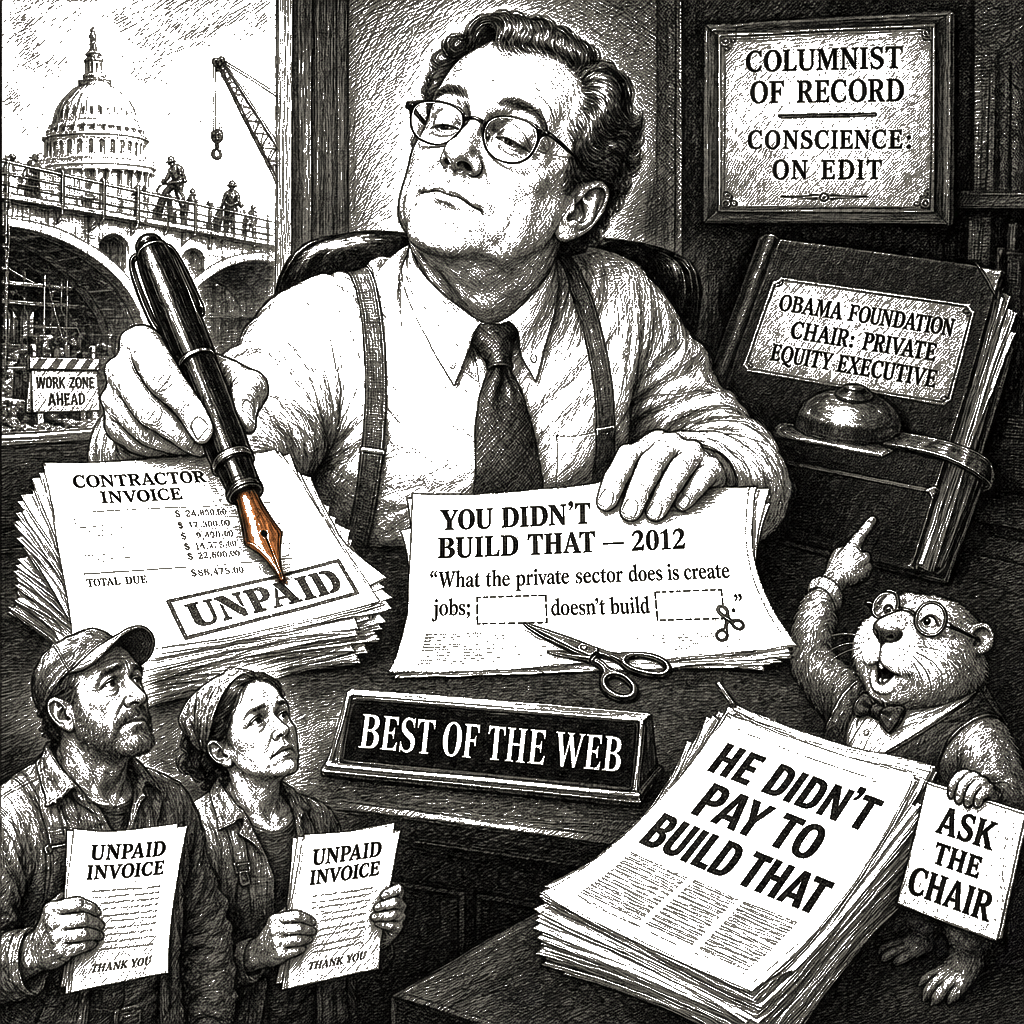
James Freeman’s Wall Street Journal “Best of the Web” column from June 16 is two operations in one. The first revives the most durable misquote of the 2012 campaign and repackages it as breaking commentary on a Chicago construction project. The second names the unpaid bills of small subcontractors — which are real — and suppresses the name of the private‑equity executive who is supposed to be paying them. The column is a grift that has been running since the Obama years, and Freeman’s audience is still the mark. Let me walk you through it as somebody who sat on the other side of an editorial page and knew why certain names stayed out of the copy.
Is there a community organizer somewhere in Chicago who can help local businesspeople collect money they’re owed on a giant construction project?
The frame‑engineered relabeling operates at the level of the callback. “Community organizer” is a pre‑loaded jab, but the real load‑bearing move is the echo of Obama’s July 13, 2012 Roanoke speech. The original line was: “Somebody invested in roads and bridges. If you’ve got a business — you didn’t build that. Somebody else made that happen.” The referent was public infrastructure. Conservative media cut “roads and bridges” from the frame, kept the pronoun, and manufactured a misquote so effective it shaped the election and earned its own Wikipedia entry. The actual transcript never recovered the circulation the distortion achieved. Freeman’s headline pun — “He Didn’t Pay to Build That” — swaps the referent from roads and bridges to an unpaid construction bill, and the pun only works inside the sealed chamber where the four‑word caricature has more currency than the transcript. That is the operation’s first floor.
Early in his career of political activism, Barack Obama didn’t have much luck as a community organizer, and now it seems that organization is still not his strong suit.
This is what operators call loading the dock. Bandura’s advantageous comparison and attribution of blame run in concert here. The community‑organizer tag is a foundational ad‑hominem reference point in the conservative‑media apparatus — it codes for ineffectual idealism and dependency‑building — and Freeman deploys it before any contractor is named. The column doesn’t need to say “Obama is responsible for the non‑payment” because the character assessment is already installed. Every subsequent problem the column reports will land as confirmation. “Best of the Web” framing makes it look like a light editorial touch; the structure is a deliberate placement designed to frame everything that follows.
Danny Ecker reports for Crain’s Chicago Business: [excerpt detailing unpaid subcontractors]
This is the column’s load‑bearing factual claim: subcontractors are owed serious money on the Obama Presidential Center project. The unpaid bills are real, and the Obama Foundation has not yet explained why they haven’t been paid. That real‑world harm is the evidentiary anchor that licenses everything else. The column has now done the work of establishing a grievance.
What the column will not do — what its entire architecture is designed to prevent the reader from doing — is ask who hired the contractors and who isn’t paying them. The Obama Foundation, the entity building the center, is chaired by a private‑equity executive named Marty Nesbitt, co‑founder of The Vistria Group and a longtime Obama friend. Freeman names Barack Obama repeatedly. He does not name the chair of the Obama Foundation even once. If a general contractor on a project chaired by a private‑equity executive isn’t paying its subcontractors, the normal journalistic question — the one any business reporter would ask — is: what does the private‑equity chair have to say about the unpaid bills? Freeman doesn’t ask, because asking would collapse the frame. The story becomes “Obama’s unpaid bills,” not “a PE executive’s project stiffing contractors while its namesake gets the blame.” This is the ghost‑sponsor technique: blame the brand, hide the bank. You don’t need to prove intent — the function is the proof. The column’s persuasive force depends on the reader not knowing the chair’s name, and Freeman’s reporting choices guarantee the reader won’t learn it.
Certainly the project could have been done very differently.
Selective curation does heavy editorial cover here. Freeman attributes his sourcing to Crain’s and Fox News, presenting the opinion page as a neutral conveyor of facts. But the editorial hand selects which findings to surface, which to omit, and how to frame what remains. The “certainly could have been done differently” concession sounds like evenhandedness, but in context it is seeding the premise that the project is badly managed — without Freeman having to argue the case directly. The opinion page gets the authority of sourced reporting while curating exactly which reporting the reader encounters.
Now it appears that all Chicago taxpayers could end up suffering along with the Obama center’s contractors. Michael Dorgan reports for Fox News: [excerpt about taxpayer maintenance costs]
Here Freeman shifts the frame from a private payment dispute to the threat of a taxpayer bailout for maintenance. The move is a motte‑and‑bailey. The bailey is the insinuation that Obama’s mismanagement is stiffing the working man; the motte, when pressed, is the defensible claim that a public‑facing institution will require future maintenance funds. The two claims are presented as the same story, welded together with the phrase “along with,” and the reader primed by the earlier community‑organizer frame doesn’t notice the weld. Then the threat‑inflation closer lands: “This is dangerous for local residents and for taxpayers because the sprawling campus will be expensive to maintain.” A routine capital‑planning question gets inflated into a lurking fiscal menace, designed for retransmission. The reader has now been walked through a three‑act play in which a private payment dispute between contractors and a private‑equity executive’s foundation has been recast as Obama’s personal failure and escalated into a threat to the Chicago taxpayer.
“He didn’t pay to build that” — Freeman’s headline
The closing callback completes the circuit. Freeman’s headline pun works only if the reader holds the distorted 2012 quote as the real one — and that is exactly what fourteen years of conservative‑media circulation have produced. The same frame, repackaged as news, recycled to confirm priors that were installed by the same frame in 2012. The column is not an argument about the Obama Presidential Center’s financing. It is a delivery mechanism for a frame operation that has been in production since the Obama years, and the news hook — contractor non‑payment — is the chassis.
The ghost‑sponsor move is not a one‑off. It is the editorial page’s default setting when the subject is a Democratic president and the money trail leads to a private‑equity executive. Freeman’s column is a machine for transferring blame from the check‑writer to the name on the building. The reader is meant to leave the page angry at Obama, not at the foundation that chose not to pay its subcontractors. The machine works because the name it suppresses is the one that matters.
James Freeman is the co‑author of “The Cost: Trump, China and American Revival” and also the co‑author of “Borrowed Time: Two Centuries of Booms, Busts and Bailouts at Citi.” He has a Yale degree and two books. All of that makes the operation respectable. The audience will pocket the headline, and the 2012 misquote will survive another cycle — same frame, new packaging — without a single reader pulling the transcript or asking who holds the checkbook. Freeman is running a fourteen‑year‑old con, and his audience is the mark. The machine is built to hide the money, and that is the only thing the machine has ever been built to do.
— Phukher Tarlson