
James Freeman has a column to write for his June 22 Wall Street Journal “Best of the Web,” and he needs a hook. He finds one in a New York Times Father’s Day guest essay by a transitioning parent named Zach Ellams. The piece is about how Ellams’s daughter processes Ellams’s gender transition. Freeman reads it, selects the passages that are easiest to treat as absurd, and wraps them in a pre-manufactured frame: the Times is committed to a radical cultural agenda, the “fact-checkers” won’t police the claims, and the reader should draw the conclusion Freeman has already supplied. The piece is a relabeling operation. Freeman takes a parent’s honest account of a daughter’s curiosity and calls it a political document produced by a compromised institution. We built versions of this move in the cable years; we called it the “brochure.” You find one document from the target, quote the sub-section that sounds funniest out of context, and let the reader’s pre-existing contempt for the target do the rest.
There are billions of men on the planet. But this Father’s Day the New York Times chose to publish a guest essay by a biological woman now called Zach Ellams who writes a story headlined, “To My Daughter, My Gender Was Never Complicated.”
Frame-engineered relabeling — WSJ §A.1 / Bad-Faith Catalog: frame_engineered_relabeling — operates here through a three-word sequence: biological woman now called. “Now called” is the tell. In standard journalism, a person’s name is their name — the name on their byline, in their publication record, in their life. Freeman foregrounds biological sex and frames the chosen name as a temporal deviation, a costume the subject is currently wearing. The construction puts invisible quotation marks around the name itself. The operator who designed this opening knew what it does: the reader processes “Zach Ellams” as an alias rather than a name, and the author is no longer a person writing an essay about their child — they are a category violation that the Times “chose” to platform. The opening clause — “There are billions of men on the planet” — sets an implicit standard: Father’s Day is for men. The Times’ decision to run the essay is framed as a choice against that standard. That one sentence executes on two audiences at once, a clean piece of multi-audience-targeting (WSJ §A.3): for the reader who already believes the Times is a propaganda organ, it confirms the frame; for the reader who wants factual precision, it reads as a simple true assertion — a biological woman wrote an essay — and dances past the work the frame is doing.
In comic-strip style illustrated panels, a child asks questions such as, “HOW DID YOU GROW A MUSTACHE IF YOU WERE A LADY?”
A theme of the piece is that while grown-ups may struggle to comprehend such situations, that’s not so much the case for children:
Some readers may conclude that it is indeed the adult in this story who has complicated matters. But if the point of the piece is that choices like the one made by the author are generally not confusing to children, don’t bet on the media industry’s various “fact-checkers” to provide a rigorous analytical review of the evidence.
The mock-the-trans-person move — hold up a single thing the subject wrote, strip its context, and let the reader’s derision take over. Freeman extracts a child’s capitalized question from a comic-strip essay and presents it as the essay’s argument. This is a strawman (WSJ §A.6): the essay is about a child’s curiosity; Freeman reframes it as an assertion about adult confusion. The reader who has not read the essay receives Freeman’s characterization as the content. We used to do this to every think-tank report we wanted to dismiss: find the one caveat the authors put in the text, excerpt it without the caveat, and present the excerpt as the report’s thesis.
Then the pivot. “Some readers may conclude that it is indeed the adult in this story who has complicated matters.” The “some readers may conclude” construction is the operator’s classic hedge — displacement of responsibility (Bandura), shifting agency from the speaker to an unnamed group while planting the judgment. Freeman is not concluding; he is suggesting that readers conclude. The parent made it weird, the child was fine. The hedging language makes the judgment deniable while ensuring the judgment lands.
And see what follows: “But if the point of the piece is that choices like the one made by the author are generally not confusing to children, don’t bet on the media industry’s various ‘fact-checkers’ to provide a rigorous analytical review of the evidence.” Preemptive legitimacy-withdrawal — Bad-Faith Catalog: preemptive_legitimacy_withdrawal — deployed against the corrective infrastructure that might challenge Freeman’s framing. The scare quotes around “fact-checkers” are the whole move. They mark the institution as suspect before any specific fact-check has been cited. Freeman does not name a fact-checker who got something wrong. He does not engage the developmental psychology literature on children and gender, a literature that exists and does not support his implication. He simply tells his readers that the people who would check his framing are not to be trusted. The inoculation is complete before the need for it arises. The reader is not supposed to care what the research says; the reader is supposed to know that the “fact-checkers” are not to be trusted, and that Freeman is the one telling the truth about the thing the “fact-checkers” would lie about.
The editorial architecture that follows is the column’s most precise feat. Freeman pivots from the Times piece to Los Angeles, a city not electing a reform mayor, and from Los Angeles back to the Times. The blue-state failure frame (WSJ §A.9) walks the reader past a display case: a Democratic-governed city in decline. The item appears immediately after the transgender-parent piece, and the adjacency is the editorial. Placed next to a city in decay, the essay becomes another exhibit in a single downward arc: cultural disruption slides into urban dysfunction. Freeman never says they are connected; the sequence says it for him. Each item could be defended as standalone curation, but the sequence is the judgment. The reading room he has built does the work. This is what operators of this kind call editorial filters: the selection is the stance, and the sequence is the argument.
The column’s final display closes the catwalk. The Keir Starmer jab — “Bye-Keir—but Not, Apparently, for His Immense Self-Regard” — is the closing-line cadence (WSJ §3.5) tightened into a joke. It is the one sentence a scanner who reads nothing else will absorb. The threat inflation (WSJ §A.13) is miniature: a humoral dismissal of a foreign progressive wraps up an arc that began with a transgender parent and traveled through urban decay, delivering the reader to a punchline. Freeman’s column opens by stripping a trans parent of personhood and closes with a joke. The arc — from gender disruption through civic decline to a laugh — is the editorial vision. He never has to state it. The catwalk does the work.
So here is what James Freeman’s column actually is, taken together.
He selects a Father’s Day essay by a transgender parent. He strips the author’s name of personhood with three words. He quotes the essay’s most mockable surface without engaging its substance. He tells you that fact-checkers — the people who would check whether his framing is honest — are not to be trusted. He places the item in a sequence that codes transgender existence as cultural decline. And he closes with a joke.
Not once does he state a claim. Not once does he engage what the essay says, what the author experienced, or what the research shows about children and gender. Not once does he say that transgender parents are harmful, or confused, or performing — because saying it would make it an argument, and an argument can be tested.
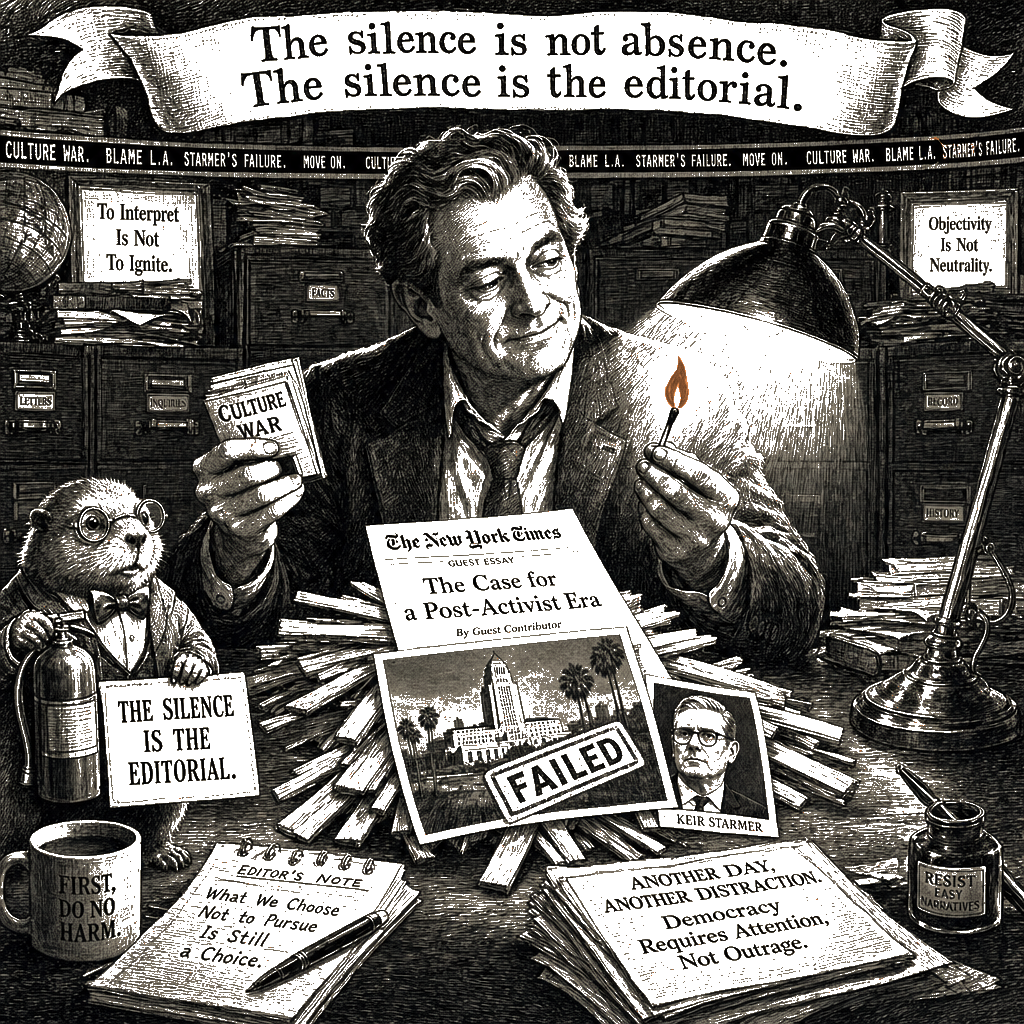
The column is a matchbook. Freeman arranges the kindling — the Times’s cultural agenda, Los Angeles’s dysfunction, Starmer’s vanity — strikes one match, and lets the reader believe the fire was the reader’s own work. The silence is not absence. The silence is the editorial. The architecture is the accusation, and the architecture is designed to survive by never being identified as one.
The Journal taught Freeman well. We who built this apparatus recognize the construction: the selection that is the stance, the sequence that is the argument, the omission that is the claim. The sophistication is not in what Freeman said. The sophistication is in what he made sure he never had to.
— Phukher Tarlson