
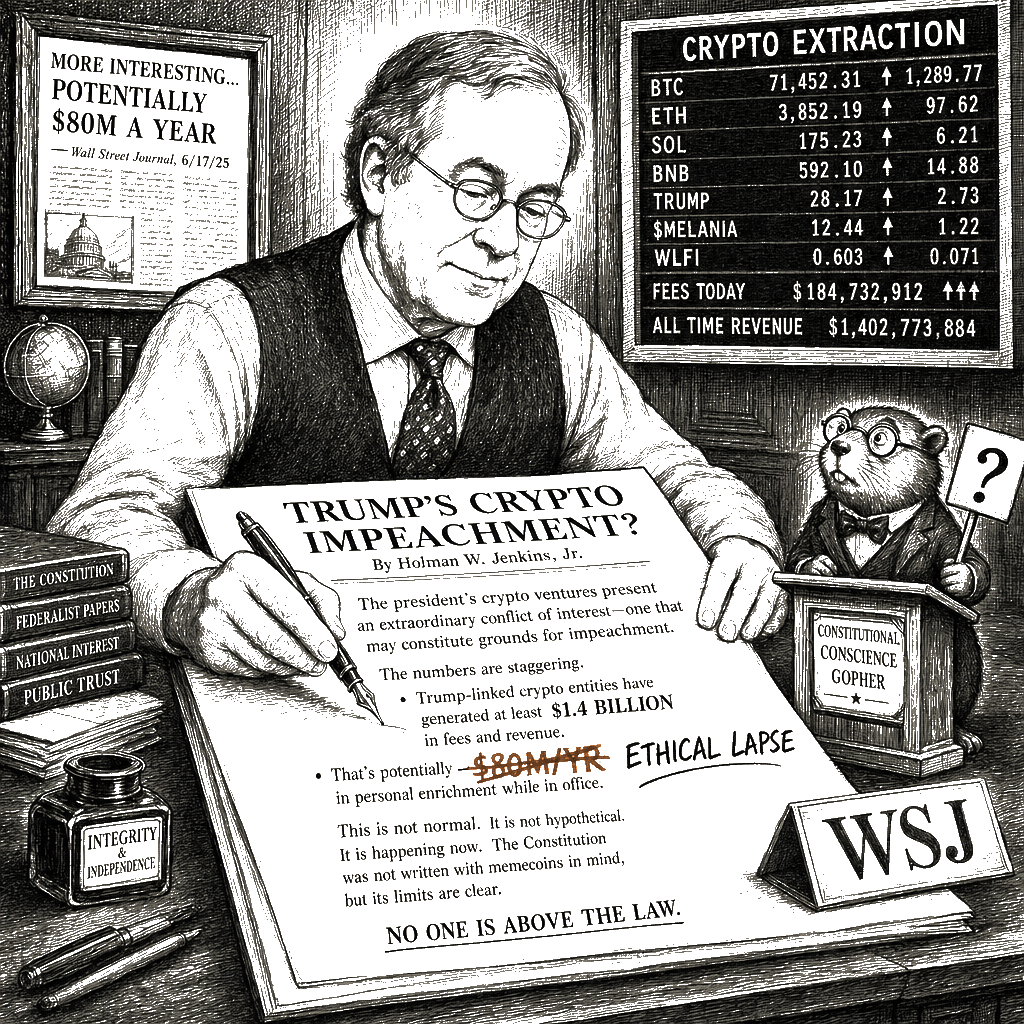
Holman Jenkins is laundering Trump’s crypto extraction racket into a cheap spectator sport. I worked the cable years, and I read pieces like this the way a building inspector reads permits. The headline tells you everything the body is going to deny. The piece will name the violation, move the standard, decline the remedy, and close with contempt for the voters who would hold the violation accountable. The reader doesn’t know the form. The form is the protection.
In his July 7 “Business World” column for the Wall Street Journal opinion page, Jenkins works the standard sequence — trivialization, whataboutism, and elite contempt — deployed to shield a sitting president’s documented financial looting from constitutional scrutiny. I’ll walk through the machinery as he turns each crank.
Crypto might seem the ultimate Donald Trump business: Add a Trump name of no intrinsic value to something that already has no intrinsic value. The strategy has indeed paid off. Crypto accounts for $1.4 billion in newly disclosed Trump earnings since he returned to the presidency. Emotional maturity is also clearly gaining a foothold in our markets. Retail investors who lost gobs buying worthless Trump memecoins tell the press they have no hard feelings. They were speculating, after all. — Holman W. Jenkins, Jr., “Trump’s Crypto Impeachment?”, WSJ Opinion, July 7, 2026
Attribution of blame — Bandura’s mechanism of moral disengagement — operates here to protect the apparatus by punishing the marks. In the cable years we called this “letting the rubes play.” The operator builds the con, collects the vig, and then turns to the audience to mock the people who fell for it. Jenkins opens by acknowledging the $1.4 billion extraction — a figure that should trigger a constitutional crisis — and immediately pivots to sneer at the retail investors who bought the memecoins. “They were speculating, after all.” That is the operator’s laugh: a deliberate contempt for the captured audience, designed to shift the moral injury from the grifter who designed the scam to the marks who lost their savings. The contempt is targeted at three audiences simultaneously — the populists who bought the coins, the markets that tolerated the operation, and Trump himself for being a seller of nothing. The sitting president monetizing the office is not the story. The sociology of retail investors is the story. The contempt is the protection racket’s way of not naming what is being protected.
Which leaves what? More interesting, then, for future Democratic investigators will be cases where sophisticated moneyed interests seemed intent on putting cash deliberately in Mr. Trump’s pockets. Look up, say, this paper’s accounts of deals involving the United Arab Emirates and Binance… One transaction they participated in, when denominated in a Trump-issued stablecoin, was potentially worth $80 million a year to Mr. Trump and his partners. Then there are those Trump stock trades, averaging 85 per market day. President Trump says he wasn’t involved, and we can believe him because otherwise he wouldn’t have time for anything else. — Holman W. Jenkins, Jr.
Credentialed understatement deploys here to launder bribery into a parlor game. The catalog entry is the standard WSJ deferral: cite the report, treat its findings as not-at-issue, refuse to call the operation what it is. Jenkins names the UAE deal, names Binance, names the pardon, names the $80 million figure, then describes the operation as “interesting” and “potentially” worth the sum. The hedge — “potentially” — does substantial legal-protection work for a piece that doesn’t want a libel suit from a sitting president whose lawyers are on retainer. The President of the United States is taking $80 million a year from a foreign-government-adjacent deal in a stablecoin his family issues, and the editorial page calls the matter “interesting.” The structure is the racket. The corruption is conceded. The word for it is declined.
Then comes the motte-and-bailey on the stock trades. Jenkins offers “we can believe him” as a charitable reading of Trump’s denials, then plants the inside-trading implication through a rhetorical question — the form when a writer wants to plant a suspicion without owning the suspicion. Eighty-five algorithmic stock trades per market day, and the charitable reading is that the President of the United States doesn’t have time to call in any of them. That is the wink. It is the long con laundered as a spectator sport. He sees the shakedown, names the price tag, and treats it like a fun riddle for the opposition party to solve if they can ever get their act together.
“Everybody needs money,” Danny DeVito says in the David Mamet-scripted movie “Heist.” “That’s why they call it money.” For his part, it’s not that Mr. Trump is unconcerned about the appearance of personal profiteering. He believes it actually adds luster to the family brand. This poses a challenge for future impeachers. Americans knew exactly who they were electing… Mere evidence of a president’s ethical lapses likely isn’t a big enough whoop for most voters. — Holman W. Jenkins, Jr.
Frame-engineered relabeling — the signature technique of sanitizing loaded concepts through focus-grouped talking points — executes the pivot from constitutional crime to personality quirk. Jenkins quotes a movie about theft to frame the President of the United States taking $1.4 billion in crypto as a charming brand strategy. Then comes the relabel: $1.4 billion in foreign and domestic extraction, plus $80 million a year in stablecoin flow from a foreign-government-adjacent deal, is reduced to “Mere evidence of a president’s ethical lapses.” This is the whitewash. He is taking what would have been Articles of Impeachment for bribery and emoluments violations — the kind of concrete, documentable offenses that anchored the Nixon Judiciary Committee’s draft articles in 1974, statutes including Article I, §9, Clause 8 of the Constitution (the Foreign Emoluments Clause) and 18 U.S.C. §§201 and 1343 — and calling them “ethical lapses.” He is framing a looting operation as a “challenge for future impeachers” because the “electorate usually wants to see its own interests implicated.” The scam is calling a shakedown a character flaw so the donor class can keep writing the checks.
The Bandura mechanism is moral justification: universal human need for money is invoked to license specific conduct, which is foreign money in presidential pockets. The DeVito quote is the pop-culture citation doing the protection work — a Hollywood line from a heist movie used to license sympathy for a sitting president monetizing the office. Mamet wrote the script. Jenkins is running it.
Remember when Nancy Pelosi, in early 2019, said impeachment should be broadly bipartisan then changed her mind when her speakership was threatened by militants in her caucus. Remember how the Jan. 6 impeachment and related prosecutions benefited Joe Biden, rallying Republicans back to Mr. Trump so Mr. Biden could run against him in 2024. For that matter, don’t underestimate the role of the first Trump impeachment (involving Ukraine) in helping now-Sen. Adam Schiff shake off some of the odor of the Russia collusion hoax. — Holman W. Jenkins, Jr.
Whataboutism and false equivalence arrive to change the channel. Having established that the President of the United States is taking $80 million a year from a foreign sovereign via a stablecoin his family issues, Jenkins suddenly needs to talk about Nancy Pelosi’s 2019 speakership math and Adam Schiff’s Russia-collusion odor. He is equating Trump’s documented, ongoing financial extraction with Democratic political miscalculations from a decade ago. The structure is (a) the conduct is real, (b) the procedure will fail, (c) here are three historical cases where the procedure failed. The piece takes the question of consequence off the table by making the question of electoral utility the only question. Recite the failures. Decline to act. Recite the failures again. The operator’s goal here is exhaustion: if every political act by the opposition is framed as a cynical calculation, then the actual, documented theft happening in the White House gets buried under a pile of partisan grievance. It is a deflection racket, designed to make the reader shrug and say, “Well, they’re all crooks.”
The Ford formulation does the standard-moving work Jenkins needs. Impeachment is whatever a House majority says it is — fine. But then the bar is raised past ethical lapses and constitutional violations to voter self-interest. The piece concedes Trump is “a known quantity” who monetizes the office and turns every gerrymandering knob. It then says voters can’t impeach for “mere” ethical lapses. The concede-the-conduct-move-the-standard form is the editorial page’s most reliable institutional defense: hold the constitutional-concern high ground while declining constitutional action. The conduct becomes a reality-show episode — gerrymandering, foreign money, self-dealing processed as entertainment — so the page can perform seriousness about the violation while declining seriousness about the remedy.
Democrats (and their media allies) are the ones who need to show Americans something to cause them to trust Democrats again… Right now the stage looks likelier to be dominated by the sort who’ve been winning primaries in Manhattan and other ultrablue districts while causing the larger electorate to reach for its barf bag… Impeachment will complete its transformation from the ultimate constitutional sanction to just another degraded political antic. — Holman W. Jenkins, Jr.
Elite contempt and the “common sense” rhetorical pivot — the classic play of dressing up partisan sneers as plain-speaking truth — close the piece by sneering at the electorate to protect the extraction. Note the exact phrasing: Jenkins explicitly warns that the political opponents of the establishment are “causing the larger electorate to reach for its barf bag.” This is the elite flex. The establishment columnist addresses his wealthy subscribers, assuring them that the people demanding accountability for a $1.4 billion crypto shakedown are just unserious radicals causing a nuisance. The “Manhattan” reference is class-positioned: the editorial board reads in Manhattan, and is signaling that Manhattan Democratic primary voters are not the WSJ’s audience. He reduces the constitutional safeguard of impeachment to “just another degraded political antic.” The operation is complete. He has taken a president turning the executive branch into a crypto ATM for his donors and his family, and reframed the defense of the republic as an annoying spectacle perpetrated by people who make the big subscribers uncomfortable. The voters are the problem. The President is the reality show. The editorial page is the constitutional observer. The piece is structured for excerpt-mining — the barf-bag line travels, the $80 million paragraph does not. The protection lives in what gets excerpted and what does not.
So here is what this column actually is, taken together. It is an establishment hostage note, written in invisible ink. Jenkins has just walked you past a sitting president converting the executive branch into a Shopify store for foreign sovereigns, and his advice to the republic is to look at Nancy Pelosi’s speakership math and remember to bring a barf bag. The ultimate constitutional sanction is dismissed as a “political antic” because the men who write the checks that fund this page need the ATMs to keep dispensing. They don’t need a republic that self-corrects; they need a spectator sport that distracts you while the ushers steal the copper out of the walls. The scam isn’t just that they’re looting the treasury. The scam is that they sit in the greenroom, count the take, and write 800 words to convince you that the real tragedy is the poor, shambolic audience. The protection racket does not announce itself. It announces itself as seriousness. The seriousness is the protection. The barf bag is for the editorial page, and the fucking card gets played at the end, on the voters, every goddamn time.
— Phukher Tarlson