
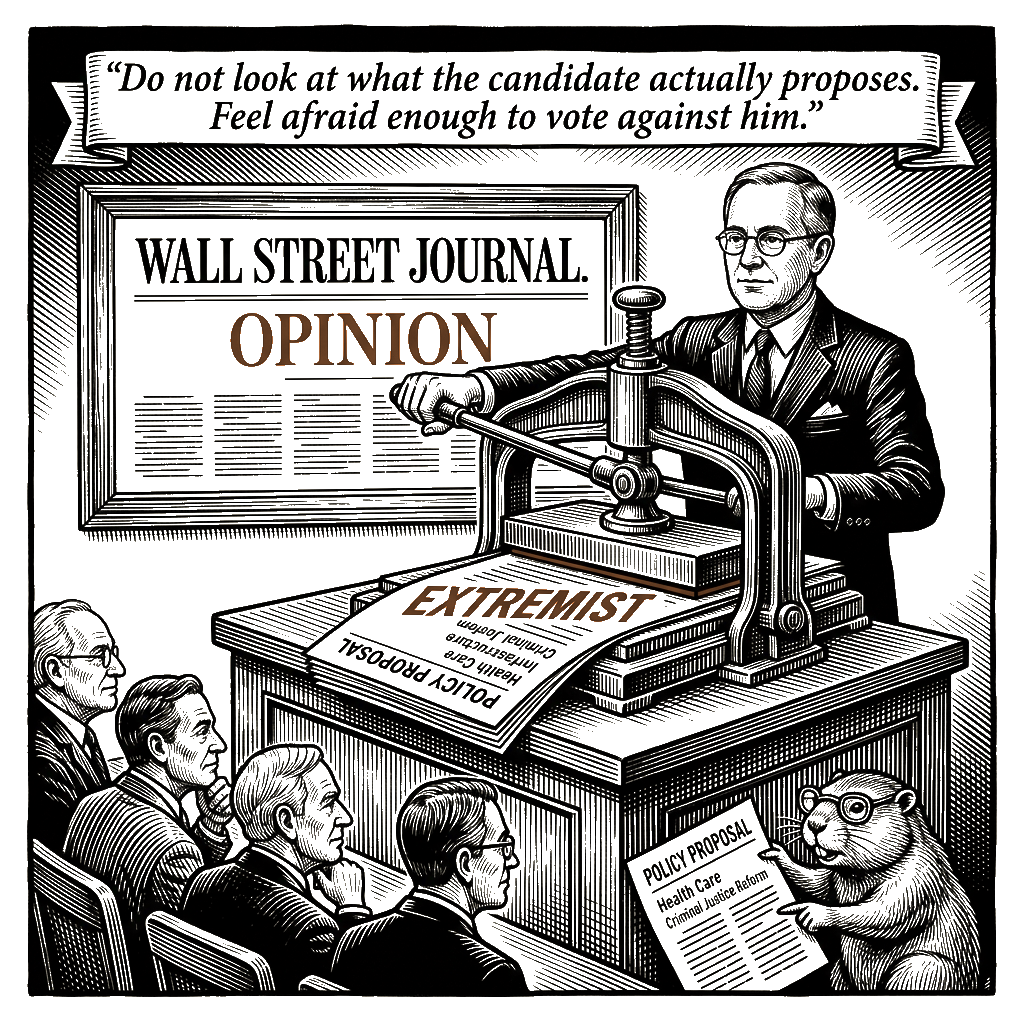
James Freeman turns Michigan policy disagreement into bigotry.
That is the operation in his August 10 “Best of the Web” column in the Wall Street Journal opinion pages. I built versions of this frame-loading trick in the cable years. Freeman targets Abdel El-Sayed’s Michigan gubernatorial candidacy through five connected moves: label the candidate an extremist, label his possible defender a coward, reduce a prior political appeal to a scolding, convert policy disagreement into moral contamination, then attach the candidate to a hated outside figure. The surveillance item and the experts item in the roundup — including Ethan Baron’s San Jose Mercury News report and Rachael Robertson’s MedPage Today question about what we would do without experts — are the daily housekeeping. They make a one-target attack look like innocent news collection.
The operation lives here.
In a perfect world, the elder statesmen of the Democratic Party would help discourage voters from embracing the reckless extremism of the hard left. But the former community organizer who is the party’s most influential politician seems to have decided for now to signal support—but not too much support.
— Opening paragraph
“Reckless extremism of the hard left” — frame-engineered relabeling, WSJ §A.1 — opens the piece by assigning the verdict before the reader encounters a policy. The operation is simple: substitute a term carrying a different emotional charge, then let the new term do the thinking. A Michigan gubernatorial candidate becomes “the hard left” before he becomes a person with a health-care plan, an infrastructure proposal or a record that can be examined.
Operators call this loading the dock. You set the frame before the cargo arrives.
The phrase “elder statesmen” does complementary work. It places the Democratic Party’s reasonable center on the page as the natural home of seriousness, with El-Sayed already outside the fence. Freeman is running a con in the first sentence. The reader absorbs “extremism” and never goes back to ask whether the candidate earned it.
This is not a disagreement about a program. It is the relabel scam.
For now it seems Mr. Obama is executing the same self-serving straddle he did with New York City Mayor Zohran Mamdani—offering encouragement but not an explicit endorsement, so that Mr. Obama still has the option to avoid responsibility in the event of political catastrophe.
— Paragraph 3
“Self-serving straddle” — frame-engineered relabeling again, with attribution of motive smuggled inside the label. Freeman gives the reader no evidence that Barack Obama’s position is self-serving, no account of what the calculation might involve, and no distinction between caution, coalition management and cowardice. The word “straddle” supplies the conclusion. It makes judgment look like fear.
This is the coward’s ledger Freeman writes for Obama: encouragement on one side, responsibility on the other, with every act of political care entered as evidence of personal calculation. The phrase is designed to survive verification because it does not quite assert a fact. It supplies a character verdict and calls the verdict analysis.
I helped build sentences like this. The trick is to make motive feel documented before documentation appears.
There’s no doubt that Mr. El-Sayed has been struggling to win over black voters, but recent history suggests that Mr. Obama may not be able to solve this problem for him. The Obama approach of lecturing voters to fall into line has its limits. In 2024, for example, Mr. Obama flew into Pennsylvania and tried to help Vice President Kamala Harris by insulting local black men who weren’t excited about voting for her. The gist of the fact-free Obama scolding was that black men just didn’t want a female president, as if Ms. Harris’ record as vice president hadn’t provided ample reasons to oppose her candidacy. The unfair Obama shaming didn’t work. Donald Trump won Pennsylvania as Ms. Harris underperformed in black precincts.
— Paragraph 5
“The Obama approach of lecturing voters to fall into line” — strawman, Bad-Faith Techniques Catalog; the phrase is paired with a selective retelling of Obama’s Pennsylvania appeal. Freeman turns an argument into a scold and then presents the scold as the argument.
The documented scene, as described in the draft of the attack, is less convenient. Obama opened by acknowledging the grievance of Black men who had been taken for granted by a party that surfaced every two years and disappeared afterward. He argued from the record of what both White House tenures had delivered for Black communities before making the plea. The line about Black men not getting past the idea of a woman as president was one moment inside that appeal. It was not its “gist.”
That distinction matters. A full appeal can contain a bad line, a clumsy line or a line that lands badly. A strawman turns the line into the whole appeal so the author can condemn the speaker without engaging the appeal that actually occurred.
The reduction is also a contempt transfer. Freeman casts the voters as Obama’s victims rather than as citizens weighing a record. The phrase “lecturing voters to fall into line” does the mechanical work: engagement becomes authoritarianism, persuasion becomes coercion, and the voter becomes a subject who should be left alone rather than a person being addressed.
Then the precedent is loaded. The failed Pennsylvania appeal becomes a template for every future Obama intervention. This is the precedent-load: build one bad memory so every later version feels familiar.
It is a strawman, not a rebuttal. It is also a relabeling scam.
If Mr. Obama is now tempted to jet into Michigan to claim that opposition to Mr. El-Sayed is due to some sort of bigotry, he may have an even tougher time making the case. Voters remember Michigan’s spike in violent crime in 2020 and 2021. Not only was Mr. El-Sayed calling for police defunding at the time, but his recent efforts to pretend otherwise naturally make voters question whether he’s truly abandoned the bloody policy. Mr. El-Sayed was also a bitter-ender in demanding Covid restrictions on personal liberty. Even more than Ms. Harris, he has given voters numerous eminently sensible reasons to oppose him.
— Paragraph 6
“Calling for police defunding” and “bloody policy” — strawman of progressive positions, WSJ §A.6 — followed by pre-emptive legitimacy withdrawal. Freeman characterizes El-Sayed’s position in its most alarming available form, then treats any later clarification as proof of deceit. The candidate is not permitted to have changed, clarified or been misunderstood. Every exit is sealed in advance.
The true half must be conceded. Michigan did experience a violent-crime spike in 2020 and 2021. Public safety is a legitimate concern. Covid restrictions imposed real costs on personal liberty, and voters had reasons to assess them. That is the documentary starting point.
The operation begins when a call to defund the police and reinvest in communities is compressed into “bloody policy,” and when public-health restrictions imposed during a deadly pandemic are converted into a “grudge against liberty.” The chosen labels do not describe the dispute. They decide which moral universe the dispute will inhabit.
The “some sort of bigotry” line performs a second job. Freeman tells readers in advance that any defense of El-Sayed will be an accusation against them. Voters who disagree receive confirmation. Voters who might defend him are told that their defense is the same shaming that failed in Pennsylvania.
This is the all-exits-sealed operation. The candidate is extreme if he stands by his position, dishonest if he modifies it, and morally dangerous if anyone explains it. That is not scrutiny. It is a shell game with the policy removed.
Here in 2026 Hasan Piker is still cheering for theft and excusing murder, and it seems Mr. El-Sayed is still willing to stand with him.
— Closing paragraph
The Hasan Piker line is circumstantial ad hominem — Bad-Faith Techniques Catalog — and the emotional detonator. After paragraphs of relabeling and strawman, Freeman pastes an internet provocateur’s face over a state gubernatorial candidate in one sentence. No platform. No record. No demonstrated relationship. Just a name that carries a preloaded charge.
The phrase “cheering for theft and excusing murder” is Freeman’s accusation against Piker. “It seems” is the fig leaf. Freeman does not quite claim that El-Sayed shares those views; he says El-Sayed is “still willing to stand with him,” a construction calibrated to imply association while preserving deniability.
This is the contamination play. The reader is walked through extremism, cowardice, bloody policy and bigotry-shaming, and then given a final image that makes support for El-Sayed feel morally dirty. The candidate does not have to lose an argument about health care or infrastructure. Supporting him only has to feel like something a decent person would not do.
The column turns association into evidence and revulsion into proof.
The effect is especially clear when placed beside the roundup’s other material. Baron’s surveillance item carries the familiar promise that the innocent should accept permanent recording so long as the actual wrongdoers are prosecuted. That is precisely backward. A free people who hand over every street and stop to an all-seeing apparatus are not made safer; they are made watchable. The innocent person’s queasiness is a healthy reflex, not a bug to be engineered out.
Robertson’s experts item asks what we would do without experts. The answer is that we would lose more than we can afford. Experts are why societies retain guardrails during a pandemic, and contempt for expertise is not independence. It is a permission slip for avoidable harm. The same apparatus that mocks expertise can then mock El-Sayed for having followed it.
Those items are not the Michigan operation, but they reveal the surrounding weather: suspicion of expertise, fear of public intervention, and a constant demand that the reader treat institutional protection as the threat while the actual threat remains offstage.
So here is what Freeman’s August 10 column actually does, taken together.
First, it tells you the candidate is an extremist. Then it tells you the candidate’s potential defender is a calculating lecturer. Then it tells you the candidate’s positions are bloody. Then it tells you that any defense of the candidate is just the same shaming that failed last time. Then it pastes an internet provocateur’s face over the candidate’s own and asks you to feel the contamination.
Five moves. One message.
Do not look at what the candidate actually proposes. Feel afraid enough to vote against him.
This is the operation the Wall Street Journal opinion page runs when it cannot win before the policy conversation begins. You do not need to persuade the voter that your position is right if you can make the other side feel too dangerous to consider. The voter does not need a platform. The voter needs a contaminant.
Freeman’s readership does not need El-Sayed defeated on a health-care plan or an infrastructure proposal. It needs him defeated before those conversations happen. The frame is loaded before the cargo arrives. The fact that this resembles the technique Freeman says failed in Pennsylvania is not an accident. It is the point.
I built versions of this trick in the cable years. You set the frame, you never ship the cargo, and the voter does the rest.
— Phukher Tarlson